
February 26, 2026
How Thermal Imaging Works: The Science Behind Your Scope
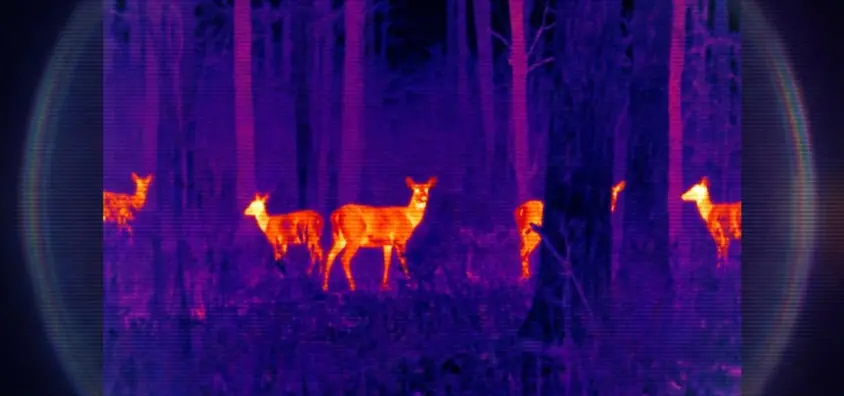
Every object above absolute zero emits infrared radiation. A coffee cup, a deer standing in tall grass, a human hand — all of them constantly radiate heat as invisible light. Thermal cameras don’t amplify existing light the way image intensifiers do. They detect that emitted radiation directly. That’s why thermal works in complete darkness, through light fog, and in situations where a night vision device tuned to visible or near-infrared light would struggle. Understanding how the sensor actually captures and processes that radiation helps explain why two thermal monoculars at very different price points can look so different in the field.
For broader context on how thermal fits within the night vision category, the night vision technology overview covers image intensification and thermal side by side.
LWIR vs. MWIR: which wavelengths matter for civilians
Infrared radiation spans a wide range of wavelengths. Thermal cameras for civilian use almost exclusively operate in the long-wave infrared band, roughly 8 to 14 micrometers (LWIR). Objects at typical environmental temperatures — animals, people, vehicles — emit most strongly in this range.
Mid-wave infrared (MWIR, roughly 3–5 micrometers) requires cryogenic cooling to detect efficiently. Military and aerospace thermal systems often use MWIR for its higher resolution potential and better performance through certain atmospheric conditions. The detectors and cooling systems required are expensive and complex, which is why essentially all consumer and prosumer thermal devices use uncooled LWIR sensors. When you’re looking at hunting thermals or patrol monoculars, LWIR is what you’re working with.
The microbolometer: how the sensor actually works
The sensor inside an uncooled thermal camera is called a microbolometer. Think of it as a very fine grid of tiny resistors, each one suspended above the detector substrate by thin legs that act as thermal insulators. When infrared radiation hits a pixel element, it absorbs the energy and heats up slightly. That temperature change causes a measurable change in electrical resistance. The camera’s electronics read those resistance values across the entire grid and convert them into a temperature map — which becomes the image you see.
The material used for those resistor elements matters. Two types dominate the market:
Vanadium oxide (VOx) — the more common material in higher-end sensors. VOx has a steep resistance-temperature curve, meaning even small temperature changes produce large, easily measurable resistance changes. Better sensitivity. Used in sensors from FLIR, DRS, and most premium OEM manufacturers.
Amorphous silicon (a-Si) — simpler to manufacture, lower cost. The sensitivity isn’t quite as high as VOx, but the manufacturing process is more consistent and better suited to high-volume production. Many Chinese-manufactured sensors use a-Si. At equivalent price points, VOx sensors generally outperform a-Si, but the gap has narrowed as Chinese manufacturing has matured.
NETD: sensitivity that actually matters in the field
NETD stands for Noise Equivalent Temperature Difference. It’s the smallest temperature difference the sensor can reliably distinguish from background noise. A lower NETD number means better sensitivity — the sensor can resolve finer temperature contrasts.
A sensor with 25mK NETD can detect a temperature difference of 0.025 degrees Celsius. A 50mK sensor needs a 0.05 degree difference before it reliably distinguishes signal from noise. That difference is significant when you’re trying to pick out a deer bedded in grass on a cool morning, where the temperature contrast between animal and background might only be a few tenths of a degree. At 25mK, that animal shows up clearly. At 50mK, it might blend into the noise.
For hunting applications, NETD below 40mK is the practical target. Budget sensors at 50mK work acceptably in moderate conditions but struggle in situations where temperature contrast is low — warm summer nights, rain, or animals that have been bedded long enough to warm their immediate surroundings.
Sensor resolution: 384, 640, and 1024
Microbolometer pixel counts are usually stated as width × height. Common sensor resolutions are 160×120, 256×192, 384×288, 640×480, and 1024×768.
384×288 is the practical entry point for hunting and field use. At that resolution, you can identify a deer-sized animal at 200–300 meters with a good sensor and appropriate lens. 640×480 improves identification range significantly — roughly double — and produces an image that holds up better when zoomed digitally. The 1024×768 sensors in premium devices are genuinely impressive, but the price jump is substantial and most civilian use cases don’t require that resolution.
One important distinction: sensor resolution and display resolution are different things. A 384×288 sensor displayed on a 1280×960 screen still has only 384×288 pixels of actual thermal data. The display upscaling makes it easier to see, but doesn’t add information. For a buyer’s comparison across actual devices at various resolutions and price points, the thermal monoculars buyer’s guide breaks down specific models.
Refresh rate and why 50Hz matters
Refresh rate on a thermal camera is how many frames per second the sensor updates the image. The two common rates are 30Hz (30 fps) and 50Hz (50 fps).
For most stationary observation, 30Hz looks fine. The difference becomes apparent when either you or your target is moving. At 30Hz, a running animal or a quickly-panning view shows visible motion blur and image lag — the display can’t keep up with the scene. At 50Hz, motion looks fluid and you can track moving targets without losing them in the blur.
There’s also a regulatory dimension: some thermal devices export with 9Hz or 30Hz modes to comply with export controls. For domestic buyers, 50Hz devices are generally available without restriction.
Germanium lenses: why they’re expensive
Ordinary glass is opaque to LWIR radiation. Thermal cameras use germanium lenses because germanium transmits the 8–14 micrometer wavelengths effectively. The problem is that germanium is expensive to mine, requires precise machining, and must be coated with anti-reflection treatments specifically formulated for LWIR. A 35mm germanium lens for a mid-tier thermal device can cost $200–$400 on its own — often more than the sensor costs to produce.
Lens quality affects resolution, light transmission, and aberration at the edges of the image. Budget thermals frequently use lower-grade germanium or simplified lens designs that save cost but reduce image sharpness, especially toward the frame edges. When evaluating thermal devices, check for image sharpness in the corners, not just the center.
Color palettes
Thermal cameras don’t produce color images naturally — the sensor outputs temperature data. The camera’s processor applies a color lookup table to map temperatures to visual colors. Different palettes suit different use cases:
White hot — hotter objects appear lighter. The most common palette. Easy to read, intuitive. Works well for animal detection because warm bodies stand out as bright against cooler backgrounds.
Black hot — inverted from white hot. Hotter objects appear darker. Some users find it easier on the eyes in extended use. Detection performance is equivalent to white hot — it’s personal preference.
Iron (or Ironbow) — a color gradient from black through orange and yellow to white. Better for identifying temperature gradients in complex scenes. Frequently used for equipment inspection or vehicle detection rather than wildlife.
Rainbow and other palettes — more specialized. Not commonly used for hunting or patrol work. Useful for identifying specific temperature features in mechanical or electrical inspections.
Most hunting and observation work defaults to white hot or black hot. The other palettes are worth having available but are secondary features. When comparing devices across brands, the NV brands guide covers manufacturers producing both thermal and II sensors and how their product lines are structured.
Thermal imaging is a fundamentally different technology from image intensification, not simply a more expensive version of it. Knowing what the sensor is doing makes it easier to match a device to what you actually need rather than buying on resolution numbers alone.
IR Illuminator Not Working With Night Vision? Beam, Battery, Focus and Compatibility Check.
Is your NV not turning on? Battery, Contacts, Mount and Tube-Safe Troubleshooting
Night Vision Collimation and Alignment: Fix Double Vision, Eye Strain and Dual-Tube Setup Issues