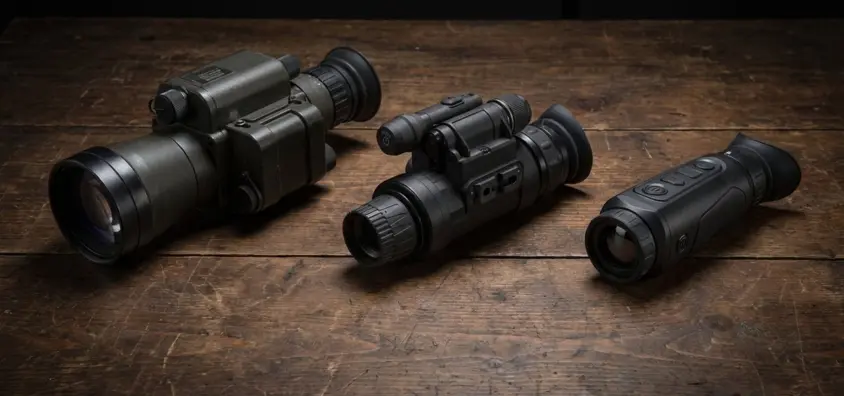
Night vision technology has been around since the 1960s, and the gap between a $150 Gen 1 monocular and a $3,500 Gen 3 tube is not just price — it’s physics. Each generation uses a fundamentally different approach to amplifying light, which means real differences in range, clarity, and what you can actually do with the device in the field. This guide walks through every generation so you can match the hardware to your use case without overpaying or underbuying.
If you want to understand the underlying physics — how photons turn into electrons and back into light — this breakdown of NV technology covers the tube mechanics in detail. For now, we’re focused on what each generation means at ground level.
Gen 1: the baseline
Gen 1 devices use a single-stage image intensifier tube. Photons hit a photocathode, release electrons, those electrons are accelerated by a high-voltage field, and they strike a phosphor screen. No microchannel plate — just a straightforward electrostatic acceleration process. The result is roughly 1,000x light amplification.
Real-world performance: Gen 1 works in moderate ambient light — partial moon, open sky, some light pollution. In true darkness or heavy overcast, you’re looking at 20–40 yards of useful detection range. Image distortion at the edges is common, and the tubes have a shorter lifespan (around 1,500 hours vs. 10,000+ for Gen 3). The characteristic “soft” image quality is acceptable for casual observation but limits effective use for anything requiring target identification at distance.
Price range: $150–$600
Best for: Casual wildlife watching, property surveillance with IR illuminators, first-time buyers who want to understand what NV feels like before spending more.
Examples: Sightmark Ghost Hunter 1×24, Yukon NVMT Spartan 1×24, ATN NVM14-1 (older units). Most sub-$300 monoculars you’ll find on Amazon are Gen 1 or unlabeled Chinese tubes of equivalent spec.
Gen 2: serious upgrade
Gen 2 introduced the microchannel plate (MCP) — a glass disc with millions of microscopic channels. Each electron entering a channel produces a cascade of secondary electrons, multiplying the signal 10,000–20,000x before it reaches the phosphor screen. This is the jump that makes the technology actually usable for professional applications.
Real-world performance: Gen 2 tubes in good condition resolve detail at 75–150 yards on a moonless night with no IR illuminator. The image is sharper, edge distortion is reduced, and the tube handles higher ambient light better. Signal-to-noise ratio is noticeably better, meaning you get a cleaner image with less graininess in low-light conditions. Tube life typically runs 2,500–5,000 hours.
Price range: $600–$2,500 (entry Gen 2 to quality Gen 2+)
Best for: Security professionals, hunters who need real capability but can’t justify Gen 3 pricing, outdoor enthusiasts who go out regularly in low-light conditions.
Examples: Armasight Spark CORE (budget Gen 2), Pulsar Edge GS 1×20 monocular, older ITT and Photonis-tube devices. The brands guide covers which manufacturers use which tube sources.
Gen 2+: refined MCP
Gen 2+ is not a separate generation classification in the military sense — it refers to improved photocathode materials (often S-25 or higher multialkali) and tighter MCP specifications within the Gen 2 platform. European manufacturers, particularly Photonis, have pushed this category hard. Photonis XD-4 and XR-5 tubes fall here.
Real-world performance: A well-specced Gen 2+ tube bridges most of the practical gap between Gen 2 and Gen 3. Figure of Merit (FOM) scores of 1,400–1,800+ are achievable. Resolution at 100+ yards in low-ambient conditions is genuine, not marginal. Some European law enforcement and military units run Gen 2+ because it avoids ITAR restrictions while delivering adequate performance.
Price range: $1,200–$3,000
Best for: European buyers (where Gen 3 export is restricted), tactical users who need good performance without the Gen 3 price, anyone whose use doesn’t require the last 15% of performance Gen 3 adds.
Examples: Photonis-tube devices from Argus, Hensoldt, some Pulsar and Yukon commercial units. For understanding how to read the tube spec sheet behind these numbers, the FOM explainer is worth reading before you buy.
Gen 3: the standard for serious use
Gen 3 moved to a gallium arsenide (GaAs) photocathode, which is significantly more sensitive than the multialkali materials used in Gen 2. Combined with an ion barrier film on the MCP to extend tube life, Gen 3 delivers 30,000–50,000x amplification with substantially better photocathode sensitivity in the near-infrared spectrum — where most ambient starlight and covert IR illuminators operate.
Real-world performance: A quality Gen 3 tube will give you genuine detection capability at 200–300 yards on a clear, moonless night without an IR illuminator. The image is sharp, signal-to-noise is high, and the tube handles dynamic lighting transitions (walking from darkness toward a light source) without blooming to the point of blindness. Tube life is typically 10,000+ hours. This is the hardware that US military fielded in PVS-7s and PVS-14s.
Price range: $2,000–$5,000+ (depending on tube grade)
Best for: Tactical users, serious hunters who go out in true darkness, anyone who needs dependable performance without IR illuminator reliance.
Examples: AN/PVS-14 (most common Gen 3 monocular platform), ITT Pinnacle tubes, L3Harris thin-film tubes, Elbit Systems of America units. For a full breakdown of what makes civilian and military-spec tubes different, see the civilian vs. military NV comparison.
Gen 3+ (auto-gated): the refinement layer
Auto-gating adds a circuit that rapidly adjusts the voltage to the photocathode in response to bright light sources in the field of view. Without it, direct exposure to a streetlight or headlight can temporarily blind a Gen 3 tube. With auto-gating, the tube manages the transition in milliseconds, making it practical in mixed urban environments or situations where you’re moving between lit and unlit areas.
Real-world performance: Identical low-light sensitivity to standard Gen 3, but dramatically more usable in dynamic environments. If you’re hunting near farms or roads, or doing any kind of work in environments with vehicle traffic, auto-gating matters. Current thin-film Gen 3 tubes from L3Harris (formerly ITT) come standard with auto-gating at most spec levels.
Price range: $2,800–$6,000+
Best for: Law enforcement, military, tactical users in varied environments, hunters who work edges near lit areas.
Examples: L3Harris OMNI VIII and Pinnacle tubes in auto-gated configuration, Elbit Onyx series, most current PVS-14 builds from reputable dealers.
Digital night vision: a different approach
Digital NV uses a CMOS or CCD sensor (the same basic technology as a camera) paired with an IR illuminator and a digital display. There’s no image intensifier tube — ambient light is captured by the sensor and displayed on a screen in near-real time. The illuminator does the heavy lifting in true darkness.
Real-world performance: Consumer digital NV is highly dependent on IR illuminator range and output. With the built-in illuminator, most units give you 50–100 yards of useful range in total darkness. Higher-end units like the ATN X-Sight 5 or Pulsar Digex push further, and supplemental IR illuminators extend range significantly. Image quality in daylight and low-light can be quite good — the ATN 4K sensor produces a clear, color-capable daytime image. The fundamental limitation is IR illuminator visibility: any device with an 850nm illuminator is detectable with another NV device. 940nm illuminators are covert but reduce range.
Price range: $200–$1,500 (consumer digital); premium digital runs $1,500–$2,500
Best for: Budget-conscious hunters, coyote and hog hunting where supplemental IR is acceptable, shooters who want video recording capability, anyone who needs day/night versatility in one device.
Examples: ATN X-Sight 5, Sightmark Wraith 4K Max, Pulsar Digex C50, Hikmicro Greet series. Digital is the dominant format for dedicated night hunting applications because of the value-to-capability ratio.
Generation comparison table
| Generation | Technology | Performance | Price range | Best for |
|---|---|---|---|---|
| Gen 1 | Electrostatic tube, no MCP | 20–40 yd effective; needs ambient light | $150–$600 | Casual observation, budget entry |
| Gen 2 | MCP-based intensifier | 75–150 yd; functional in moonless conditions | $600–$2,500 | Security, regular night use |
| Gen 2+ | Advanced MCP + S-25 photocathode | 100–200 yd; near-Gen 3 performance | $1,200–$3,000 | European market, mid-tier tactical |
| Gen 3 | GaAs photocathode + ion barrier | 200–300+ yd; minimal ambient light needed | $2,000–$5,000+ | Serious tactical, professional use |
| Gen 3+ (auto-gated) | Gen 3 + voltage auto-gating circuit | Same as Gen 3 + dynamic light handling | $2,800–$6,000+ | Law enforcement, mixed environments |
| Digital | CMOS/CCD sensor + IR illuminator | 50–150 yd (illuminator-dependent) | $200–$2,500 | Hunters, budget users, video recording |
Which generation do you actually need?
Casual outdoor use / wildlife watching: Gen 1 or entry digital covers it. If you’re glassing a field edge on a half-moon night for curiosity, there’s no reason to spend $3,000. A Gen 1 unit or a Sightmark Wraith with a strong IR illuminator gets the job done.
Hunting (hogs, coyotes, deer): Digital NV has largely taken over this use case for practical reasons — onboard recording, day/night capability, and price. The ATN X-Sight line and Sightmark Wraith dominate here. If you’re hunting open country at extended range where an IR illuminator creates range limitations, a Gen 2+ or Gen 3 monocular paired with a daytime scope is worth considering. Check your state’s regulations before buying — some states restrict NV hunting; this state-by-state law reference covers current rules.
Tactical / home defense / law enforcement: Gen 3, period. The performance gap between Gen 3 and everything below it matters when conditions are real and not controlled. Auto-gated Gen 3 for any environment with mixed lighting. For a full look at current monocular options in this category, the NVG buyer’s guide covers current models across price points.
Professional / military-equivalent use: The question isn’t Gen 3 vs. anything else — it’s which tube grade. White phosphor vs. green, FOM score, auto-gating spec, and housing quality separate the $2,500 unit from the $5,000 unit in this category.
Bottom line
Generation matters, but it’s not the only variable. A Gen 3 device with a mediocre tube grade and cheap housing can underperform a well-specced Gen 2+ in practical use. Digital NV has made serious inroads in hunting applications because the feature set — recording, rangefinding integration, ballistic calculators — offsets the raw sensitivity gap compared to a Gen 3 tube.
Match the generation to what you’re actually doing. Overspending on Gen 3 for occasional backyard wildlife observation is as poor a decision as expecting Gen 1 to perform in a serious security role. The technology is well understood — the variables are use case, budget, and how much you’re willing to learn the hardware’s limitations before you rely on it.