
March 18, 2026
Night Vision Binoculars vs Monoculars: Which Do You Actually Need?
First: Define Your Terms
Night vision “binoculars” covers three distinct product categories that are often confused:
Single-tube monoculars used with both eyes — Some night vision monoculars are mounted to head gear in front of one eye while the other eye remains uncovered and sees in ambient light. This is not binocular viewing; it’s monocular viewing with one eye in NV mode.
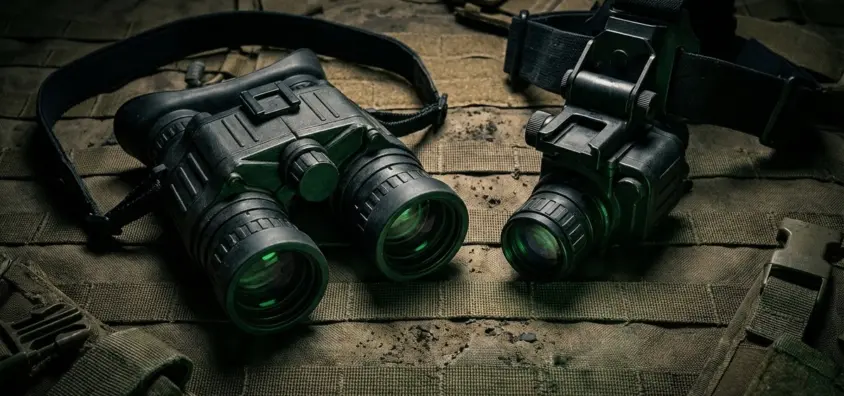
True NVGs with dual image intensifier tubes — Each tube feeds one eye. This is genuine stereoscopic night vision: the same depth cues your brain uses in daylight are active. NVG-style binoculars like the AGM NVG-40 or similar dual-tube systems fall here.
Digital binoculars with two lenses — Budget products that use two camera sensors feeding two displays. The lenses and sensors are present, but the image processing chain is typically not well-synchronized, and image quality lags behind analog tube technology significantly.
When experienced NV users say “get a monocular,” they usually mean a single-tube image intensifier monocular like the PVS-14 or equivalent. When they say “upgrade to binoculars,” they mean true dual-tube NVGs.
This guide addresses the comparison between single-tube monoculars and true dual-tube NVGs. Digital binoculars occupy a separate use-case category covered elsewhere.
The Core Difference: Depth Perception
Your brain constructs depth perception by comparing the slightly different images from your left and right eyes. The disparity between the two images is called stereopsis — it’s the mechanism that lets you catch a ball, judge distance to a deer, and navigate uneven terrain without thinking.
When you use a single-tube NVG in front of one eye, stereopsis shuts down for your NV-enhanced view. Your brain is receiving depth information from only one eye. This has practical consequences:
Terrain navigation: Depth perception loss makes moving over uneven ground significantly more challenging. Steps, roots, ditches, and grade changes all become harder to judge. The classic problem for single-monocular users is miscalculating a step-down and twisting an ankle. This is not a hypothetical — forum threads on NV navigation report it frequently.
Shooting with a weapon: Running a weapon under NVGs with a night vision-compatible scope or IR aiming laser is workable with a monocular, but the depth information your brain uses to track moving targets is degraded. Dual-tube users consistently report smoother target tracking.
Extended observation sessions: The fatigue profile is different with one-eye vs. two-eye viewing. With a monocular, your brain is constantly trying to resolve the conflict between what one eye sees through the tube and what the other eye sees in ambient light. Over two or three hours, this creates a specific type of ocular fatigue that dual-tube viewing reduces significantly.
The Case for Monoculars
Despite the depth perception limitation, single-tube monoculars remain the most practical choice for the majority of civilian NV users. The reasons are straightforward.
Cost: A quality single-tube monocular with a verified Gen 3 tube costs roughly half of an equivalent dual-tube system. Two tubes means two photocathode components, two objective lenses, two eyepiece assemblies, and twice the quality control complexity. For users who don’t need hands-free operation or long observation sessions, a single tube is a rational choice.
Weight: A PVS-14-style monocular weighs around 300-350 grams. A dual-tube NVG system weighs 600-900 grams depending on housing material and accessories. When worn on a head mount for extended periods, the weight difference is noticeable.
Flexibility: A monocular can be handheld, weapon-mounted (with appropriate adapter), head-mounted on one eye, or used as a spotting device from a fixed position. A dual-tube NVG is primarily a head-mounted observation system. The monocular’s versatility makes it the right choice for users who want one NV device for multiple roles.
Tube quality concentration: The money that would buy a two-tube system with mid-grade tubes can buy a single-tube system with a higher-grade tube. For many applications, a single excellent tube outperforms two mediocre ones.
The Case for Dual-Tube NVGs
Dual-tube systems solve the depth perception problem. If your primary NV application involves prolonged handheld observation or navigation through terrain, the difference is tangible.
Hunting applications: Spotters on a hog hunt, security patrols on a large property, or anyone who needs to move through terrain and simultaneously track animals will benefit from depth perception restoration. The difference between one hour and four hours in the field without fatigue is meaningful for serious hunters.
Head-mounted mobility: Running dual tubes head-mounted lets you move, use both hands, and navigate simultaneously. This is the standard configuration for military personnel and law enforcement. For civilian hunters who need hands-free movement through terrain, it’s a functional advantage over a single monocular.
The comfort argument: As one r/Hunting user put it when discussing observation devices: “Spotting through a monocular all night gets pretty annoying after an hour or two.” This sentiment appears repeatedly in hunting communities — users tolerate monoculars but acknowledge that the viewing experience is more comfortable with both eyes in NV mode.
Bridged Systems: A Middle Path
A third configuration exists that’s worth understanding: bridged or “bridge” NVG systems.
A bridge connects two single-tube monoculars into a binocular housing. The PVS-31 and similar tactical systems work this way. In the civilian market, some users build custom setups with two monoculars in a bridge configuration.
The advantage: you can assemble a dual-tube system gradually — buy one monocular, add the second later, connect with a bridge. You also maintain the flexibility to use each monocular independently.
The disadvantage: bridged systems require tube matching for optimal stereoscopic performance. Two tubes with different gain levels or sensitivity characteristics produce a slightly mismatched image that the brain must reconcile. Matched-tube systems from manufacturers like AGM avoid this problem by grading and pairing tubes at the factory.
Practical Decision Framework
Choose a monocular if:
– Budget is primary consideration and tube quality matters more than dual-tube capability
– Your primary use is weapon-mounted or fixed-position observation (spotting post)
– Sessions are typically under 2 hours
– Weight and packability are important
– You need flexibility to use the device in multiple configurations
Choose dual-tube NVGs if:
– You routinely run 3+ hour sessions in the field
– Navigation through terrain is a core use case
– You need hands-free operation without eye fatigue
– You’re setting up a dedicated head-mounted system
– Budget allows for a properly graded dual-tube system
The wrong reason to buy dual-tube: Because it looks more professional or tactical in photos. The functional advantages only materialize in specific use cases. If you don’t run long sessions or navigate terrain in the dark, you’re paying a significant premium for a capability you won’t notice.
Understanding Tube Grades Across Both Formats
Whether you buy a monocular or binocular system, tube quality within a generation is what determines real-world image performance. Two Gen 3 systems from different quality tiers can look substantially different in the field.
Tube grading is typically based on figure of merit (FOM), which combines resolution (lp/mm) and signal-to-noise ratio into a single value. Higher FOM numbers produce cleaner, higher-resolution images with less noise in low ambient light.
For a detailed explanation of FOM and how to read a tube data sheet, see FOM Explained at NVGuide USA.
Key grades to understand:
– Unfilmed/Filmed: Filmed tubes have a thin aluminum film over the MCP (micro-channel plate) that reduces halo effects around bright light sources. Hunting-grade tubes are typically unfilmed for maximum sensitivity; law enforcement and tactical tubes are filmed.
– Gen 2+ vs Gen 3: The generation refers to the photocathode technology. Gen 3 uses gallium arsenide, which produces higher quantum efficiency and better performance in very low light.
– Auto-gated: Auto-gating protects the tube when exposed to bright lights (vehicle headlights, campfires). Important for hunting in areas with ambient light sources.
Both monoculars and binoculars are available in the same tube configurations. The format (single vs. dual tube) is a separate decision from the tube quality decision.
Eye Dominance and Monocular Placement
If you use a single monocular on a head mount, which eye it covers matters more than most guides acknowledge.
Shooting with a weapon mounted scope while wearing a monocular works best when the monocular covers the non-dominant eye. This way, your dominant eye looks through the weapon scope normally while the non-dominant eye sees the broader field in NV. The brain blends these two images tolerably well.
Placing the monocular over the dominant eye while shooting requires either closing the non-dominant eye (losing situational awareness) or using the NV image as your sighting reference, which requires an NV-compatible scope or IR aiming laser.
Getting this wrong creates an uncomfortable shooting experience and is one of the most common setup errors new NV users make. If you’re unsure of your eye dominance, determine it before purchasing and mounting a monocular.
A Note on Digital “Binoculars”
Budget digital binoculars — units under $500 with dual camera sensors — are marketed heavily to first-time buyers and deserve a clear-eyed assessment.
These units use standard CMOS sensors and IR illuminators rather than image intensifier tubes. The user on r/NightVision who described them as “Not worth it… heavy on laggg… Real thing is expensive for a reason” was characterizing a real limitation. Image lag, limited low-light performance without the built-in IR illuminator, and inferior resolution at distance are genuine weaknesses for hunting applications.
That said, digital binoculars serve a specific use case: low-cost observation for users who don’t need image intensifier performance. For casual wildlife watching, security perimeter checks at short range, or users who are unsure whether they’ll use NV enough to justify the cost of an image intensifier device, digital binoculars provide a functional entry point.
The critical mistake is buying a digital binocular expecting it to perform like a Gen 2+ or Gen 3 image intensifier system. It won’t.
Summary
The monocular vs. binoculars question has a clear answer once you know your use case:
Long sessions requiring hands-free movement through terrain — dual-tube NVGs are worth the premium.
Flexible use, weapon mounting, or budget optimization — single-tube monocular is the rational choice.
Both formats are available in quality Gen 2+ and Gen 3 tube grades. The format decision and the tube quality decision are independent of each other.
For more technical background, see Night Vision Generations Explained and White Phosphor vs Green Phosphor at NVGuide USA.
IR Illuminator Not Working With Night Vision? Beam, Battery, Focus and Compatibility Check.
Is your NV not turning on? Battery, Contacts, Mount and Tube-Safe Troubleshooting
Night Vision Collimation and Alignment: Fix Double Vision, Eye Strain and Dual-Tube Setup Issues