
March 19, 2026
Night Vision in Bad Weather: Rain, Fog, and Cold Explained
Night vision equipment is designed and tested under specific conditions. Manufacturers quote detection ranges assuming clear air, appropriate ambient light, and moderate temperatures. Field conditions rarely match lab conditions, and understanding how rain, fog, dust, and cold actually affect your device determines whether you can rely on it when the weather turns.
This guide covers what happens to both image intensifier NV and thermal devices in bad weather, how the physics works, and what practical steps you can take to maximize performance when conditions aren’t ideal.
How rain affects night vision
Image intensifier (analog) NV in rain
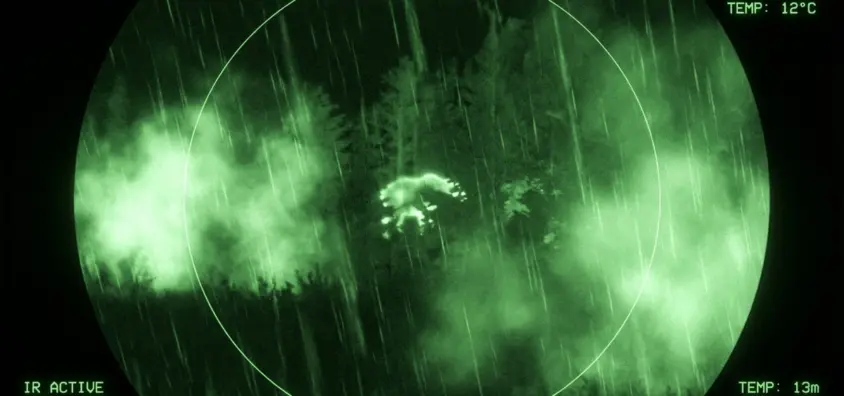
Rain does not damage a weatherproof NV device. The operational concern is optical, not mechanical. Rain in the light path — falling between you and the target — scatters ambient light and IR illuminator output. Every raindrop that intersects your viewing cone reduces contrast and creates small bright artifacts in the image.
Light rain at moderate range (under 100 yards) is manageable. You’ll notice reduced contrast compared to clear conditions, but identification remains possible. Heavy rain compresses effective range significantly. At 200 yards in heavy rain with an analog device, image quality degrades to the point where species identification becomes difficult.
IR illuminator performance in rain is directional. If you’re running an active IR illuminator pointed at the target, each raindrop in the beam reflects IR back toward you. This creates a “snow globe” effect — the image fills with bright specks that compete with the actual target. Reducing IR illuminator power or switching it off entirely and relying on ambient light only sometimes produces cleaner images in light rain at close range.
Thermal in rain
Thermal imaging fares better in rain than analog NV, but not without limitations. Thermal sensors detect temperature differentials — rain itself is relatively temperature-neutral and doesn’t significantly scatter the thermal signal the way it scatters light. A warm animal in rain produces essentially the same thermal contrast as it does in clear conditions, assuming the rain hasn’t cooled the animal’s surface.
The limitation with thermal in rain is surface cooling. Continuous heavy rain cools the fur, feathers, or exposed body surfaces of warm-blooded animals. This reduces the temperature differential between the animal and its surroundings, compressing the contrast in the thermal image. In sustained heavy rain, a deer that would normally appear as a high-contrast bright target can wash into the background as its surface temperature approaches ambient.
Additionally, rain cools vegetation, reducing background thermal clutter. In some cases, light rain actually improves thermal imaging by suppressing background noise from sun-warmed ground and foliage. The effect is temperature and duration dependent.
Fog and its specific challenges
Why fog is harder than rain
Fog is suspended water vapor — microscopic droplets distributed uniformly through the air volume between you and the target. Unlike rain, which falls through the path, fog fills it completely. Every meter of fog between you and the target attenuates the signal.
For analog NV, fog scatter is severe. Fog particles are excellent scatterers of visible and near-infrared light. The image intensifier amplifies everything — including the scattered light from fog — which reduces contrast dramatically. Dense fog at 50 meters can reduce a Gen 3 device’s useful range to under 20 meters.
For thermal, fog attenuation is wavelength-dependent. Long-wave infrared (LWIR), the range used by most consumer and hunting thermal devices, penetrates moderate fog better than visible light or near-infrared. This is one of the most practical real-world advantages of thermal over analog NV: in foggy conditions, thermal maintains useful range when analog devices become nearly non-functional.
Dense fog still attenuates thermal. At extreme density, thermal range is reduced. But the degradation curve is considerably flatter for thermal than for analog. A thermal device that performs at 400 yards in clear conditions might retain 200–250 yards of useful range in light-to-moderate fog, while an analog device that performs at 200 yards in clear conditions might be reduced to 30–40 yards in the same fog.
Understanding these differences between technologies is fundamental — review our guide to how thermal imaging works and our thermal vs NV rifle scope comparison for the complete physics behind both technologies.
Cold weather and its effects
Electronics and cold
Modern NV electronics function reliably at temperatures down to -30°F or lower in well-designed units. The practical issues are battery chemistry and LCD display performance, not the imaging hardware itself.
Alkaline batteries lose capacity rapidly below freezing. A fresh set of AA alkalines that delivers 40 hours at 70°F may deliver only 10–15 hours at 10°F. Lithium batteries (not lithium-ion, which have different cold characteristics) maintain capacity significantly better at low temperatures. CR123A lithium cells are the standard choice for cold-weather NV use.
Devices with OLED eyepiece displays can show reduced brightness or sluggish refresh in extreme cold. Most hunting NV devices don’t use OLED for the main image display, but auxiliary displays and battery indicators sometimes do.
Thermal and cold weather: why it improves
Cold weather is favorable for thermal imaging in a counterintuitive way. Thermal sensors detect temperature differentials — the contrast between a warm-blooded animal and its surroundings. At 10°F ambient temperature, a deer at 98°F body temperature creates a differential of nearly 90°F. At 75°F ambient temperature, the same deer creates a differential of only 23°F.
Cold weather produces higher contrast thermal images with less risk of background thermal clutter from sun-warmed surfaces. Many hunters who run thermal report that their best image quality comes during the coldest winter hunts, precisely when the temperature differential is maximized.
Condensation: the real cold-weather threat
The most common cold-weather damage to NV equipment comes from condensation. Bringing a cold device into a warm vehicle, house, or blind causes moisture from warm air to condense on cold optical surfaces and electronics. This moisture can damage image intensifier tubes over time and temporarily obscure optics.
The solution is temperature equalization before exposure to warm environments. Store your NV device in a case and let it come to room temperature gradually rather than exposing cold surfaces directly to warm, humid air. Moving from a warm environment to cold (going outside) is less problematic because cold air holds less moisture — but watch for condensation on warm internal components when you first go outside.
Dust and sand
Dust and fine particles affect NV differently than water-based atmospheric conditions. For analog devices, dust scatter is similar in mechanism to fog but typically less severe in hunting environments. Blown dust reduces contrast and can cause significant flare if dust particles are illuminated by IR or ambient sources.
Thermal handles dust differently than it handles fog. Small dust particles are typically warmer than the surrounding air during the day (heated by solar radiation) and cooler at night. Night hunting in dusty conditions can create thermal clutter from airborne particles, though this is usually minor compared to the degradation analog devices experience in the same conditions.
The mechanical concern with dust is lens and housing contamination. Clean your lenses after dusty sessions using appropriate lens cloths. Inspect housing seals periodically if you hunt in consistently dusty environments.
Practical recommendations by condition
| Condition | Analog NV | Thermal |
|---|---|---|
| Light rain | Reduced range, manageable | Minimal impact |
| Heavy rain | Significantly reduced | Some surface cooling effect |
| Light fog | Severely reduced | Moderate reduction |
| Dense fog | Nearly non-functional | Reduced but functional |
| Cold/dry | Battery management required | Improved performance |
| Dust | Moderate reduction | Minor impact |
Equipment choices that help in bad weather
Higher FOM tubes in analog devices perform better in reduced-light conditions caused by weather, simply because they’re more efficient at capturing available light. Read the FOM guide for a detailed breakdown of how this specification translates to real-world performance.
For hunters who regularly hunt in fog, rain, or dust, thermal has a meaningful performance advantage over analog NV in those specific conditions. The tradeoff is that thermal doesn’t produce the natural visual image of analog, which matters for identification in some hunting scenarios.
Choosing optics with robust weather sealing (IPX4 or better) ensures that moisture ingress doesn’t become a mechanical failure mode on top of the optical limitations described above.
What this means for how you hunt
Weather-dependent NV performance is a factor in shot decisions, not just equipment selection. A shot that’s a straightforward identification in clear conditions may not be a safe shot in fog at 150 yards with an analog device. Building your understanding of your specific equipment’s actual performance in bad weather — through field testing before the season — is the only way to know where your limits are.
Test your device in the conditions you actually hunt. Night fog in your hunting area behaves differently than the specifications on paper. Give yourself a season to understand what your equipment actually does when the weather turns before you rely on it for ethical shot decisions.
IR Illuminator Not Working With Night Vision? Beam, Battery, Focus and Compatibility Check.
Is your NV not turning on? Battery, Contacts, Mount and Tube-Safe Troubleshooting
Night Vision Collimation and Alignment: Fix Double Vision, Eye Strain and Dual-Tube Setup Issues