
March 20, 2026
How Image Intensifier Tubes Work: Night Vision Technology Guide
The image intensifier tube (IIT) is the component that defines analog night vision performance more than any other variable — more than optics, housing, or software. Every specification on a night vision device spec sheet — FOM, line pairs per millimeter, signal-to-noise ratio — describes some aspect of tube performance.
Understanding how tubes work explains why Gen 3 costs five times more than Gen 2, why tube specifications are measured rather than advertised, and what the numbers on a night vision data sheet actually mean.
This guide covers the physical process of image intensification, how each tube generation improved on the previous, and what the key specifications measure in practice.
For a broader technology comparison that includes thermal alongside analog night vision, the how thermal imaging works guide covers the parallel technology used in non-intensified thermal devices.
—
The Core Problem: What Night Vision Is Solving
The human eye requires photons — light particles — to trigger vision. In low-light conditions, the photon flux (number of photons arriving per second per area) drops far below what the retina can process effectively. At 0.01 lux (overcast, moonless night), the eye can detect coarse shapes at very short range. At 0.001 lux (deep dark conditions), functional vision essentially stops.
An image intensifier tube takes the available photons — even in near-total darkness — converts them to electrons, amplifies those electrons using a quantum process, and converts them back to visible photons on a phosphor screen. The output is a visible image of the scene at amplification levels of 10,000 to 100,000 times above what the raw photon count would produce.
The tube is not creating light. It is amplifying the existing photon flux to a level the eye can process. This distinction matters: in environments with zero photon flux (sealed room, underground), even the best IIT produces no image without an external infrared illuminator supplying photons.
—
The Physical Structure of an Image Intensifier Tube
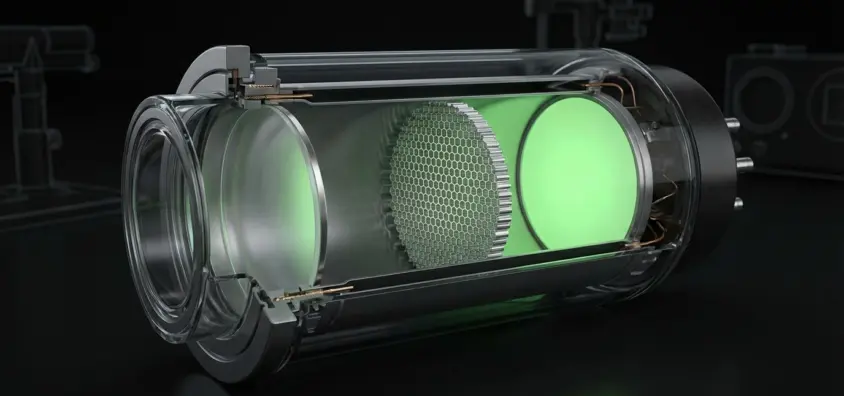
A standard Gen 2 or Gen 3 tube is a cylindrical vacuum-sealed component, typically 18–25mm in diameter and 20–30mm in length. Inside, in sequence:
1. Photocathode
The front of the tube is the photocathode — a thin layer of photosensitive material deposited on the inner surface of the input window. Incoming photons strike the photocathode and eject electrons through the photoelectric effect.
The efficiency of this process — how many electrons are produced per incoming photon — is called quantum efficiency (QE). A low-performance photocathode might achieve 12–15% QE. High-performance Gen 3 photocathodes using gallium arsenide (GaAs) achieve 25–30% QE, meaning the tube produces nearly twice as many electrons from the same light input compared to a lower-grade photocathode.
The photocathode material determines which wavelengths of light the tube responds to. Gen 3 GaAs photocathodes are particularly sensitive to near-infrared wavelengths (700–900nm), which is why Gen 3 tubes respond extremely well to 780nm or 850nm IR illuminators and natural near-infrared in nighttime starlight.
2. Microchannel Plate (MCP)
The electrons ejected by the photocathode are accelerated by an applied voltage toward the microchannel plate — the component responsible for most of the amplification in Gen 2 and Gen 3 tubes.
The MCP is a thin disk, typically 0.5mm thick, containing millions of microscopic channels (each 5–12 micrometers in diameter) angled at 8–12 degrees from the tube axis. As electrons enter a channel, collisions with the channel walls create secondary emission — each electron produces additional electrons, which in turn produce more electrons in a cascade. By the time an electron exits the other end of a channel, the original single electron has become 1,000–10,000 electrons.
The density of channels in the MCP — measured as line pairs per millimeter — determines the spatial resolution the plate can support. Higher channel density preserves finer detail from the photocathode image.
The voltage applied across the MCP controls amplification level. Auto-gated tubes modulate this voltage in real time, reducing gain when a bright source enters the field of view to prevent image washout.
3. Phosphor Screen
The amplified electrons leaving the MCP strike the phosphor screen, where they are converted back to visible light. The phosphor screen produces the green image characteristic of most night vision devices.
The phosphor material is typically P20 (standard green phosphor) or P45 (white phosphor). P45 produces a gray-white image rather than green. The choice is visual preference — many users find white phosphor easier to parse for detail and to transition from without color adaptation. There is no functional resolution or sensitivity difference between green and white phosphor; it is purely a display characteristic.
The fiber optic faceplate on the output end maintains image geometry as electrons travel from the MCP to the phosphor, preventing distortion that would otherwise result from the electron path’s angles.
For a detailed comparison of how white and green phosphor output differs in real-world use, the white phosphor vs green phosphor guide covers the practical considerations that matter for buyers.
—
How Tube Generations Differ
Generation 1 (Gen 1)
Gen 1 tubes use a simple electrostatic lens system to accelerate electrons from photocathode to phosphor screen. There is no MCP — amplification comes from the voltage differential across the tube. This design is simple and inexpensive.
Performance limits of Gen 1:
– Gain: 100–1,000×
– Image distortion: significant at tube edges due to electrostatic lens geometry
– Sensitivity: dependent on ambient light — performance degrades rapidly below 0.01 lux
– No automatic brightness control — bright sources wash the image
– Tube life: 1,000–2,000 hours
Gen 1 tubes require more ambient light or a more powerful IR illuminator to operate. They are the basis for most consumer night vision under $500. Useful for close-range observation with IR illuminator supplementation; not suitable for tactical or professional applications.
Generation 2 (Gen 2)
Gen 2 introduced the microchannel plate. This single change transformed night vision performance:
- Gain: 20,000–30,000×
- Image quality: significantly better edge-to-edge uniformity
- Sensitivity: workable from 0.001 lux (starlight conditions) with the right photocathode
- Auto-gating: available in Gen 2+ variants
- Tube life: 5,000–10,000 hours
Gen 2 tubes use multialkali photocathodes, which are sensitive primarily in the visible spectrum with some near-infrared sensitivity. This limits performance in deep near-infrared conditions versus Gen 3.
Gen 2+ (also called XD-4, XR-5, or similar manufacturer designations) includes improvements — better photocathodes, proximity-focused MCP design, and optional auto-gating — that bring performance significantly closer to Gen 3 for a fraction of the cost.
Generation 3 (Gen 3)
Gen 3 replaced the multialkali photocathode with gallium arsenide (GaAs). The result is a substantial jump in photocathode sensitivity, particularly in the near-infrared range:
- Quantum efficiency: 25–30% (vs 12–18% for Gen 2 multialkali)
- Sensitivity peak: 700–900nm near-infrared
- Gain: 30,000–50,000× typical
- Signal-to-noise ratio: measurably higher than Gen 2 at equivalent conditions
Gen 3 tubes also incorporate an ion barrier film on the input face of the MCP. This film protects the GaAs photocathode from ion back-bombardment (positive ions produced in the MCP traveling backward and damaging the photocathode). Early Gen 3 tubes used a thick ion barrier that reduced performance; modern thin-filmed Gen 3 tubes minimize this trade-off.
The practical result: Gen 3 produces a cleaner, lower-noise image in low-light conditions and extends effective detection range compared to Gen 2.
ITAR restriction: GaAs photocathode technology is classified under ITAR (International Traffic in Arms Regulations). Gen 3 tubes cannot be legally exported from the United States without license. This is why Gen 3 devices are primarily a US civilian and military market, and why military-specification Gen 3 tubes are not commercially available outside the US. For a full explanation of how ITAR affects civilian purchasing, the ITAR and night vision guide covers legal considerations for civilian buyers.
—
Key Specifications Explained
Figure of Merit (FOM)
FOM is the primary single-number tube quality indicator used in military procurement and commercial grading. It is calculated as:
FOM = Signal-to-Noise Ratio × Resolution (lp/mm)
Example: A tube with SNR of 25 and resolution of 72 lp/mm has a FOM of 1800.
FOM represents the overall performance of the tube — higher is better. US military specification historically required minimum FOM of 1400 for contract acceptance. Premium tubes sold commercially achieve FOM 1600–2500.
Tubes are individually measured after manufacture. Two Gen 3 tubes from the same production run may have different FOM values — which is why precision night vision devices include a data sheet with the specific tube’s measured specifications rather than category averages.
Signal-to-Noise Ratio (SNR)
SNR measures how cleanly the signal (the photon-derived image) emerges from background noise (random electron emission, MCP uniformity variations, thermal noise). Higher SNR means a cleaner, less grainy image, particularly at low light levels where noise is most visible.
Practical impact: A tube with SNR 20 shows visible graininess in starlight conditions. A tube with SNR 30 shows noticeably less grain, and the image appears smoother and more usable at lower light levels.
Resolution (Line Pairs per Millimeter)
Resolution in IIT specifications is measured at the center of the tube in line pairs per millimeter (lp/mm). It represents the finest detail the tube can resolve.
Practical impact: Higher lp/mm means you can read more detail at the same distance — the difference between identifying that the shape at 200 yards is a person versus only knowing something is there.
Edge resolution in most tubes is lower than center resolution. This is a physical limitation of the lens and tube geometry.
Photocathode Sensitivity (µA/lm)
Photocathode sensitivity measures how efficiently the photocathode converts incoming light to electrons. Measured in microamperes per lumen. Higher values mean more electrons produced per unit of light input, which translates to better performance at low light levels.
Luminous Gain
Total brightness gain of the tube — how much brighter the output image is compared to the input scene. Measured in cd/m²/lux. A tube with high luminous gain produces a bright image from a dim input, which reduces the need for IR illuminator supplementation.
—
Why Tubes Are Measured Individually
Unlike digital sensors where every unit from a manufacturing batch produces identical results, image intensifier tubes vary due to the complexity of the photocathode deposition, MCP fabrication, and assembly process. A batch of Gen 3 tubes from the same week’s production may have FOM values ranging from 1400 to 2200.
Premium night vision manufacturers — ITT Exelis, L3 Harris, Elbit — produce tubes that are individually tested and sorted by grade. When you buy a “mil-spec” PVS-14, the retailer can provide a data sheet showing the actual measured SNR and resolution of the specific tube in your unit. Generic offshore devices do not provide individual tube data sheets because the tube quality is not controlled to that specification.
The price difference between $1,200 Gen 3 and $3,500 Gen 3 is largely this: the higher-priced unit contains a tube with measured FOM 1800+ and a data sheet proving it. The lower-priced unit contains a Gen 3 tube — the same physical architecture — but from a production grade where FOM may be 1200–1400.
—
Image Intensifier vs Digital and Thermal
The IIT is the oldest and most established night vision technology for military and law enforcement use. Digital sensors and thermal imaging have different performance profiles:
| Factor | IIT (Gen 3) | Digital NV | Thermal |
| Performance in zero light | Requires IR | Requires IR | Passive |
| Image detail texture | High | High | Low (heat map) |
| Detection through brush | No | No | Yes |
| Color rendering | Green or white mono | Color possible | No |
| Price for comparable performance | $2,000–4,000 | $400–1,200 | $1,400–5,000 |
| ITAR restricted | Yes (Gen 3) | No | Some military-grade |
For wildlife observation, photography, and applications where visual texture matters, IIT provides capabilities thermal cannot replicate. For detection through cover, passive operation, and adverse weather conditions, thermal has significant advantages.
—
Frequently Asked Questions
Can Gen 3 night vision tubes wear out?
Yes. IIT tubes have a rated operational lifetime, typically 10,000–20,000 hours for mil-spec Gen 3. Performance degrades gradually — increasing noise, decreasing resolution — rather than failing suddenly. A tube used 500 hours per year has a 20–40 year service life, which is effectively permanent for most civilian users.
Why does Gen 3 perform better with starlight than Gen 2?
The GaAs photocathode in Gen 3 has higher quantum efficiency in the near-infrared wavelengths that dominate starlight. More electrons are produced per photon, resulting in a lower noise floor and higher signal-to-noise ratio at the same light level.
What is auto-gating and why does it matter?
Auto-gating rapidly modulates the voltage across the MCP in response to bright sources in the field of view. Without auto-gating, a car headlight or flashlight in the scene would temporarily wash out the entire image (blooming). Auto-gating prevents this by reducing gain to that section of the image. It is important for any application where you may encounter unexpected bright sources.
Can I upgrade the tube in an existing night vision device?
Technically yes, if you can source a compatible tube. Practically, this requires expertise in IIT handling (tubes are fragile and sensitive to light exposure during replacement) and access to properly graded replacement tubes. Most users opt to sell a lower-grade unit and buy a higher-grade complete device.
What does “mil-spec” mean for night vision tubes?
Mil-spec refers to tubes that meet military procurement specifications — minimum FOM, SNR, resolution thresholds, and environmental qualification standards. Mil-spec does not mean the tube was made for military use; it means it was tested to military acceptance standards and passed.
IR Illuminator Not Working With Night Vision? Beam, Battery, Focus and Compatibility Check.
Is your NV not turning on? Battery, Contacts, Mount and Tube-Safe Troubleshooting
Night Vision Collimation and Alignment: Fix Double Vision, Eye Strain and Dual-Tube Setup Issues