

March 23, 2026
How to Read Night Vision Specs: The Numbers That Actually Matter
Night vision spec sheets are built for people who already know what the numbers mean. If youre buying your first serious NV device, thats a problem. A manufacturer can list impressive figures across every specification category and still sell you a device that performs poorly in actual field conditions.
This guide covers the specs that matter, the specs that are largely marketing, and how to read a spec sheet the way someone who uses the gear every week would read it.
The specs that actually predict performance
NETD (Noise Equivalent Temperature Difference)
NETD applies to thermal devices and measures how small a temperature difference the sensor can detect. Expressed in millikelvin (mK), lower numbers are better.
- Below 25mK: High-end commercial grade. Youll see detail in conditions where lesser sensors show noise.
- 25-35mK: Good hunting grade. Adequate for most conditions, may struggle in warm weather where animal-to-ambient temperature differential narrows.
- 35-50mK: Entry-level thermal. Works when theres clear thermal contrast between target and background.
- Above 50mK: Detection works, identification is difficult in mixed-temperature conditions.
The practical implication: if you primarily hunt in warm climates or during summer months, NETD matters more than it does for hunters in the northern states who hunt fall and winter. A 50mK sensor on a Texas August night is a frustrating tool. The same sensor on a November morning in Wyoming is adequate.
Some manufacturers dont publish NETD at all, which is usually a sign the number isnt competitive. For a detailed breakdown, the NETD specification guide covers why this metric predicts performance better than resolution alone.
Resolution: sensor vs. display
Night vision specs typically list at least two resolution figures: sensor resolution and display resolution. These are different things and both matter.
Sensor resolution determines how much thermal or visual information is captured. For thermal devices, 384×288 vs. 640×480 is the critical divide. The 640 sensors capture significantly more target detail at range.
Display resolution determines how that information is rendered to your eye. A 640×480 sensor feeding a 400×300 OLED display has wasted most of that sensor resolution — youre still seeing a 400×300 image.
For image-intensified (tube-based) NV, resolution is typically expressed as line pairs per millimeter (lp/mm). Tubes above 64 lp/mm are considered good hunting quality. The FOM explained guide covers how resolution and signal-to-noise combine into a single performance metric.
One thing to watch for: “4K recording capability” on a digital NV device does not mean 4K image quality through the eyepiece. Recording resolution and viewing resolution are typically different specs.
Magnification and field of view
These two specs are inversely related: more magnification means narrower field of view. Whats less obvious is how that tradeoff affects practical use.
At 1x-2x magnification, you have a wide field of view that makes target acquisition fast. At 4x-8x, you narrow your field of view but can resolve smaller targets at longer range. The limitation: parallax error becomes more significant, and image noise from the sensor is magnified along with the target.
Most hunting NV devices run 2x-4x native magnification with digital zoom to 8x-16x. Native magnification is useful. Digital zoom degrades image quality and should be treated as an identification aid, not a shooting tool.
Detection, recognition, and identification ranges
These three numbers should appear in any spec sheet worth reading. They represent fundamentally different performance thresholds:
- Detection range: Distance at which the device can indicate something is present. A thermal sensor detecting a person at 2,000 meters might show a single-pixel heat signature.
- Recognition range: Distance at which the device shows enough detail to recognize the category of target (animal vs. person, deer vs. coyote in general silhouette).
- Identification range: Distance at which you can confidently determine specific target identity. This is the number that actually matters for hunters.
Manufacturers often publish the most impressive number (detection range) without clearly labeling which metric it represents. Always verify which range figure is being quoted.
For a 384×288 thermal sensor, realistic hunting identification ranges typically run 200-400 meters depending on target size. For a 640×480 sensor, 400-700 meters for large animals. Detecting something at 1,500 meters but not knowing what it is doesnt help in the field.
Tube specs for image-intensified NV
Signal-to-Noise Ratio (SNR)
SNR measures how much useful signal the tube amplifies versus how much electronic noise it adds to the image. Higher numbers produce cleaner, brighter images.
- Above 25: High quality, Gen 3 performance range
- 18-25: Good Gen 3 to good Gen 2+ range
- Below 18: Visible noise in the image, particularly at low-light thresholds
SNR is one component of the FOM calculation (FOM = SNR × lp/mm × 100). High SNR with mediocre resolution, or high resolution with mediocre SNR, both produce a lower FOM than balanced specs.
Photocathode sensitivity
Expressed in microamps per lumen (µA/lm), this measures how efficiently the tube converts incoming photons into electrons. Higher sensitivity means better performance in low light.
- Above 2,000 µA/lm: Excellent
- 1,400-2,000 µA/lm: Good hunting grade
- Below 1,400 µA/lm: Adequate in good conditions, limited at low-light thresholds
Context on how these numbers compare to military-grade specs: the civilian vs. military NV guide covers the gap between civilian-grade spec sheets and MIL-SPEC performance requirements.
Luminous gain
This is the amplification factor — how much brighter the output image is compared to input. Very high gain amplifies noise along with signal. A high-quality tube produces clean, bright images at high gain; a lower-quality tube at the same gain produces noisy, washed-out images. The gain figure alone tells you nothing about whether a tube is good or bad.
Specs that matter less than their prominence suggests
Recording resolution
4K recording is a selling point that primarily benefits video content creators, not hunters. The image you see through the eyepiece is determined by sensor and display specs, not recording capability. A device with 4K recording and a modest eyepiece display still looks moderate through the eyepiece.
Digital zoom range
Digital zoom multiplies the pixel values of the existing image — it doesnt capture new information. At 2x digital zoom on a 384-pixel thermal sensor, youre viewing a 192×144 portion of the sensor output. Useful for identifying a target youve already detected; not useful for extending hunting range. Manufacturers that heavily emphasize digital zoom ranges are typically compensating for limited native magnification or sensor resolution.
Max range claims without context
“Maximum range: 1,800m” means nothing without knowing what target size, in what conditions, at what detection threshold. Ask what the identification range is for a deer or hog-sized target. That number — harder to find but more honest — tells you what the device actually does.
Putting specs into context
Reading a spec sheet well means knowing what your actual hunt looks like.
If youre hunting hogs at a feeder inside 100 yards: NETD, sensor resolution, and detection range at distance are all less critical than battery life, weight, and software reliability.
If youre calling coyotes in open terrain at 300+ yards: sensor resolution, NETD, and true identification range are the specs to optimize.
For context on how tube technology levels relate to spec ranges across NV generations, the night vision generations overview provides a useful reference when comparing tube-based NV to digital alternatives.
How to use specs when comparing devices
- Identify the scenario youre optimizing for
- Find the spec that most directly predicts performance in that scenario
- Compare that spec honestly between devices
- Check owner forums and reviews for real-world performance data
Forum data is often more useful than manufacturer specs. When multiple experienced users report consistent real-world identification ranges, those numbers are more reliable than a spec sheet tested under optimal conditions.
Knowing how to read the numbers is half the task. The other half is knowing whether the numbers in front of you are honest.
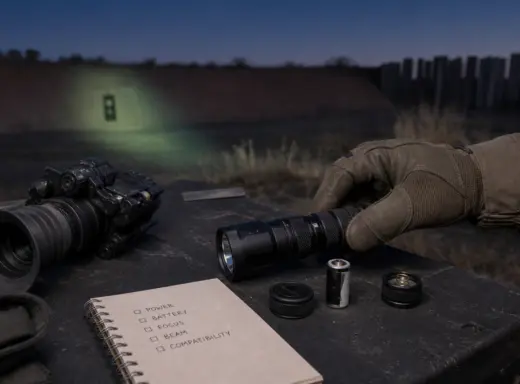
IR Illuminator Not Working With Night Vision? Beam, Battery, Focus and Compatibility Check.
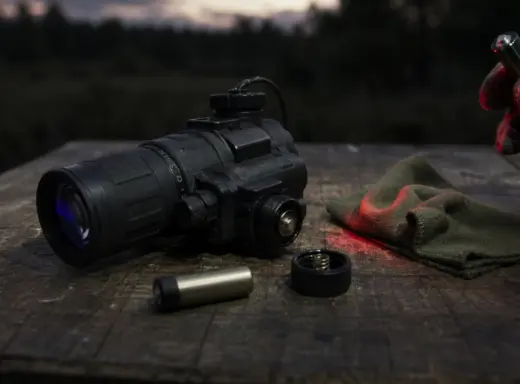
Is your NV not turning on? Battery, Contacts, Mount and Tube-Safe Troubleshooting
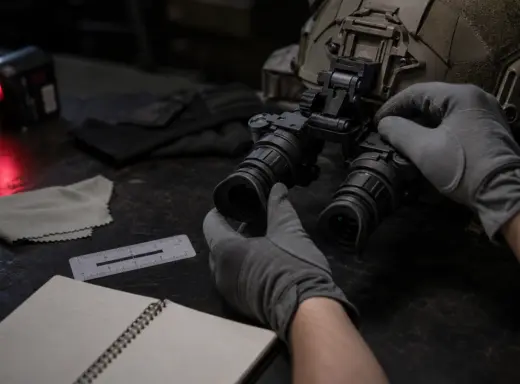
Night Vision Collimation and Alignment: Fix Double Vision, Eye Strain and Dual-Tube Setup Issues