Last updated: March 2026
The IP rating on a night vision device is one of the most misread specs in the buying process. Hunters glance at “IPX4” or “IP67” in a product listing and either dismiss it as irrelevant marketing language or assume it means the device will survive anything the field throws at it. Neither assumption is accurate. Understanding what IP ratings actually measure — and what they don’t — will prevent gear failures at the worst possible moment.
This guide explains the IP rating system in plain terms, what each rating means for night vision devices specifically, and how to use this information when comparing optics for field use in rain, heavy fog, creek crossings, and the other conditions hunters actually encounter.
What IP ratings measure
IP stands for Ingress Protection. The rating is defined by the International Electrotechnical Commission (IEC) under standard 60529. It describes two things: the device’s resistance to solid particle intrusion and its resistance to water intrusion. The two numbers in the rating correspond to these two categories in that order.
The full rating format is IP followed by two digits. The first digit runs from 0 to 6 and covers protection against solid particles — dust, dirt, fine grit. The second digit runs from 0 to 9 and covers water resistance. An “X” in either position means the device was not rated for that category — IPX4 means the water resistance was rated at 4 but no dust rating was assigned. It does not mean the device has zero dust protection; it means the manufacturer chose not to test and certify it for dust.
The solid particle protection scale
For context on what the first digit represents:
A rating of 5 means the device is dust protected — some particle ingress is possible but not in quantities that would affect operation. A rating of 6 means the device is dust tight — no particle ingress is permitted under the test conditions. Night vision devices rated IP65 or IP66 are sealed against dust intrusion. Devices rated IPX4 or IPX6 were not dust tested and may or may not have internal seals adequate to exclude grit in sandy or dusty conditions.
For hunters in environments with significant airborne dust — desert Southwest, dry grassland, agricultural fields after harvest — the first digit matters. A device that handles rain but allows fine dust through internal seams may develop internal haze or fogging on the tube over extended use in those conditions.
The water resistance scale
The second digit is what most hunters focus on, and with good reason. The levels relevant to night vision hunting use are:
IPX3: Protected against spraying water. Water sprayed at up to 60 degrees from vertical does not cause harmful effects. This is adequate for light rain in calm conditions — misting rain, drizzle, brief light showers. It does not cover rain in wind, which delivers water at angles outside the tested range.
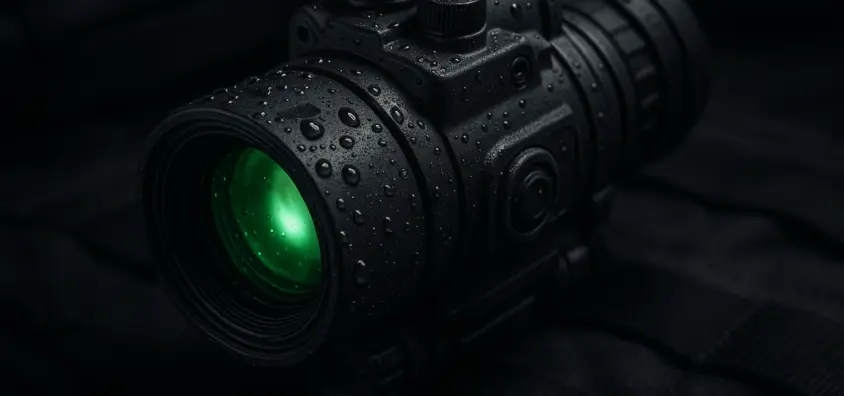
IPX4: Protected against water splashing from any direction. This is the first rating that covers wind-driven rain and splash from any angle. The test involves water sprayed from all directions at a controlled rate. It does not cover submersion or sustained direct water flow. Most mid-range hunting optics targeting the “weather-resistant” claim use IPX4.
IPX5: Protected against water jets. A water jet from a 6.3mm nozzle applied from any direction at 12.5 liters per minute for at least three minutes does not cause harmful ingress. This is genuinely useful — it means heavy rain, water running down a barrel while crossing terrain, a spray from a leaking pack or water bottle, and similar field exposures are covered.
IPX6: Protected against powerful water jets. A 12.5mm nozzle at 100 liters per minute from any direction. This substantially exceeds anything you’ll encounter in field weather conditions. IPX6-rated devices are designed to withstand high-pressure wash-down environments, which is relevant for tactical applications and devices that will be subjected to field cleaning.
IPX7: Protected against temporary immersion. The test requires the device to survive at a depth of 1 meter of water for 30 minutes. This is the minimum rating for true waterproofing. A device rated IPX7 can be dropped in a shallow creek, submerged during a water crossing, or fall into a stock tank without sustaining damage.
IPX8: Protected against continuous immersion beyond 1 meter. The test depth and duration are specified by the manufacturer, so two IPX8-rated devices may have different actual depth limits. Generally indicates the device is designed for sustained underwater use at defined depths.
What hunters actually need
For the environments most hunters encounter, the practical thresholds look like this:
Stand hunting in rain and getting in and out of a blind or tree stand: IPX4 is the absolute minimum, IPX5 is better. Rain driven by wind consistently exceeds the IPX3 tested conditions.
Still hunting or stalking in wet conditions — pushing through wet brush, moving through rain-soaked grass, crossing wet terrain: IPX5 at minimum. Direct water contact from wet vegetation is functionally equivalent to a low-pressure water jet on the device surface.
Water crossings, hunting in marshes, swamp hunting, or any situation where total submersion of the device is possible: IPX7 is required. An IPX5 device dunked in a creek may survive the crossing, but the rating does not cover it — any seal failure is not covered under warranty and the internal components may corrode over time from moisture ingress.
Night hunting in sub-freezing temperatures with potential icing: IP ratings do not cover ice formation at seal points. A device that meets IPX6 for water jet resistance may allow moisture ingress when ice forms at the seal interface and then thaws during warmth changes. Nitrogen-purged housings — where internal air is replaced with dry nitrogen gas — prevent internal fogging regardless of water ingress and are relevant for hunting in freezing conditions.
Nitrogen purging and its relationship to IP ratings
Many quality night vision and thermal devices advertise nitrogen purging as a feature alongside their IP rating. These are related but separate properties. IP ratings describe resistance to water ingress from outside. Nitrogen purging addresses what happens inside the device if temperature changes cause pressure differentials or if minor moisture has already entered.
An unpurged device sealed to IPX7 will not allow water in during a 1-meter submersion test, but if the device is moved rapidly from cold to warm environments, pressure differentials can draw atmospheric moisture through seals rated for water resistance but not vacuum conditions. A nitrogen-purged device has the internal atmosphere replaced with dry inert gas, eliminating any internal moisture source and preventing the fogging that occurs when warm humid air contacts cold internal optics.
For hunters who regularly move between cold outdoor conditions and warm vehicles, blinds, or buildings — which describes most of a hunting season — nitrogen purging eliminates the fogging issue entirely, independently of the device’s water resistance rating. The two features together provide comprehensive protection against moisture-related damage.
Common misconceptions about IP ratings
“My device is IPX7 so I can use it underwater.” IPX7 covers temporary immersion at 1 meter. Extended use at depth, swimming with the device, or use during diving is not covered by IPX7. If underwater use is required, verify the manufacturer’s stated depth and duration limit, not just the IP number.
“IPX4 is weather-resistant enough for any hunting condition.” IPX4 covers splash and low-angle rain. Hunting in steady wind-driven rain, wading through wet brush, or crossing streams exceeds IPX4 test conditions. Devices have survived these conditions with IPX4 ratings, but there is no engineering guarantee — it depends on the quality of the actual seals, not just the rating.
“Higher IP rating always means better build quality.” IP rating reflects sealing performance under standardized test conditions. A device can have a high IP rating and poor optical quality, mechanical durability, or temperature tolerance. It is one relevant specification among several, not a proxy for overall build quality.
“IP ratings cover drops and impacts.” They do not. Drop resistance and shock resistance are separate specifications, typically tested under IEC 60068-2-27 or MIL-STD-810G protocols. A device rated IPX7 that is dropped on rock will sustain the same mechanical damage as an unrated device subjected to the same drop. Night vision devices that advertise drop resistance alongside their IP rating are describing separate test results for separate failure modes.
Reading IP ratings in night vision product listings
Manufacturers present IP information inconsistently. Some list only the water rating (IPX4), some list both digits (IP65), some use “weather-resistant” or “waterproof” marketing language without citing a specific standard. When evaluating any night vision purchase:
Look for the specific IEC standard number if the manufacturer provides it — IP67 under IEC 60529 is verifiable. “Weather-resistant” without a specific rating could mean anything from light drizzle tolerance to a deliberately vague marketing claim.
Cross-reference with the product’s stated operating temperature range — a device rated IPX6 but only tested to 32°F has a gap in its cold-weather performance documentation that matters for winter hunting.
For devices with nitrogen purging listed as a feature, confirm whether the purging is factory-sealed permanent (common on quality optics) or user-refreshable (common on quality binoculars). Factory-sealed purging is maintenance-free; user-refreshable requires periodic dry gas recharge.
The guide to caring for your night vision device covers practical maintenance steps for extending the life of any optic regardless of its IP rating, including how to dry and store devices after wet-weather use.
Practical recommendations by hunting environment
Arid climates, mostly clear weather: IPX4 minimum, focus more on dust protection (first digit 5 or 6). Nitrogen purging is less critical when temperature swings are moderate.
Temperate climates, regular rain: IPX5 minimum, IPX7 preferred. Nitrogen purging is valuable if you hunt in temperature extremes between vehicle, blind, and field.
Wet climates, marsh or swamp hunting, water crossings routine: IPX7 required. Nitrogen-purged housing strongly recommended. Budget for the protection level the environment demands.
The night vision in bad weather guide expands on how rain, fog, and cold affect thermal and image intensification performance beyond the sealing question — what actually happens to image quality in these conditions and how to compensate.
Summary
IP ratings give you objective, testable information about how a night vision device was validated for water and dust resistance. IPX4 handles light rain and splash. IPX5 handles sustained rain and direct water contact. IPX7 covers total submersion at 1 meter. Nitrogen purging prevents internal fogging independently of the water ingress rating. Matching the device’s IP rating to the actual field conditions you hunt in — not the best-case weather scenario — is the practical application of this information. A device rated for the conditions you actually encounter will perform reliably across a season; one rated below those conditions is an unknown risk every time the weather changes.