
May 19, 2026
Best Thermal Scopes for Coyote Hunting in 2026
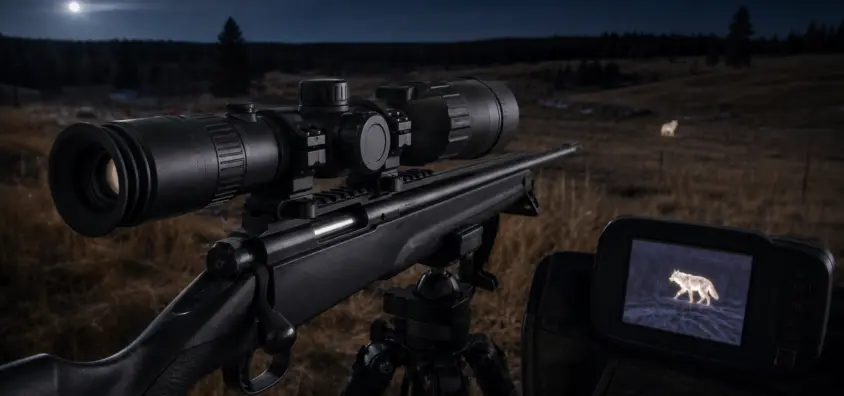
Coyote hunting puts more pressure on a thermal scope than many hunters expect. A hog is large, heavy, and usually easier to read through a thermal image. A coyote is smaller, faster, lower to the ground, and much easier to confuse with a dog, fox, calf, or other warm target if your image quality is not good enough.
That is why the best thermal scope for coyote hunting is not simply the one with the longest advertised detection range. Detection only tells you that a heat source is there. For real hunting, you also need recognition, identification, usable magnification, enough field of view, smooth refresh rate, and a stable zero.
For most coyote hunters, the sweet spot is a 384 or 640 thermal sensor, a 35mm to 50mm objective lens, 2x to 4x base magnification, and a refresh rate around 50Hz or 60Hz. A 256-core scope can work at close range, but if coyotes are your main target, a 384-core optic is a better starting point.
What Makes a Thermal Scope Good for Coyote Hunting?
Coyotes do not give you much time. They move quickly, stop briefly, and often appear at odd angles. A good coyote thermal scope needs to show enough body shape and movement detail to help you identify the animal before you shoot.
Resolution matters because a coyote is a smaller target than a deer or hog. Magnification matters because coyotes often hang up at distance. Field of view matters because a narrow image makes scanning harder and can make moving animals difficult to track. Refresh rate matters because a choppy image is frustrating when an animal is trotting or circling.
The best thermal scopes for coyotes balance all of those factors. A high-magnification scope with a narrow field of view may look impressive on paper, but it can be hard to use when you are trying to locate a moving animal. A wide low-magnification scope may be excellent for scanning but less useful when you need more confidence at distance.
Detection Range vs Identification Range
Thermal scope specs usually advertise detection range. That number is useful, but it can mislead hunters. Detection means the optic can see a heat signature under specific conditions. It does not mean you can identify that target as a coyote.
For coyote hunting, identification range is the number that matters in the field. Identification depends on the sensor, lens, NETD, humidity, terrain, background temperature, target posture, and how much experience the hunter has reading thermal images.
A scope may detect heat at 1,400, 1,800, or even 2,600 yards, but your practical coyote ID distance will be much shorter. That is normal. The goal is not to buy the biggest detection number. The goal is to buy enough image quality and magnification to make responsible decisions at your real hunting distances.
Best Overall: AGM RattlerV2 35-384
The AGM RattlerV2 35-384 is one of the strongest all-around choices for coyote hunters because it balances resolution, magnification, field of view, and price. AGM lists it with a 384×288 thermal sensor, 35mm germanium lens, 3x base magnification, 3x to 24x digital zoom, 50Hz refresh rate, and detection range up to 1,800 m/yd.
That combination makes sense for coyote hunting. The 3x base magnification gives more reach than many close-range thermals, while the 384 sensor still keeps the image useful enough for scanning and identification at realistic field distances.
The RattlerV2 35-384 also has practical hunting features: rechargeable batteries, up to 11.5 hours of runtime under listed conditions, shot-activated recording, multiple zeroing profiles, and a 5-year warranty.
Best for: hunters who want one thermal scope for coyotes, hogs, and general predator control.
Main tradeoff: it is still a 384-core optic, so it will not match a good 640-core scope for fine detail at longer distances.
Best Premium Pick: Pulsar Thermion 2 LRF XG50
The Pulsar Thermion 2 LRF XG50 is a premium choice for hunters who want more image detail and integrated ranging. Pulsar lists the scope with a 640×480 sensor, 12-micron pixel pitch, 50mm F/1.0 objective lens, 3x to 24x magnification, 50Hz frame rate, 1024×768 AMOLED display, and 2,300-meter detection range.
For coyotes, the major advantage is the 640 sensor paired with a 50mm lens. That gives the hunter more detail when animals are farther out or when conditions are less than ideal. The built-in laser rangefinder is also useful because judging distance at night can be difficult, especially across open fields.
This is not a budget scope. It is for hunters who spend enough nights in the field to justify premium thermal performance.
Best for: serious coyote hunters who want premium image quality, long detection capability, and built-in ranging.
Main tradeoff: price. It costs far more than mid-range 384 thermals.
Best Long-Range 640 Option: AGM Adder TS50-640
The AGM Adder TS50-640 is another strong long-range option. AGM’s datasheet lists the Adder TS50-640 with a 640×512 thermal detector, 12-micron pitch, 50Hz refresh rate, 50mm F/1.0 lens, 2.5x to 20x magnification, 8.7° x 7.0° field of view, 1024×768 OLED display, and 2,600-meter detection range.
For coyote hunting, the Adder TS50-640 makes sense when you want more image detail than a 384-core scope and prefer a traditional 30mm tube-style riflescope format. It also brings long battery life, onboard recording, multiple reticle options, and IP67 protection.
The 2.5x base magnification is a good middle ground. It gives enough reach for open-country predator hunting without becoming too narrow for scanning.
Best for: hunters who want a 640-core thermal scope with a traditional riflescope body.
Main tradeoff: it is heavier and more expensive than compact 384-core predator scopes.
Best Value 384 Pick: Sightmark Wraith Mini 2-16×35 Thermal
The Sightmark Wraith Mini 2-16×35 Thermal is a practical value option for hunters who want 384 resolution without premium pricing. Sightmark lists it with a 384×288 thermal sensor, 35mm lens, 2x optical magnification, 1-8x digital zoom, 13-degree field of view, 1024×768 OLED display, and 1,400-yard detection range.
For coyotes, the biggest advantage is the wide 2x base magnification. That makes it easier to scan, pick up movement, and follow animals in closer terrain. It also has 5 color palettes, 10 reticles, 9 reticle colors, 5 weapon profiles, and built-in recording with sound.
This is not the long-range choice in the group. But for hunters working closer fields, feeders, farms, and mixed terrain, it is a useful 384-core scope at a more accessible price point.
Best for: hunters who want a compact 384 thermal for closer coyote and predator work.
Main tradeoff: battery life is shorter than many higher-end scopes, and the 2x base magnification is not ideal for longer shots.
Best Compact Predator Scope: Bering Optics Super Hogster R 2.9-11.6×35
The Bering Optics Super Hogster R 2.9-11.6×35 is built around the kind of compact thermal performance predator hunters often want. B&H lists the model with a 384×288 thermal sensor, 2.9x optical magnification, 4x digital magnification, 50Hz refresh rate, and 1280×960 LCOS display. The listing describes it as suitable for feral hog and predator hunting at night, with running-hog detection listed at 1,100 yards.
For coyotes, the appeal is the 2.9x base magnification and compact form factor. It has enough reach to be more useful than many low-base-magnification thermals, but it is still manageable in the field.
Best for: hunters who want a compact 384-core predator scope with a useful base magnification.
Main tradeoff: it is not a 640-core optic, so detail at longer distances will not match premium thermals.
Best Smart-Feature Option: ATN ThOR 5 LRF 640 3-24x
The ATN ThOR 5 LRF 640 3-24x is for hunters who want thermal imaging plus smart features. ATN lists the LRF 640 3-24x model with a 640×480 sensor, 12-micron 60fps platform, 3x to 24x magnification, built-in laser rangefinder, ballistic calculator, video recording, and listed detection around 2,900 yards for that configuration.
For coyote hunting, the rangefinder and ballistic calculator can be useful when animals hold up farther out. The 60fps refresh rate is also helpful for moving targets.
The tradeoff is complexity. Some hunters prefer a simpler scope with fewer menus and fewer electronics to manage at night. If you like smart features, ATN makes sense. If you want the most straightforward field optic, Pulsar, AGM, or Bering may feel cleaner.
Best for: hunters who want thermal imaging, rangefinding, recording, and ballistic tools in one scope.
Main tradeoff: more features mean more setup, more menu time, and more things to learn before a hunt.
What Resolution Do You Need for Coyotes?
A 256-core thermal scope can work for close-range predator control, especially inside 100 yards. But for coyote hunting as a primary use case, 384 should be considered the practical starting point.
A 384×288 sensor gives enough detail for many realistic hunting distances while keeping price and size manageable. A 640-core scope gives better detail, especially when paired with a 50mm lens, and is the better choice for open fields, longer shots, and hunters who spend many nights behind the optic.
If your budget allows it, buy 640. If it does not, buy a good 384 instead of chasing a cheap optic with a bigger marketing number.
Final Verdict
The best thermal scope for most coyote hunters is the AGM RattlerV2 35-384 because it balances 384 resolution, 3x base magnification, a 35mm lens, 50Hz refresh rate, good battery life, and a realistic price.
The best premium option is the Pulsar Thermion 2 LRF XG50. It offers a 640 sensor, 50mm objective lens, strong detection range, and integrated laser rangefinder.
The best long-range 640 alternative is the AGM Adder TS50-640. It gives hunters a traditional riflescope format with a 640×512 sensor and a 50mm lens.
The best value 384 option is the Sightmark Wraith Mini 2-16×35 Thermal, especially for closer fields and farm use. The Bering Optics Super Hogster R remains a strong compact predator scope, while the ATN ThOR 5 LRF 640 3-24x is the smart-feature pick for hunters who want rangefinding and ballistic tools.
For coyotes, do not buy based on detection range alone. Buy for identification confidence, image detail, field of view, refresh rate, and the distances you actually hunt.
IR Illuminator Not Working With Night Vision? Beam, Battery, Focus and Compatibility Check.
Is your NV not turning on? Battery, Contacts, Mount and Tube-Safe Troubleshooting
Night Vision Collimation and Alignment: Fix Double Vision, Eye Strain and Dual-Tube Setup Issues