
May 27, 2026
Thermal Scope Battery Life: Internal vs Removable Batteries, Power Banks, and Cold Weather
Introduction
Battery runtime is one of the most overlooked specifications in thermal scope reviews. Hunters compare the resolution, lens diameter, detection range, NETD rating, refresh rate, and other specs first. Only after a couple of hours of hunting, battery capacity becomes just as important as image quality.
But a thermal rifle scope with an excellent sensor would not help much if it drains completely before reaching the hogs at the feeder or before a couple of coyotes move.
And here comes the tricky part – thermal scope battery runtime is not just a spec. It depends on many factors including the temperature, brightness, Wi-Fi connection, recording, standby, laser rangefinding, and so forth.
So the right question for a hunter is not necessarily “How long does the scope last?” But rather “Can I keep the scope operational in the way I hunt?”
Why Does a Good Battery Run Time Matter
Every thermal scope is an electronic camera. The scope contains the imaging sensor, display, processor, battery management system, recording module, wireless connectivity module, battery pack, and sometimes even a laser rangefinder.
It means that almost everything in a thermal scope eats power.
Wi-Fi consumes power. Recording videos requires energy. High screen brightness drains the battery. Cold weather affects maximum capacity. Constantly browsing through the menu or looking through the screen reduces battery runtime. The amount of features and functions also matters – the more complex a thermal rifle scope is, the greater amount of energy it will drain.
So if a hunter only activates the scope just before the shot, he would get near the listed runtime number. But if he spends much time recording videos, broadcasting them to the phone, scanning around, etc. – runtime will decrease significantly.
Why Internal and External Batteries Matter for Thermal Scopes
Internal batteries have pros and cons.
On the positive side, they are convenient. A hunter charges the scope once and then takes it to the hunt with nothing else to consider except the scope itself. No additional battery caps, battery packs, and spare cells are required.
Internal batteries can become problematic with time since any rechargeable cells degrade. If the internal battery is the only source of power – long-term reliability becomes crucial.
Best for: clean setup hunters, who usually don’t hunt for too long
Tradeoff: the impossibility of field battery replacement, unless another source of power is provided.
Removable battery systems give freedom to the hunters.
The major advantage of removable batteries is the ability to switch battery packs in the field. This feature becomes extremely valuable for those who spend nights sitting near hog feeders or calling predators.
Examples include:
- AGM’s RattlerV2 35-384 – 9-hour battery runtime and removable rechargeable Li-ion batteries
- iRayUSA’s RICO Mk1 series – 6-hour runtime with replaceable rechargeable batteries (3.7V/4500mAh)
- Pulsar Thermion 2 LRF – hybrid battery system (built-in and removable)
As usual, there is always some trade-off.
The removable batteries have some disadvantages as well. Most often, removable battery packs are proprietary meaning their price could be higher than that of ordinary batteries and they must be charged with a special charger.
Best for: hunters, who stay overnight in the woods
Tradeoff: additional battery packs and chargers.
Hybrid batteries are the best from both worlds.
Such battery system provides an internal power pack as a backup while removable packs increase operational time.
In other words, a hunter charges the scope and replaces the removable battery in the field if it runs low.
Pulsar’s Thermion 2 LRF models contain such a battery system featuring a built-in APS5 battery and removable APS3 battery with support of USB-C Power Delivery and runtime up to 11 hours at 22°C.
This is perfect since a hunter gets the best from both worlds – convenience and additional runtime.
Best for: hunters, who need both clean rifle and prolonged operation
Tradeoff: expensive scopes
External Power Banks
Now, let’s discuss a more advanced concept – external battery packs.
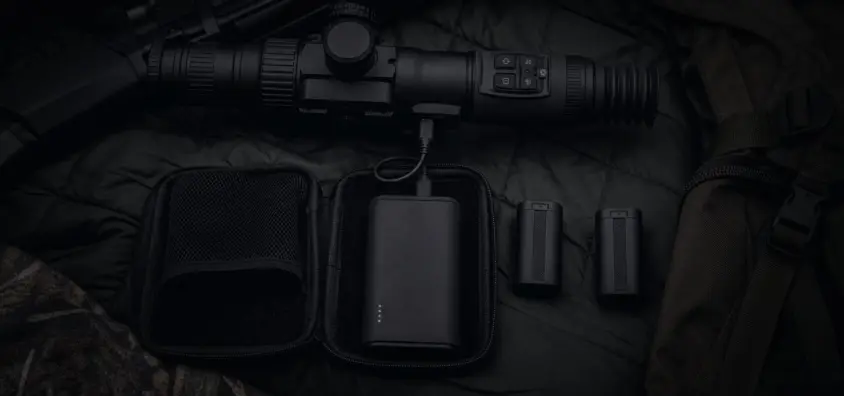
The vast majority of modern thermal scopes have external power via USB-C port. Some manufacturers like ATN offer an additional power kit that can increase runtime significantly.
AGM RattlerV2 35-384 has an external power support via USB-C. Pulsar Thermion 2 LRF series support external power using USB-C PD port. And Sightmark Wraith Mini Thermal scopes use CR123A batteries and support external powering through USB-C.
At the same time, ATN offers its Extended Power Kit featuring 20000 mAh battery capacity providing 22-hour runtime. The kit has a USB-C connector.
External power source is perfect for long stays, hunting tournaments, working at feeders, or cold-weather hunting. Still, there is a list of possible problems hunters may face during such hunting trips.
One needs to consider cables’ possibility to get caught, mounting position, and proper weatherproofing. Additionally, the connection must be reliable under any circumstances. So, the external power pack may be considered as an option, but far from the main method of prolonging operation.
Best for: tournament hunting, cold-weather hunting, hunting at feeders, stationary hunting
Tradeoff: cable management, mounting, and reliability issues
CR123A Batteries
Some hunters use scopes that accept CR123A batteries as power sources.
Such scopes are usually more compact since CR123A batteries are smaller than Li-ion ones. Moreover, it is easy to purchase additional packs of disposable batteries in case of necessity.
CR123A batteries have a significant disadvantage – their capacity and runtime are usually lower compared to larger rechargeable battery packs.
Nevertheless, CR123A batteries have the advantage of being available everywhere. Some scopes even support external powering. Sightmark’s Wraith Mini Thermal uses CR123A batteries and supports USB-C powering.
Not all batteries have the same characteristics and abilities to operate in certain environments. Energizer’s Ultimate Lithium battery can provide maximum power performance from -40°F (-40°C) to 140°F (60°C). Similarly, Panasonic describes its Lithium batteries as able to operate in low-temperature conditions down to -40°C.
The major advice: never ignore the battery recommendations of the manufacturer.
Best for: hunting at short distances
Tradeoff: lower runtime compared to lithium-ion battery packs.
Effect of Cold Weather on Battery Capacity
All batteries change their performance when exposed to cold weather. That’s obvious. At the same time, Pulsar’s manual to Thermion 2 LRF models states that the battery capacity becomes reduced in cold weather and it is normal. It also warns about immediate charging after removing the scope from cold.
What does it mean? Obviously, the battery capacity changes in cold weather and it may lead to unexpected runtime reduction. Hence, a scope, which operates perfectly during the day, may fail during nighttime hunting.
Additionally, it is recommended to charge a scope battery only after it warmed up in a warm room.
Which Battery Should I Take Into Account?
There is a list of features that reduce scope runtime.
First, video recording consumes much energy. It is necessary to avoid excessive recording and streaming videos as much as possible.
Second, Wi-Fi and phone connection also use power. It is better to disable unnecessary connections, especially at cold nights. Moreover, laser rangefinding, calculation, and constant menu use increases energy consumption too.
Moreover, high screen brightness can consume lots of power. However, many users prefer to maximize their screen brightness when looking through the scope.
Third, scope refresh rate also influences battery runtime.
Fourth, thermal scopes with standby modes can significantly extend runtime. It is advised to enable the mode if there is no target nearby.
Which Thermal Scope Battery Pack is the Best One?
It is important to understand which type of battery is more advantageous for hunting.
Internal-only batteries are more convenient. On the other hand, hunters can only use the batteries in their scopes without the possibility to add more energy during hunts. Therefore, hunters should choose internal battery systems carefully to avoid failures.
Removable battery systems are much more preferable if a hunter prefers a thermal scope. Removable battery systems allow hunters to swap batteries in the field and extend runtime.
Hybrid systems are even more useful since the hunter can use the internal battery for safety. At the same time, he or she can replace the batteries in the field if necessary. Hence, the hunter can use his weapon safely during nighttime.
External battery packs are great to have as an additional source of power. On the other hand, they require the scope to be charged using the cable.
Thus, it is recommended to take removable battery system as the best hunting one. However, external power packs should be taken into account as a great option.
Battery Life for Hog Hunting
Hog hunting usually implies long waits and sitting next to the feeder.
Therefore, the scope with good battery runtime becomes critical for successful hunts. Ideally, the thermal scope would be equipped with removable batteries.
If hunters hunt over the night, they should prefer scopes with good battery runtime and with standby mode to conserve power.
Removable battery systems could also be preferred. If hunters hunt in a stationary manner using blind or vehicle as a cover, they should think about using external power packs.
Recommended setup: removable battery pack or hybrid power with one spare battery or power pack.
Battery Life for Coyote Hunting
Coyote hunting implies a different set of requirements.
During coyote hunting, hunters usually call predators, move around feeders and roads, reset the spot and wait.
So a coyote hunt can involve constant use of the scope for scanning the area. Thus, the most important parameter of the scope should be the quick activation and the fast start.
Therefore, a standby mode should be activated to save power when coyotes are not close to the hunter.
If hunters use a thermal monocular for coyote hunting, they would benefit from scopes with removable batteries or scopes having an internal battery with long runtime.
Recommendations: removable batteries or good internal batteries, ideally with standby mode.
Battery Life for Thermal Monoculars and Scanners
Thermal scanners and monoculars imply constant use of the thermal camera.
Unlike riflescopes, hunters often use thermal devices frequently scanning the area. The time spent on using the thermal scope could be longer than that spent on shooting.
Hence, the runtime of the thermal device becomes crucial. As soon as hunters hunt with both thermal rifle scope and scanner, it becomes important to take care of the devices and spare batteries.
Recommended setup: good internal batteries or removable batteries.
Power Banks: How to Choose?
It is essential to choose the right power bank for hunting purposes. There is a list of requirements to such battery packs.
Power bank must contain sufficient amount of power. The battery capacity should be enough to operate the scope throughout the whole night.
Power bank must deliver enough voltage and current. Some scopes require only 5V/2A, while others use higher voltage values via USB-C Power Delivery.
Cable must be short and rugged to prevent the possibility of getting caught. Hunters must thoroughly test the connection in the field.
Power bank should have protection from water and dust.
Additionally, it should survive shocks and impacts.
Hunters must not rely on the external power bank until they test their thermal scopes.
What Amount of Runtime Do I Need?
Four-six-hour runtime is perfect for short hunting sessions and for daytime hunting.
Eight to ten hour runtime is sufficient for regular hunting at night.
For extended hunting over several nights or at cold weather, a thermal scope must operate over 12 hours.
The most important thing: hunters should not rely on scope’s listed battery capacity.
What Mistakes Do Hunters Make While Selecting Thermal Scopes Based on the Batteries?
The first mistake – taking the listed battery capacity for the truth. It is good to have such information but the scope’s performance must also be taken into consideration.
The second mistake – not paying attention to the battery type. Removable batteries and internal batteries must be considered in the hunting terms.
Third mistake – hunters may forget that external power must be checked in the field.
The fourth mistake – hunters can try charging their scopes incorrectly.
The fifth mistake – hunters do not notice that Wi-Fi, recording, high screen brightness, and rangefinding reduce battery capacity.
Recommendations for Purchasing a Thermal Scope Based on Battery Type
Internal battery system is recommended if hunters mainly prefer short hunting sessions with no stationary stands and long nights.
Removable battery system should be chosen by hunters who need to spend nights in the woods, travel between different locations, and prefer field-swapping.
If hunters are looking for the most reliable way, it is advisable to select a hybrid system (internal and removable batteries).
External battery packs could be used if the hunting takes place in stationary positions.
It is important to be careful at night hunts since the battery runtime can decrease dramatically due to cold weather.
Conclusion
Battery type and capacity is very individual.
Thermal scope’s internal battery is the most convenient but the least powerful and less long-term one.
Removable and hybrid batteries have advantages since they extend hunting time significantly.
External power is also great and allows hunters to continue hunting at night.
Thus, removable and hybrid battery systems are the best for hunters.
IR Illuminator Not Working With Night Vision? Beam, Battery, Focus and Compatibility Check.
Is your NV not turning on? Battery, Contacts, Mount and Tube-Safe Troubleshooting
Night Vision Collimation and Alignment: Fix Double Vision, Eye Strain and Dual-Tube Setup Issues