
May 29, 2026
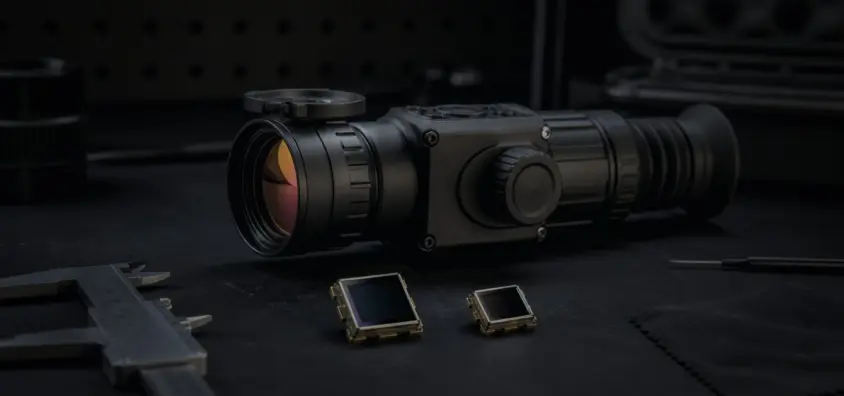
Thermal Scope Pixel Pitch Explained: 12 Micron vs 17 Micron
12 micron vs 17 micron on a thermal scope is one of the biggest myths of modern hunting optics. Buyers read a spec sheet, spot two pixel pitches, and immediately think that 12 micron means better image quality. This assumption is false and misleading, but it persists year after year as manufacturers push 12-micron cores in popular new thermal scopes.
The truth is more complicated: 12 micron usually means a more compact optic with more magnification at a given lens diameter. That does not automatically mean clearer image quality, although with the same resolution and lens it usually creates a more reach-oriented, narrower view.
What Pixel Pitch Is
Simply put, pixel pitch is the physical spacing between detector pixels on a thermal sensor. Thermal scopes usually come with 12 micron pitch or 17 micron pitch. Sometimes you see 20 micron and even smaller or larger values, but most hunting optics stick to 12 or 17.
Micron is the short name for micro-meter. One micron equals one millionth of a meter. A thermal sensor with 12-micron pixel pitch has a horizontal spacing of 0.012 mm per pixel. A 17-micron sensor has a horizontal spacing of 0.017 mm per pixel.
It may seem minuscule, but this tiny difference changes the physical size of the sensor itself. Take a 640×512 detector as an example.
A 640-pixel detector with 12-micron pitch has a horizontal size of 0.012 mm x 640 pixels = 7.68 mm.
A 640-pixel detector with 17-micron pitch has a horizontal size of 0.017 mm x 640 pixels = 10.88 mm.
This matters because it directly affects field of view when combined with a certain lens.
Pixel Pitch and Field of View
According to Edmund Optics, the general relationship between focal length, sensor size, and field of view is shown by the angle-of-view formula. It is easy enough to grasp and remember: larger sensors mean wider angle of view; shorter focal lengths mean wider field of view.
In other words, field of view depends on two things: the size of the detector and the focal length of the lens used to form the image on the detector.
If pixel pitch determines the physical size of a detector with a given resolution, it is an important factor for determining field of view in a given thermal scope. In fact, it is so important that 12-micron thermal scopes often feel more compact and reach-oriented for the same focal length.
12 Micron vs 17 Micron: Main Difference
Let us consider two fictional thermal riflescopes. Both have identical resolution (640×512 pixels), identical lens focal length (35mm). Only one detail changes: one scope has 12-micron pixel pitch, another has 17 microns.
This is what the resulting view would look like on both devices.
A 640×512 12-micron pixel pitch thermal sensor is approximately 7.68 mm wide.
A 640×512 17-micron pitch thermal sensor is approximately 10.88 mm wide.
With the same lens focal length, one device sees a narrower strip of the image due to the smaller pixel pitch of the thermal sensor.
In other words, pixel pitch helps determine whether the scope provides a wider view or a narrower one. A 12-micron thermal sensor with the same lens sees a narrower field of view than a 17-micron sensor.
Why This Matters for Hunters
For many hunters, this becomes a key choice. Should they pick 12-micron vs 17 micron? This is not an easy question, especially considering the importance of other factors.
Field of view and base magnification are just the beginning. There are also NETD, lens quality, thermal sensor resolution, signal processing, image display resolution, and even the hunting distance.
But here are some general recommendations based on field of view and base magnification differences.
12-micron sensors with the same lens are usually more reach-oriented due to narrower field of view. This makes them useful for open field hunting with a clear sight picture.
17-micron sensors with the same lens are usually better for woodland hunting and tracking moving animals. Their wider field of view can provide a more forgiving scope feel for hunters who do not like too narrow views.
These are rough guidelines, and it would be a mistake to buy a thermal scope based on pixel pitch alone.
Understanding the IFOV Effect
One last point about 12-micron vs 17 micron: the impact of instantaneous field of view (IFOV).
The instantaneous field of view is the angle of a single detector pixel of a thermal sensor in relation to the focal plane. It defines the minimum angular spatial resolution of a detector pixel.
In the simplest terms, each detector of the thermal sensor sees a certain angle slice of the scene. The smaller the slice, the finer the angular sampling rate and the easier it becomes to separate details at distance.
The exact formula is complex, but we can use a simplified approach to calculate the IFOV effect.
The relationship between IFOV, focal length, and pixel spacing is approximately linear.
The IFOV of a thermal detector pixel is approximately pixel spacing / focal length.
For example, the 12-micron detector pixel has an IFOV = 0.012 mm / 35mm = ~0.343 mrad with a 35mm lens.
For a 17-micron pixel = 0.017 mm / 35mm = ~0.486 mrad with a 35mm lens.
It is not necessarily true, but in general, smaller IFOV means finer spatial sampling rate. Theoretically, this allows separating more detail on the target.
However, this is only possible if the other parameters are optimized: optics, focusing, thermal sensitivity, etc.
So is 12 micron always better?
Does 12 Micron Mean Better Image Quality?
Not always.
Many top hunting scopes feature 12-micron detectors because they allow creating compact and powerful optics. Many modern AGM, iRayUSA, Pulsar, and other thermal models use 12-micron sensors.
The clear trend among many hunting brands is the switch to 12-micron core thermal sensors. This proves that smaller pixel pitch is more relevant for hunting now.
However, this does not make all thermal scopes with 12-micron sensors superior to 17 micron sensors.
For example, a 12-micron thermal sensor can be paired with mediocre optics, noisy electronics, bad firmware, weak image processor, weak thermal sensitivity, and other factors that limit the performance. A better-performing 17 micron sensor with more favorable specs can be superior in such case.
According to Pulsar, thermal imaging system image quality depends on various parameters, including optical elements, display quality, thermal sensing capability, signal processing, and more. Pixel pitch is important but not decisive.
Does 17 Micron Still Matter?
Of course.
Just because many popular hunting scopes use 12 micron, does not mean that the 17-micron sensor becomes useless. It still has applications in various scopes and can be chosen for particular advantages.
Some older hunting scopes rely on 17-micron cores because of proven design, cost, reliability, and wider field of view with a given lens. Some models from Pulsar also use 17-micron thermal sensors.
However, there are two points that make 17 micron interesting even today: increased signal margin per detector and wider viewing angles with the same lens.
17 micron has a larger per-pixel surface area than 12-micron core. If the exact pixel design and f-number allow, more surface area means more signal margin in each pixel. This can be crucial for low contrast thermal scenes with foggy or humid weather.
Moreover, a 17-micron sensor can be more preferable when using certain types of optics to create wider field of view.
So is the pixel pitch more important for the image quality?
Why Lens Focal Length Is Important Too
Larger lens focal length can overshadow even a 12-micron thermal sensor’s advantages.
For example, a 25mm 12-micron thermal scope can feel roughly comparable in field of view to a 35mm 17-micron scope, depending on sensor format and optical design.
At the same time, a 50mm 12-micron lens may feel more powerful but provide a very narrow view.
The bottom line is that lens focal length makes a bigger contribution to thermal scope performance than the pixel pitch. A thermal scope buyer should look at the field of view, base magnification, and sensor resolution first.
If a thermal scope lists a 640×512 resolution, 12 micron pitch, 35mm focal length, and approximate base magnification of 2x, it will probably have a good hunting potential.
If it features 384×288 resolution, 12 micron pitch, 50mm focal length, and very high base magnification, it could offer great reach but a very narrow field of view.
If it has 640x resolution, 12 micron pitch, 25mm focal length, and low base magnification, it might offer superb field of view and close/mid-range reach.
How Digital Zoom Impacts the Picture
Another point about 12 micron: the digital zoom.
Unlike the traditional optical zoom, digital zoom crops and expands already existing video footage. It does not add any new thermal data because it operates within the frame created by the thermal sensor.
As explained above, thermal sensor with 12 micron creates a tighter sampling frame around the focal plane than 17-micron with the same lens focal length. It can help preserve apparent detail when digitally zoomed, assuming resolution, optics, focus, NETD, and processing are strong enough.
However, resolution plays a more critical role because it directly defines the maximum cropping potential of digital zoom.
For example, a thermal sensor 640×512 resolution can handle much more digital zoom than 384×288 because it has more thermal pixels from the start. It would be wise to consider the pixel resolution when purchasing a thermal weapon scope.
For example, a 384-class thermal detector might look good at base magnification but fall apart faster at 2x digital zoom compared to a good 640 model.
General Conclusion
Should hunters buy a thermal scope with 12 micron or 17 micron? This is a tough call.
Both solutions have their pros and cons. A well-designed 12-micron scope can be more compact, more powerful, and suitable for long-distance shooting. However, this also requires good optics and good image processing capabilities.
A well-designed 17-micron scope can be more comfortable in dense woods, provide a wider field of view, and offer sufficient magnification. Again, this depends on proper optics and image processing.
The ultimate goal should be choosing a thermal scope that works well in a given hunting environment.
12 Micron and 17 Micron for Hog Hunting
When choosing a thermal scope for hog hunting, it is crucial to consider the wide field of view and decent resolution for reliable identification. Hogs are relatively big, frequently travel in groups, and can be hunted in different environments including woods, crop damage areas, feeders, and large fields.
This means that a hunting device with a narrow field of view will be less comfortable and efficient.
If hunting hogs, a 12-micron sensor could be great if combined with a lens focal length of 35mm. The narrower viewing angle is fine in this case because hogs are relatively big and easy to identify with lower resolution.
If the hunting area is small, 12-micron paired with 25mm lens would be great.
However, a 12-micron 50mm focal length might provide too much magnification. Such scope could be useful in large fields and far from the hog targets but could create problems at close ranges.
12 Micron and 17 Micron for Coyote Hunting
Coyote hunting typically requires the scope to have sufficient magnification to see distant targets. Coyotes tend to move in fields and are smaller than hogs. They need to be tracked and detected at greater distances with relative ease and confidence.
12 micron thermal sensor would be great for this purpose if coupled with 35mm or 50mm focal length optics.
This combination creates a narrow but high magnification picture, which is great for tracking targets at greater distances. Many 640x thermal scopes with 12 micron detectors have 35mm or 50mm lens focal length precisely for this purpose.
17-micron thermal detector can also work well for coyotes. With the same resolution, lens, NETD, optics, and processing, a 12-micron sensor will usually feel more reach-oriented than a 17-micron sensor. But a better 17-micron scope with a longer lens or stronger image quality can still outperform a weaker 12-micron model.
12 Micron for Beginners
A beginner thermal scope buyer does not need to focus on pixel pitch and other advanced characteristics. First, he or she should determine whether the scope is convenient to use. When it comes to pixel pitch, it is essential to understand that more compact and powerful optics with narrower field of view can complicate the search for animals.
When buying a thermal scope for beginners, one must pay attention to focal length and resolution to ensure sufficient identification capabilities at close and medium ranges.
In most cases, 12-micron thermal sensors will work best if coupled with 25 or 35mm lens. This will allow getting a decent hunting scope with decent field of view and sufficient reach.
The beginner’s priorities are focus adjustment, quick scanning capabilities, learning the behavior of animals, picking the best thermal profile, using the scope with battery power correctly, and so on. These are the most important skills that a beginner should master before going to hunt.
Common Mistakes While Buying
A beginner may make several mistakes while looking at thermal scopes. First, he or she assumes that 12 micron sensors are universally better than 17 micron sensors and vice versa. This is completely wrong.
Second, the beginner assumes that all thermal scopes with 17 microns are poor performing and outdated products that lack features. This is wrong too.
Third, the hunter ignores the field of view aspect and assumes that higher magnification is better regardless of the type of hunting.
Fourth, the beginner ignores sensor resolution and thinks that higher pixel pitch automatically translates to more thermal image information per scene.
Fifth, the hunting enthusiast considers detection capabilities above all. However, this aspect matters much less than identification performance and capabilities.
Buying Tips
First of all, choose 12 micron if you need to get a compact thermal scope with a wide range of magnification at the same lens length. It will be the optimal solution for open fields and coyote hunting at varying ranges.
If a hunting enthusiast is looking for a proven thermal solution with sufficient field of view at a reasonable price for his or her hunting distance, 17-micron sensors could be preferred.
Always consider lens focal length, thermal resolution, NETD, and display capabilities before purchasing a thermal hunting scope.
Simple Table for Comparison
| Pixel pitch | Physical sensor size | Field of view | Base magnification | Optical design |
|---|---|---|---|---|
| 12 micron | Smaller | Narrower | High | Compact |
| 17 micron | Bigger | Wider | Lower | More forgiving |
Conclusion
There are no definite rules about 12 micron vs 17 micron because both options have advantages and disadvantages depending on hunting preferences and needs. However, 12-micron sensors prevail in modern popular thermal scopes because they enable more compact optics with sufficient reach.
IR Illuminator Not Working With Night Vision? Beam, Battery, Focus and Compatibility Check.
Is your NV not turning on? Battery, Contacts, Mount and Tube-Safe Troubleshooting
Night Vision Collimation and Alignment: Fix Double Vision, Eye Strain and Dual-Tube Setup Issues