
May 22, 2026
384 vs 640 Thermal Scope: Is 640 Worth the Money?
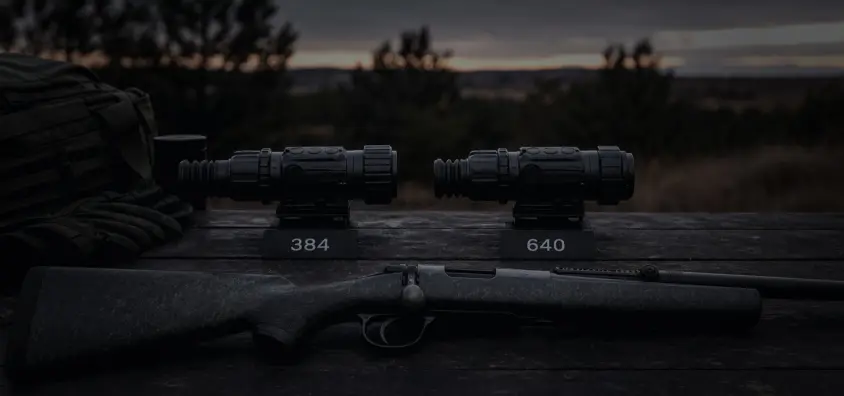
The question that many potential thermal scope buyers will eventually ask themselves is the following – should I buy 384 thermal scope or should I go for more expensive 640 scope instead? The short answer would be that 640 thermal scope provides more information, more usable digital zoom, and better identification capabilities at distance. But that is only one part of the puzzle.
A good 384 thermal scope would work much better for hog hunting, predator control, feeding station work, and farm use. On the other hand, 640 would be a preferable choice for people hunting open fields, longer-distance coyotes, using digital zoom regularly, or interested in maximum image detail their budget can provide. The final verdict would depend on several key factors like how far hunters shoot, which animals they prefer, how much magnification they might need, and if detailed image comes before price.
What Does 384 and 640 Really Stand For?
These numbers refer to the thermal scope sensor resolution.
To illustrate it, let us take a quick look at the basic specifications.
For instance, 384×288 thermal scope sensor features 110,592 pixels.
640×480 sensor includes 307,200 pixels.
And a 640×512 sensor offers 327,680 pixels.
In general, one can conclude that 640-class sensor would provide almost three times as much thermal information as compared to 384×288 one.
From the practical standpoint, resolution usually means more pixels, more image information, better edge definition, more background separation, and therefore, more reliable target identification capabilities.
Still, there are several other factors playing role here like lens size, pixel pitch, NETD, display technology, image processing, magnification, field of view, focusing capabilities, humidity, and terrain.
That is why sometimes 384 thermal scope can beat a weaker 640 scope in specific conditions. Nevertheless, if we speak about properly-designed devices, a 640 thermal scope will always offer more information.
Why 640 Thermal Scopes Provide Clearer Image
First of all, 640 resolution means more thermal pixels to play with. And this works like this.
First of all, it means better animal shape and size visualization. Hunters could spot not just a warm spot on the screen, but more of a coyote silhouette.
Secondly, better background separation would help hunters see more detail and distinguish a coyote from warm rocks or ground.
Thirdly, better thermal scope resolution allows hunters to use digital zoom more efficiently. This feature must not be confused with optical magnification as the former simply zooms in on the original image provided by the thermal sensor. Hence, the more detailed thermal sensor, the higher quality picture will become after digital zoom application.
And this is one of the main selling points of 640 thermal scopes.
While 384 might work just fine at default magnification, it will usually provide poor results after applying digital zoom. On the contrary, a 640 thermal scope would allow hunters to zoom without sacrificing too much of the picture.
When 384 Resolves All Issues
There are several cases when 384 is enough.
For instance, hunters, working with hogs inside typical field distances, will usually not require higher resolution. Hogs are bigger than coyotes, easier to recognize in thermal scope, and often hunted inside shorter hunting distances near feeders or in crop fields. Therefore, hunters do not necessarily need to pay extra money for additional thermal detail.
Also, 384 would be a preferable resolution for hunters dealing with predator control, farm protection, and other cases involving closer distances up to 150 yards.
Let us review two examples.
According to its manufacturer, AGM RattlerV2 35-384 features 384×288 sensor, 35mm germanium lens, 3x magnification, 50Hz refresh rate, and up to 1,800 m/yd detection range. And Sightmark’s Wraith Mini 2-16×35 Thermal includes 384×288 resolution, 35mm germanium lens, 2x magnification, 13-degree FOV, and up to 1,400 yards detection range.
As you see, these models might not look as impressive in comparison to top-tier 640 devices, but can do excellent work if distances and requirements are more modest.
Best for: hog hunting, newbie hunters, farms, feeders, etc.
Main trade-off: no better image detail compared to 640 scope.
When 640 is the Better Choice
There are several situations when hunters should think of buying more expensive 640 thermal scope.
One of them refers to coyote hunting when additional information will definitely prove itself. Coyotes are smaller than hogs, lower to the ground, and harder to identify inside thermal image. Thus, hunters who deal with them will not regret choosing more costly 640 models. Additionally, hunters should prefer them for hunting open fields or areas where predators tend to hide farther away from the spot.
Besides, if they often use digital zoom feature, higher resolution should be considered as well.
Let us review two devices again. According to its manufacturer, AGM RattlerV2 50-640 includes 640×512 sensor, 50mm germanium lens, 2.5x magnification, sensitivity sub-20 mK, and detection range up to 2,600 m/yd. Also, Pulsar Thermion 2 LRF XG50 offers 640×480 resolution, 12-micron pitch, 50mm F/1.0 germanium lens, magnification range from 3-24x, 50 Hz frame rate, AMOLED display, and a detection distance equal to 2,300 meters / 2,515 yards for deer-type objects.
These technical features illustrate the reason why 640 thermal scopes are more costly than 384 ones as they not only include a higher-resolution sensor, but better magnification, wider field of view, advanced lenses, better display technology, and improved image processing.
Best for: serious coyote hunting, hunting in wide open areas, predators at distance, etc.
Main trade-off: higher price.
It Pays Off to Focus on Scope Lens Instead of Sensor Resolution
Resolution alone is not sufficient for making a decision. For instance, a 640 sensor equipped with a small lens will probably provide a less clear picture compared to a 640 model with higher-magnification germanium lens.
Thus, lens size should be considered together with sensor resolution because it directly affects base magnification and field of view. For instance, 50mm lens provides higher magnification but a narrower field of view. Thus, 384 model with a 35mm lens might suit hog hunters better while 640 with 50mm lens would be used by people hunting coyotes in open areas.
Therefore, it pays off to pick the perfect combination of sensors and lenses for hunters’ specific requirements. Hunters hunting hogs near feeders will prefer lower base magnification while coyote hunters will opt for better magnification and 50mm lens.
NETD Plays Its Part As Well
NETD (noise equivalent temperature difference) is the parameter showing thermal sensitivity of the sensor and the whole device.
Lower NETD number stands for better thermal sensitivity.
This factor is crucial if hunters operate their scopes in bad thermal conditions – humidity, rain, fog, warm ground, poor thermal contrast. In such situations, good thermal sensitivity might save valuable thermal details for hunters.
Pulsar’s Talion XQ35 Pro, AGM’s RattlerV2 640, and Sightmark’s Wraith Mini 2-16×35 Thermal have their sensitivity below 40mK.
Again, these figures should be taken in connection with other characteristics. A good 384 with better NETD would probably provide more usable image than a poorer-quality 640 model in bad conditions. At the same time, good 640 thermal sensitivity would ensure better image clarity even in challenging circumstances.
Field of View – One Of The Main Trade-offs While Comparing 384 vs 640 Devices
As it was mentioned above, 640 device might provide higher field of view than 384 in case of comparable lens and magnification. This feature will certainly come in handy if hunters prefer wide fields and need more efficient scanning of their area.
Still, many 640 models utilize larger lenses and higher magnification settings. And in such cases, comparing 384 and 640 thermal scopes could be deceptive.
For instance, hunters hunting hogs will need a larger field of view because hogs usually travel in groups. And hunting them with a narrow view will become difficult. The same applies to hunting coyotes because they travel fast and change directions frequently. Thus, a 640 scope with too much base magnification will probably cause troubles for coyote hunters.
Thus, hunters should keep in mind that the best thermal scope is not always the one with the highest resolution. Instead, it is a scope offering better resolution in combination with a larger field of view.
Digital Zoom and Why 640 Provides Higher Performance
Digital zoom is one more advantage of 640 resolution.
As it was already stated, higher resolution provides more information for the scope which becomes apparent in case of applying digital zoom. At the same time, digital zoom simply zooms into the image already captured by the thermal sensor. Thus, zoomed-in image will lose detail faster than the original one.
Thus, a good 384 model could provide a rather clear picture even in zoomed-in mode, while a poor 384 model will fail at this task. On the other hand, the same operations will hardly create issues with 640 device.
Hence, if hunters use digital zoom regularly to make sure that they are shooting correct animals, higher resolution will be extremely beneficial.
384 vs 640 For Hog Hunting
Most hog hunters will find the best value in 384 devices.
Usually, hunters work in close proximity to hogs that are easier to recognize in thermal image. Moreover, hog hunting requires lower magnification as this animal is big and easy to distinguish inside thermal image.
Therefore, in most cases, hunters do not need 640 scope and would rather stick to less costly options like 384 model with 2x to 3x base magnification.
Verdict: buy 384 if budget is the issue. Otherwise, opt for better resolution.
384 vs 640 For Coyote Hunting
Coyote hunting would better suit hunters owning 640 devices.
Unlike hogs, coyotes are smaller, faster, harder to identify inside thermal scope, and may appear from longer distances. In such case, 384 will not provide sufficient resolution to reliably recognize them in thermal image. Therefore, if hunting coyotes regularly is the hunter’s primary goal, then 640 would prove itself better in the long run.
Verdict: hunters can work with 384 but 640 is a better bet.
384 vs 640 For Thermal Beginners
Most beginners should not buy the most expensive option available at once.
They have to master many skills including focus, proper color palette usage, NUC (non-uniformity correction), zeroing, batteries, scanning technique, proper animal recognition, etc. All these things cannot be purchased with money. A beginner hunter needs practice and patience to learn how thermal images change depending on temperature and atmospheric conditions.
Thus, it would be better for new hunters to begin their journey with 384 model first and gradually move on to more expensive scopes as they gain more experience. However, there is one exception when it makes sense to buy 640 from the very beginning.
If the hunter already knows they will be hunting in open areas or hunting coyotes at distance, they should buy higher resolution to avoid premature upgrades in the future.
Verdict: beginners should begin their experience with 384.
Is 640 Always the Better Choice?
Technically speaking, higher thermal scope resolution provides more information. But does it mean it is always a better investment? The answer is no.
Sometimes, 640 model is simply too expensive for hunters’ hunting style. And sometimes, additional features, better lenses, wider field of view, more complicated optics make no sense for a particular hunting scenario.
In addition, a good 384 model will be cheaper, lighter, and will provide better hunting opportunities to hunters without unnecessary complications.
Thus, in most cases, price and hunting habits play bigger roles than thermal resolution in the overall performance of a thermal device.
Price: Where Decisions Are Made
So, if the question is not whether 640 is better, then the question should be if 640 is worth extra money spent. Here, there are two different scenarios.
If the price gap is marginal, hunters should definitely buy 640. If the price is rather high, but distances are not too far, buying 384 would prove itself better in the long run.
This is why it is so important to know one’s budget before making the final decision. Hunters should not buy 640 just because the device features more megapixels. Hunters should choose the best combination of optics, sensors, and other features to get the best hunting experience.
Do not buy megapixels. Do not buy unnecessary features. Buy the best thermal scope for your hunting needs.
Final Verdict
If hunters hunt coyotes, work in open fields, hunt longer distances, or apply digital zoom often, a better resolution will bring them benefits. Hunters will enjoy better thermal detail, better target recognition, and better magnification capabilities.
However, in other hunting scenarios, 384 thermal scope will work fine. This type of device is still the best value for money for hunters hunting hogs in closer ranges, using feeders, working on farms, etc.
Conclusion:
If hunters shoot at distances less than 150 yards or work in farm areas, they should buy a good 384 scope and invest extra savings in mounting equipment and batteries. If they hunt longer distances, need more confidence while shooting, or simply desire better resolution, 640 scope would be a wise decision.
IR Illuminator Not Working With Night Vision? Beam, Battery, Focus and Compatibility Check.
Is your NV not turning on? Battery, Contacts, Mount and Tube-Safe Troubleshooting
Night Vision Collimation and Alignment: Fix Double Vision, Eye Strain and Dual-Tube Setup Issues