
April 6, 2026
How to Transport and Store Night Vision Gear: Best Practices
The Importance of Proper Gear Protection
Night vision goggles (NVGs) and thermal scopes represent significant financial investments, often costing more than the firearms they are mounted on. These devices contain fragile image intensifier tubes, sensitive microbolometers, and complex optical lens arrays. Unlike standard daytime rifle scopes constructed with thick aluminum tubes and glass lenses, electro-optics are highly susceptible to damage from impact, moisture, extreme temperatures, and light exposure. Implementing strict protocols for transport and storage is essential for maximizing the lifespan of these devices.
Hard Cases vs. Soft Bags for Transportation
The primary threat during transportation is blunt force trauma. Tossing a thermal scope loosely into a truck bed or range bag is a guaranteed method for destroying the internal display or misaligning the sensor.
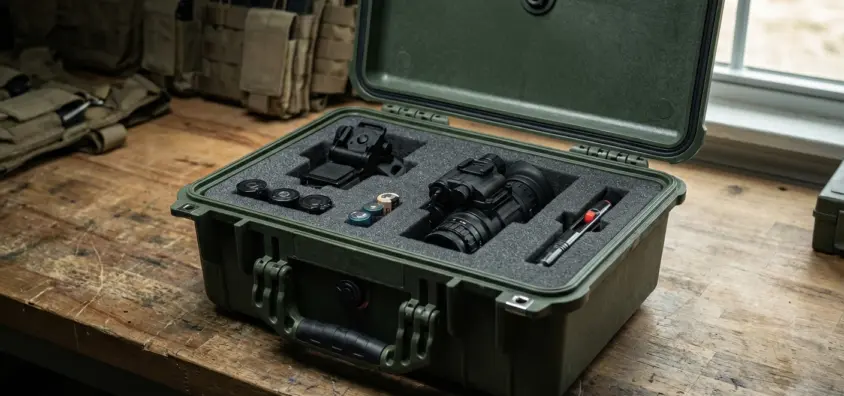
For vehicular transport, hard cases with custom-cut, closed-cell foam are mandatory. Brands like Pelican, Nanuk, and SKB offer waterproof, crushproof enclosures. According to equipment managers on the AR15.com night vision forum, closed-cell foam (often called Kaizen foam) is vastly superior to pluck-and-pull foam. Pluck foam degrades over time, absorbing moisture and leaving small foam particles that can scratch objective lenses. When cutting foam, ensure the optic fits snugly, preventing any lateral movement inside the case.
Soft bags are only acceptable for administrative transport—for instance, carrying the optic from the vehicle to the hunting stand. In these scenarios, padded tactical pouches designed specifically for NVGs, featuring rigid inserts to protect the objective lens, should be utilized.
Managing Moisture and Humidity
Moisture is the silent killer of electronic optics. While most high-end units boast IP67 waterproof ratings, prolonged exposure to high humidity during storage can cause internal condensation and fogging behind the lenses.
When storing gear in a hard case, a desiccant pack is absolutely necessary. Silica gel packs absorb ambient moisture trapped inside the case when closed. Reusable desiccant canisters that change color when saturated (and can be baked in an oven to recharge) are the preferred solution. A user on a thermal hunting subreddit documented a costly lesson: storing a sealed thermal scope in a damp basement for six months without a desiccant resulted in fungal growth on the inner lens element, requiring a complete factory rebuild.
Battery Storage Protocols
Leaving batteries inside night vision or thermal devices during long-term storage is a critical error. Alkaline batteries are prone to leaking, releasing corrosive acid that destroys battery compartment terminals and internal wiring. Lithium batteries (like CR123As) are less prone to leaking but can still slowly drain or swell under certain conditions.
Always remove batteries if the device will not be used for more than 48 hours. Store batteries in a dedicated, non-conductive plastic case to prevent accidental discharge or short circuits. For devices utilizing proprietary rechargeable battery packs, store the packs at roughly a 50% charge level in a cool, dry environment. Storing lithium-ion packs at 100% capacity for extended periods accelerates battery degradation.
Protecting Image Intensifier Tubes from Light
Analog night vision (Gen 2 and Gen 3) is highly vulnerable to light damage. Exposure to bright light sources (the sun, headlights, strong flashlights) while the unit is powered on will burn permanent blemishes into the phosphor screen. As detailed in our guide on phosphor burn and tube damage, these blemishes are irreversible.
Even when powered off, direct sunlight focused through the objective lens can burn the tube, functioning like a magnifying glass burning a leaf. Therefore, objective lens covers (daylight caps, bikini covers, or flip-up caps) must be secured at all times during transport and storage. Never leave a bare-lens PVS-14 resting on a table or dashboard during daylight hours.
Temperature Considerations
Extreme temperatures degrade performance and longevity. Avoid leaving electro-optics in enclosed vehicles during summer months, where cabin temperatures can exceed 140°F (60°C). Such heat can compromise the O-ring seals that ensure waterproofing and can warp internal polymer components.
Similarly, extreme cold impacts battery life and can cause LCD screens to become sluggish or unresponsive. When transporting gear in sub-zero environments, keep the optics inside the heated vehicle cabin rather than in the unheated bed of a truck or trunk. When bringing a cold optic into a warm room, leave it in its sealed case for several hours to allow it to acclimate slowly, preventing condensation from forming on the external and internal surfaces.
Conclusion
The longevity of night vision and thermal equipment is directly proportional to the care taken during its transport and storage. By investing in quality hard cases, managing moisture with desiccants, adhering to strict battery protocols, and protecting lenses from light and extreme temperatures, users ensure their optics remain reliable and effective for years of field use.
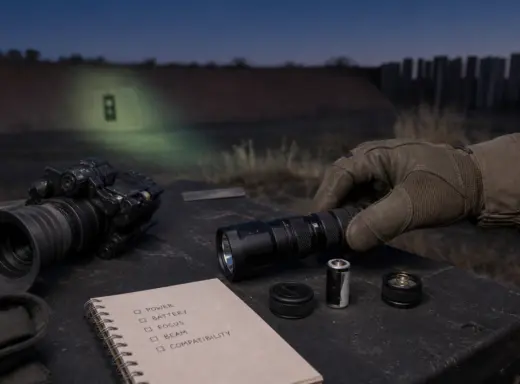
IR Illuminator Not Working With Night Vision? Beam, Battery, Focus and Compatibility Check.
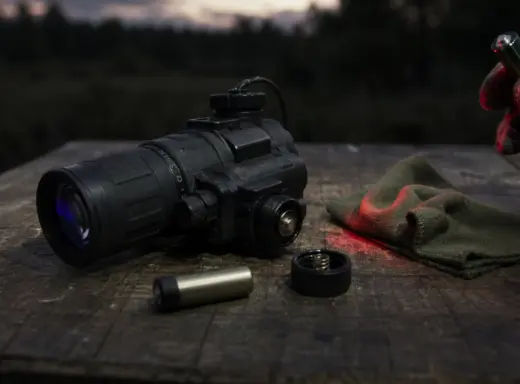
Is your NV not turning on? Battery, Contacts, Mount and Tube-Safe Troubleshooting
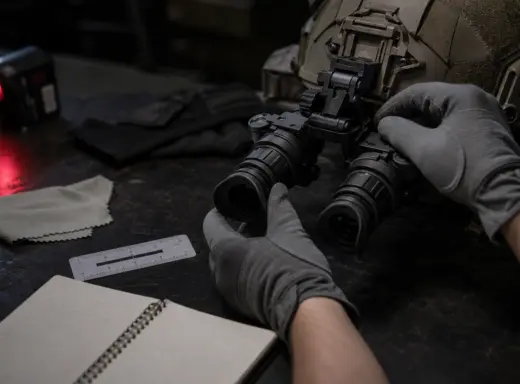
Night Vision Collimation and Alignment: Fix Double Vision, Eye Strain and Dual-Tube Setup Issues