
January 26, 2026
Movement & Scanning with Night Vision: The First Skills That Make NV Feel Natural
Night vision rewards discipline. These habits reduce errors in darkness and build confident movement without hype.
Why movement is the first real test
Most night vision discussions begin with specifications. Real outcomes begin with movement. The moment you start walking, your brain learns that night vision is not daylight vision: your field of view narrows, depth cues flatten, and small terrain changes become risks.
If you move like it is daytime, you will trip, overcorrect, or fatigue quickly. The goal is not to be fast — the goal is to be stable: stable posture, stable scanning, and stable decisions.
The rule that prevents most mistakes: Stop → Look → Move
The simplest operational pattern is also the most effective. Before terrain changes, you stop. You scan. Then you move in a short sequence. This keeps your mental map updated and prevents the common failure mode of walking while visually confused.
Think of it as friction. You are adding small pauses to remove large errors. Under NV, the smallest errors can cascade: you step awkwardly, your mount shifts, your focus changes, and now the image feels worse even though nothing is wrong with the device.
Lane scanning: near / mid / far
Many beginners stare far away because it feels exciting to see distant shapes. Others stare at their feet because they fear tripping. Both strategies fail. You need lane scanning: near lane for your next 2–3 steps, mid lane for your next 10–15 steps, and far lane for route decisions and movement detection.
Lane scanning is a rhythm. It becomes automatic with repetition. And once it becomes automatic, your confidence increases, because you are not guessing where the ground ends.
Focus discipline: functional clarity beats obsession
Under NV, you can waste your attention chasing perfect clarity. Perfect clarity is rarely necessary for safe movement. Functional clarity is enough: a stable image that lets you interpret obstacles and shapes without constant adjustment.
A helpful practice is to set focus for the mid lane. Use it for a full minute without adjusting. If the environment changes (entering canopy, moving into open space), then reassess deliberately. If it does not change, do not touch it.
Building a mental map: orientation checks
Orientation reduces panic. Panic happens when you cannot answer a simple question: where am I and where is my safe direction? Professionals anchor themselves constantly: one landmark, one boundary, one exit route.
You can do this every minute. It is a small habit with a huge payoff. It reduces the urge to over-adjust and makes your movement more decisive.
A 20-minute beginner session (repeatable)
Choose a safe environment: flat ground, minimal hazards, no traffic. Begin with five minutes of stationary scanning. Then do ten minutes of Stop → Look → Move in short sequences. End with five minutes of stationary scanning again to reset fatigue.
Do not chase distance. Chase repeatability. If you end the session calm, you succeeded.
Practical drill: Choose a safe, familiar area. Spend 10 minutes moving slowly using Stop → Look → Move. Every 3–5 steps, scan near/mid/far lanes. This is boring — and that is why it works. Boring routines create predictable performance.
Common failure mode: New users chase perfect image clarity and continuously adjust focus. This creates fatigue and reduces awareness. Instead: pick functional clarity, commit for a sequence, and only adjust after you’ve confirmed the environment changed.
Environmental variables: Moon phase, cloud cover, tree canopy, urban light spill, and reflective surfaces can change perceived performance. The right question is not “how far can I see?” but “how consistent is the image across the conditions I actually face?”
Safety note: NV reduces your field of view and changes depth cues. Do not sprint, do not drive, and do not attempt complex terrain until you have trained. Most accidents happen because users move like it’s daytime.
Decision model: Evaluate equipment by the outcome it creates: confidence, control, and reduced cognitive load. If the device forces constant management, it is failing its job even if the picture looks impressive for a moment.
Common beginner errors during movement
New users often move too quickly because the image feels empowering. This is a mistake. Night vision increases awareness but reduces certainty.
Another frequent error is tunnel vision — staring straight ahead while ignoring peripheral hazards. Conscious lane scanning corrects this.
Terrain interpretation under NV
Shadows behave differently at night. What looks like a depression may be flat ground. What looks flat may be a drop.
Professionals use micro-pauses to confirm terrain before committing weight.
Why confidence grows suddenly
Many users report a sudden confidence jump after several sessions. This is not the device improving — it is the brain adapting.
This adaptation only happens if sessions are calm and repeatable.
When not to move
There are moments when stopping completely is the safest decision: heavy fog, extreme fatigue, or unfamiliar terrain.
Night vision does not justify constant motion. Discipline does.
Skill progression timeline
Most users feel disoriented for the first 1–3 sessions.
By session five, scanning becomes automatic. By session ten, movement feels natural.
Why training beats upgrades
A user with disciplined movement on mid-tier equipment often outperforms an untrained user with premium optics.
This is why professionals prioritize routines before procurement. Before you take your equipment afield, review the night vision hunting laws by state — legal restrictions on NV use during hunting season vary significantly by state.
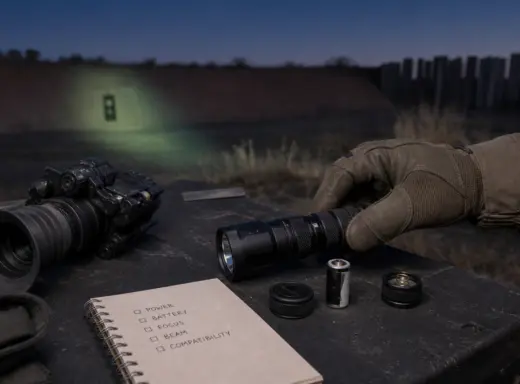
IR Illuminator Not Working With Night Vision? Beam, Battery, Focus and Compatibility Check.
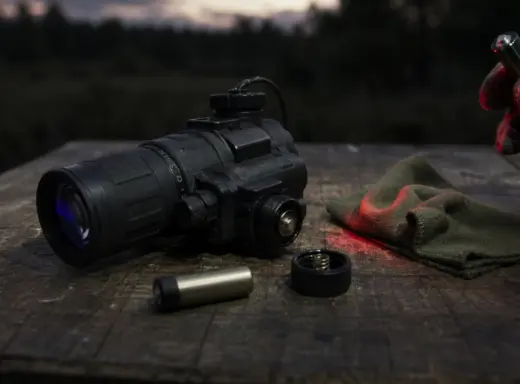
Is your NV not turning on? Battery, Contacts, Mount and Tube-Safe Troubleshooting
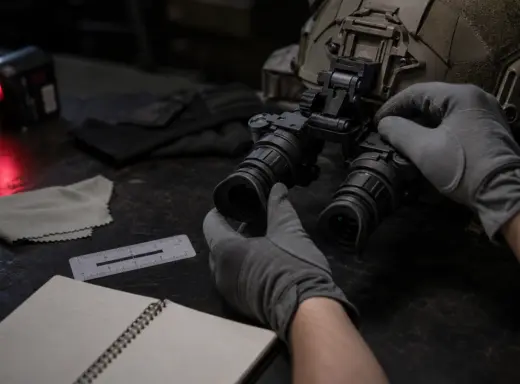
Night Vision Collimation and Alignment: Fix Double Vision, Eye Strain and Dual-Tube Setup Issues