
March 18, 2026
Night Vision Hunting Laws by State: What Is Legal in 2026
The Basics: How States Treat Night Vision Equipment
Roughly 40% of U.S. states explicitly prohibit the use of night vision equipment for hunting. This figure comes from a multi-state analysis of hunting and trapping regulations compiled against state wildlife codes — not every state’s digest addresses it clearly, but those that do fall roughly into three categories:
Permissive: Night vision and thermal are allowed for certain species (typically predators and invasive species) during night hunting seasons. Many Southern and Western states fall here.
Restricted: Night vision may be allowed for some species or on some property types (often private land only), with mandatory permits or notification requirements.
Prohibited: Night vision and/or thermal are explicitly banned for all hunting, often with specific statutory language.
One complicating factor: “night vision” in some state codes refers specifically to image intensifier equipment (amplifying existing light), while thermal imaging is a separate category. States that prohibit electronic night vision equipment may or may not address thermal separately. Always check whether your state’s code distinguishes between the two technologies.
Northeast: Generally Restrictive
The northeastern states are among the most restrictive for night hunting in general, and night vision regulations follow that pattern.
Maine is the notable exception in this region. Coyote night hunting is permitted from December 16 through August 31. Hunters must obtain a night hunting permit ($4 for residents, $12 for non-residents). Artificial lights and thermal optics are authorized. In recent years, Maine added raccoons to the approved night hunting species list when combined with a valid trapping license.
New Hampshire allows night hunting for coyotes from January 1 through March 31. Artificial lights are permitted, but thermal imaging devices are explicitly prohibited. The state has discussed potential changes to thermal regulations but as of the 2025-2026 season, standard night vision and spotlights remain the legal methods.
New York permits coyote hunting from October 1 through March 31. However, the law prohibits “lights or vision-enhancing devices of any kind” during coyote night hunting. This effectively limits legal night coyote hunting to moonlit conditions. No vision enhancement — including night vision, thermal, or even a weapon-mounted light — is authorized.
Vermont limits night hunting to raccoons pursued with dogs during authorized seasons. All predator night hunting is prohibited.
Massachusetts, Connecticut, and Rhode Island maintain complete prohibitions on night hunting for all species. No movement toward expanded night hunting has been implemented in these states for the 2025-2026 season.
Pennsylvania prohibits night hunting for game animals. Limited exceptions exist for raccoons, opossums, and foxes during their respective seasons, but night vision or artificial lights are generally not addressed as authorized equipment.
Southeast: Most Permissive Region
Southeastern states have built some of the most hunter-friendly night regulations in the country, largely in response to feral hog populations and growing predator pressure on agricultural land.
Texas leads the nation in night hunting access. Year-round night hunting is permitted for feral hogs, coyotes, and other non-game animals on private land with landowner permission. The state places no restrictions on equipment for these species — thermal, night vision, lights, and all combinations are legal. Feral hog populations cause economic losses to Texas agriculture estimated at over $500 million annually according to Texas A&M AgriLife Extension research, and the state’s permissive regulations reflect a deliberate population management strategy.
Florida allows night hunting for coyotes, feral hogs, raccoons, opossums, and beavers year-round on private property with landowner permission. Recent regulatory updates explicitly authorized thermal imaging, removing previous ambiguity. Night hunting on Wildlife Management Areas has specific property-by-property rules — verify before hunting public land.
Georgia permits year-round feral hog night hunting on private land with a free permit available from the Department of Natural Resources. Coyote night hunting runs from March through October. Recent rule changes authorized all forms of thermal and night vision technology, removing prior restrictions on equipment type.
Alabama allows night hunting for feral hogs and coyotes on private land. A special permit is required ($15 resident, $51 non-resident). The season runs February 11 through November 1. Thermal imaging is explicitly authorized in current regulations.
South Carolina permits night hunting for feral hogs, coyotes, and armadillos year-round on private land with landowner permission. Hunters must notify the Department of Natural Resources at least 48 hours before hunting, providing location information. An online notification system is available. Night vision and thermal are not restricted in the current regulations for these species.
Mississippi and Louisiana both allow night hunting for feral hogs and coyotes on private land, generally without equipment restrictions for non-game species. Verify current regulations for specific parish/county-level rules in Louisiana, which can add restrictions beyond state-level codes.
Midwest: Mixed Regulations
Midwestern states show significant variation, often shaped by agricultural traditions and deer hunting culture.
Kansas requires a special Night Vision Equipment Permit for hunters using night vision devices. This is one of the few states with a specific NV permit system rather than a general night hunting authorization. Contact the Kansas Department of Wildlife and Parks for current permit requirements and authorized species.
Indiana mandates the use of a visible safety light when hunting at night. The specific device requirements are outlined in the current Indiana Hunting & Trapping Guide, and hunters using night vision in authorized situations must still comply with the safety light requirement.
Iowa, Minnesota, and Wisconsin generally restrict night hunting to furbearers and predators under specific permit conditions. Night vision equipment falls under “electronic light-gathering devices” in several of these state codes, which may be restricted separately from general artificial light rules.
Illinois has historically maintained stricter night hunting regulations. The state permits some predator and furbearer hunting at night but equipment restrictions apply. Night vision devices are addressed in the hunting digest — consult the current Illinois Digest for authorized methods.
Ohio and Michigan permit limited night hunting for coyotes, foxes, and other furbearers. Night vision regulations are equipment-specific in some districts. Michigan has seen enforcement action against hunters using prohibited electronic equipment — verifying county-level regulations before hunting is advisable.
West: Highly Variable
Western state regulations range from completely permissive (Nevada, Idaho for non-game) to some of the strictest in the country (Arizona).
Arizona has one of the most explicit prohibitions on night vision equipment in the country. State regulation R12-4-303 specifically prohibits: “Electronic night vision equipment, electronically enhanced light-gathering devices, thermal imaging devices or laser sights.” The exemptions are narrow: laser range finders, scopes with self-illuminating reticles, and fiber optic sights that do not project visible light onto an animal. If you’re hunting in Arizona with thermal or NV, you’re in violation of this regulation regardless of species.
Colorado prohibits the use of any electronic device not specified in legal methods of taking furbearers. This effectively bans night vision for hunting. Artificial light may be used for coyotes, foxes, bobcats, skunks, and beavers on private land, with a special permit required for public land — but electronic night vision enhancement is not authorized.
California technically allows night hunting for coyotes and foxes on privately-owned property, but restricts use of infrared or light-amplifying binoculars and scopes “at any time” for taking any wildlife. Infrared illuminators that emit non-visible IR light appear to be permitted under a separate provision, but the wording is complex and subject to interpretation. The safest approach in California is to contact the Department of Fish and Wildlife directly before using any electronic optical device for hunting.
Nevada is among the more permissive Western states for non-game species and predator control. Night hunting is allowed for coyotes and other predators, and night vision devices are generally not restricted for non-game species. Verify current regulations with Nevada Department of Wildlife.
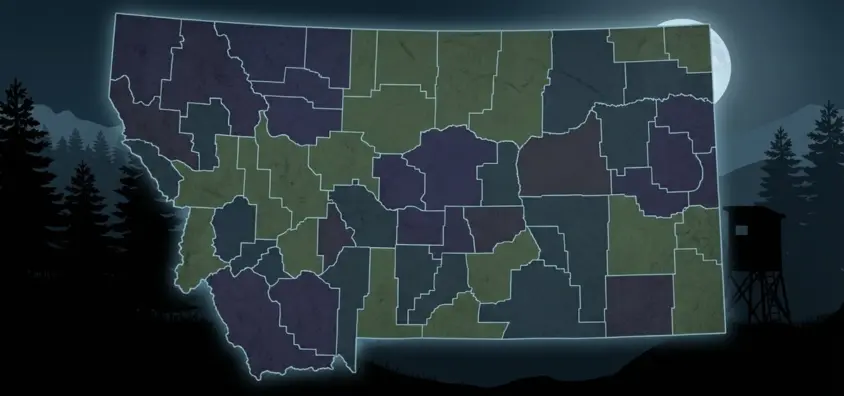
Idaho and Montana allow night hunting for predators and non-game species with relatively liberal equipment rules. Night vision is permitted for legal night hunting situations in both states, though specific species, seasons, and property-type rules apply.
Oregon has addressed night vision more explicitly in recent years following several high-profile enforcement cases. Night hunting for predators is permitted under specific conditions, but unauthorized use of night vision equipment has resulted in significant fines and equipment forfeiture in documented cases.
Utah and Wyoming have species-specific night hunting permissions for predators and furbearers. Equipment restrictions vary by species designation. Both states have updated their regulations to address thermal imaging as a distinct category from traditional night vision.
Alaska: Special Considerations
Alaska has no restrictions on shooting hours, but artificial light usage for hunting is restricted to November 1 through March 31 in specific units (7 and 9-26). The state treats night vision devices as a form of “artificial light” in some contexts. Some regulatory sections explicitly prohibit electronically enhanced night vision scopes, while other sections appear more permissive.
The Alaska Department of Fish and Game recommends contacting the local wildlife officer before purchasing or using a night vision scope for fur-bearer hunting. This is unusually candid advice from a state agency and reflects the genuine ambiguity in Alaska’s regulatory language.
What Happens When You Get It Wrong
Night vision violations are treated as wildlife law violations in most states, not minor infractions. Penalties typically include:
- Equipment confiscation (the night vision or thermal device is seized)
- Fines ranging from a few hundred dollars for minor violations to several thousand for aggravated violations
- License revocation in many states
- Criminal charges in states where nighttime poaching carries felony-level statutes
Oregon enforcement data documents multiple cases where hunters using unauthorized night vision equipment faced fines in the $5,000-$10,000 range plus equipment forfeiture. These are not hypothetical risks.
How to Verify Current Regulations
-
Your state’s hunting digest: Published annually by the wildlife agency. The most authoritative source for current-year regulations. Download the PDF rather than relying on third-party summaries.
-
Wildlife agency phone line: Most state agencies have a hunter education or enforcement line. Call and ask specifically about night vision or thermal equipment for your target species.
-
ITAR considerations: If you’re purchasing Gen 3 image intensifier equipment (American-made tubes), export control rules apply. Gen 3 NV equipment with certain tube specifications cannot be legally exported from the United States. This is a federal issue separate from state hunting laws.
-
County and municipality rules: Some states allow local governments to add restrictions beyond state-level rules. Private land adjacencies to populated areas may face additional ordinances.
Summary Table: Regional Overview
| Region | General Status | Notable Examples |
|---|---|---|
| Northeast | Restrictive | NY: no vision aids; ME: coyotes permitted with permit |
| Southeast | Permissive | TX: no restrictions for hogs/coyotes; FL/GA: thermal authorized |
| Midwest | Mixed | KS: NV permit required; IN: safety light mandatory |
| West | Variable | AZ: all NV/thermal banned; NV/ID: more permissive |
| Alaska | Complex | Contact local officer before hunting |
This guide reflects regulation status as of early 2026. Regulations change annually in many states. For authoritative guidance, consult your state’s current hunting digest or contact the state wildlife agency directly before each season.
For more on how night vision and thermal technologies work, see How Thermal Imaging Works and Gen 1 vs Gen 2 vs Gen 3 Night Vision Explained at NVGuide USA.
IR Illuminator Not Working With Night Vision? Beam, Battery, Focus and Compatibility Check.
Is your NV not turning on? Battery, Contacts, Mount and Tube-Safe Troubleshooting
Night Vision Collimation and Alignment: Fix Double Vision, Eye Strain and Dual-Tube Setup Issues