
June 2, 2026
What Is Field of View in a Thermal Scope? Why Does It Matter for Hog and Coyote Hunting?
There are a few crucial thermal scope factors hunters usually consider first: detection range, sensor resolution, noise equivalent temperature difference (NETD), refresh rate, and sometimes lens size.
Field of view may not be among the primary numbers, but it becomes apparent when you use the scope actively. You will feel it immediately when trying to scan the area with your new riflescope or chasing fast-moving hogs, looking for coyotes circling around at the edge of the image, or trying to find the perfect spot to set the trail camera.
Field of view is one of the critical thermal scope metrics, and in some cases, it is the most important factor. Let us explain what exactly is field of view, how it is measured, how it is related to the other parameters, and how to choose the right field of view for your needs.
What Is Field of View in a Thermal Scope?
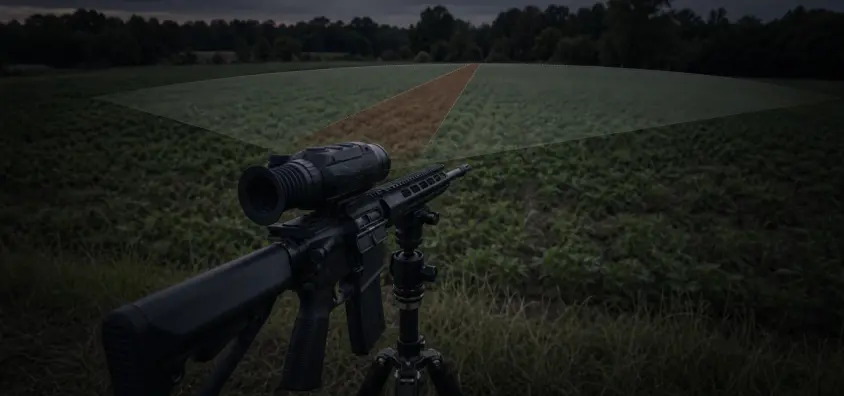
Field of view (sometimes called FoV) defines how much you can see through the scope.
Most manufacturers measure field of view in either degrees or feet at 100 yards/meters at 100 meters. A wide field of view means you can see more of the surrounding area through your optic.
On the other hand, a narrower field of view means you see less but get more image scale and magnification. That is how narrow optics make the images more zoomed in while wide scopes show a bigger scene but less target scale.
For example, a wider thermal scope will be great for scanning and following multiple hogs that move in the area and appear from different sides.
A more zoomed-in riflescope can be more useful when hunting farther or smaller targets but may become more challenging when dealing with moving animals up close.
Why More Range Does Not Always Mean Easier Hunting
More hunting scope range often comes with several key changes:
- Larger lens and higher magnification
- Smaller field of view
- Slower scanning speed
These factors mean that while your scope can now detect or inspect animals at greater ranges, it will take more time to track them and aim accurately. Moreover, it might be harder to locate the prey initially since you can see less of the surroundings.
In other words, more range does not always make things better in the field. More range does not automatically mean more efficient hunting.
For that, the hunter needs enough reach but also sufficient FOV, resolution, and target size detection. All these factors depend on the specific hunting scenario.
Field of View vs Detection Range: Key Differences
Field of view describes how much you can see at once through the scope.
Detection range is how far you can spot a heat signature of your target under specific conditions.
These are two different metrics and cannot be compared directly. For instance, a narrow long-range thermal optic will detect an object farther but will be harder to scan due to reduced field of view.
It will be harder to detect animals coming up from the sides since the visible area becomes smaller, while at close ranges, a wider thermal scope will show more of the surrounding area and let you scan more easily.
So when choosing between various thermal scopes, detection range alone does not tell you the whole story. It would be best to take other factors into account as well, such as field of view, base magnification, sensor format, identification distance, and others.
How Lens Size Affects the Image Scale
There is a direct relation between lens size and field of view.
Usually, a smaller lens corresponds to a wider field of view, and a longer lens results in a more narrow angle. The exact connection depends on many variables, but the key rule remains the same.
That is why narrow riflescopes tend to see farther, while wide optics offer better scanning opportunities at the cost of reduced range.
To illustrate that, we can look at the specifications for the AGM RattlerV2 640 series: the 35-640 model has a field of view of 12.5° x 10.0° with the base magnification of 2x. The 50-640 variant features a narrower field of view of 8.8° x 7.0° and higher base magnification of 2.5x. They use the same 640×512 sensor.
Does it mean that one lens is better than another? Of course not. Both options have their pros and cons, and choosing between them depends on the specific hunting conditions. However, you can see that increased range and magnification come at the price of FOV.
How Does Sensor Resolution Impact Field of View?
Lens size is a vital aspect of FOV and the entire optical system, but it is not the only variable that affects FOV. The other one is sensor format.
For example, if two optics have the same lens size, they can feature slightly different field of views due to various sensor formats, pixel pitch, optical and digital designs, and internal processing.
Let us take two 35mm thermal riflescopes, for instance. According to Sightmark, the Wraith Mini 2-16×35 Thermal features a 35mm thermal optic with a field of view of 13 degrees.
However, according to B&H, the Bering Optics Super Hogster R has a 35mm lens as well but an FOV of 7.5° x 5.7°. These two optics have quite different field of views despite using the same size of lenses.
Even more differences are evident when looking at Pulsar’s Thermion 2 LRF series. For example, Thermion 2 LRF XG50 uses a 640×480 sensor and 50mm F/1.0 lens, and features an 8.8° horizontal FOV. The Thermion 2 LRF XL50 uses the same 50mm lens, but it has a 1024×768 sensor that lets the scope provide an image with a 14° horizontal FOV.
So it is clear that lens size and sensor format play key roles in FOV, so hunters have to compare them individually.
How Base Magnification Affects the Image Size
Magnification determines how much closer the image seems to the user and, at the same time, how much area it covers.
Base magnification is the starting level of magnification that determines image scaling, while digital zoom multiplies the effect. So the lower the base magnification, the wider the field of view.
Base magnification depends on various factors, including lens and sensor size, but hunters need to consider it regardless of those. It is also crucial for selecting field of view.
For example, when it comes to hunting hogs at close range, hunters can usually use 1.5-3x base magnification and still get enough details for accurate aiming. At the same time, base magnification of 2.5-4x can be more convenient for hunting coyotes in open fields because of higher distance and smaller target.
However, if a hunter uses too much base magnification, then when animals approach, it might become harder to scan and acquire the target quickly enough. If you have too much zoom, you see less of the surrounding area but more of the distant objects. This is why base magnification has to match your target.
Can Digital Zoom Replace Wide Field of View?
No, digital zoom cannot replace wide FOV.
While digital zoom lets you multiply the effect of your base magnification, it does not add any new information. What is more, it makes scanning harder because you narrow the field of view even further.
Additionally, as with any type of zoom, when using digital zoom, you sacrifice some of the picture resolution. So digital zoom is good for observing faraway objects but useless for locating and acquiring them. For instance, hunters should avoid using digital zoom at close distances.
Wide vs Narrow Field of View for Hog Hunting
Wide field of view helps with hog hunting because:
- Hogs move in groups.
- They often scatter when you shoot.
- You may have to make follow-up shots.
All these features require you to see more of the surrounding area in order to locate the hogs effectively and determine the best aiming point.
Because of that, hunting hogs favors wide FOV, so a thermal scope for hog hunting should offer wide field of view.
Narrow vs Wide Field of View for Coyote Hunting
Coyote hunting requires a somewhat different approach because:
- Coyotes tend to be farther away than hogs.
- Coyotes are smaller and harder to spot.
- The hunter needs more zoom for distant identification.
For these reasons, narrow FOV with higher base magnification tends to suit coyote hunters better.
However, field of view still plays an important role because:
- You may have to locate the coyote in open fields.
- The animal may be running along the edges of the field.
- You need to see how the coyote approaches in case you plan to shoot from behind cover.
That is why hunters should choose appropriate field of view and base magnification for hunting coyotes, depending on their terrain.
Scanning With Wide vs Narrow Field of View
When the thermal scope becomes your scanner, it becomes more comfortable to use wide FOV because the hunter sees more of the surrounding area. He does not have to scan and track his targets as precisely and carefully as he would do otherwise.
If he uses the rifle-mounted scope as the scanner, he risks pointing the rifle wherever he looks. A handheld thermal monocular solves that problem.
But there is another solution: using a thermal monocular as a scanner. This way, hunters do not have to strain their eyes and narrow their field of view with the riflescope to scan large territories.
Thus, field of view matters because it is connected to how the hunters scan for animals and, ultimately, how they detect the targets.
Close-Range Hunting vs Hunting in the Open
In close-range hunting, it is preferable to see more of the area, which is why wide FOV is better than a narrow one. Hunters deal with hogs and other game within 50-100 yards, so seeing the surroundings in full detail becomes more critical than increasing image scale.
At the same time, hunting in the open country implies that:
- Targets can be farther.
- Hunters should track fewer animals.
- Hunters need more image magnification to see targets clearly.
Hunting in wide-open spaces favors a narrow field of view, but only when combined with proper magnification and detection capabilities.
Wide vs Narrow Field of View for Identification Needs
Identification range defines how far and at which magnification the scope can recognize the target. For instance, in hunting, identifying hogs means recognizing their shape and distinguishing them from other animals.
Field of view, however, determines how many objects you see. For instance, a wide FOV helps the hunter see all nearby hogs, but when it comes to distant targets, hunters require more image magnification. In distant hunting, narrower FOV and higher image scale can help inspect targets at longer distances.
Therefore, field of view and detection distance do not determine each other, but they interact with one another. Hunters should consider this interaction when selecting scopes and setting up their rigs for hunting.
Wide vs Narrow FOV With Higher Resolution
Sensor resolution, like base magnification, depends on several factors, including the size of the lens. At the same time, it can greatly affect how the user perceives FOV.
Higher resolution means the scope provides more information, and, therefore, hunters can use higher levels of image magnification without sacrificing resolution.
That is why, when discussing wide vs narrow FOV, it is crucial to remember that higher resolution scopes provide hunters with more possibilities. For example, 384×288, 640×480, 640×512, and 1024×768 sensors provide different amounts of resolution data that allows different types of magnifications.
The Most Common FOV Buying Mistakes Hunters Do
There are several common mistakes made when choosing a thermal scope based on field of view.
First of all, people usually think that the biggest lens is the best. While 50mm can be good for certain applications, it will create problems if you are going to hunt close-range hogs, coyotes, and similar game in dense forests.
Another common mistake is focusing on detection range alone. While it is great to detect targets farther away, it means nothing if you cannot track them. This is where field of view and base magnification matter more than range.
A lot of hunters overlook base magnification when picking a thermal scope. Even if the scope is sharp and clear, the hunters will still have to scan and aim with high difficulty because the image will be too close to the eye of the hunter.
People also do not realize that not all 35mm thermal scopes provide the same field of view. For instance, 640 and 1024 resolution differs significantly and affects the final field of view provided by the scope.
The final thing to remember is that a thermal riflescope is used for tracking the targets that the hunter locates with another device, such as a monocular or handheld thermal scope.
Which Field of View Will Be the Best for Beginners?
For beginners, it would be best to avoid narrow thermal scopes unless you are sure that your terrain is suitable for that type of scopes. In that case, it would be safer to pick a wide or balanced field of view scope for the following reasons:
- They are easier to learn.
- It helps to understand the movements of animals.
- It is easier to locate them.
That is why beginners should focus on 25mm or 35mm lenses first. 35mm models are versatile and easy-to-use, while 25mm thermal scopes are great for hunting feeders and other close-range activities.
Of course, 50mm scopes can also be helpful for hunting coyotes in open country, but in this case, it would be better to familiarize yourself with FOV and magnification first.
Practical Tips to Help You Buy Scopes
Here are our tips for buying scopes based on the type of your hunting.
Wide FOV is recommended for:
- Hunters who hunt hogs
- Hunting feeders, woods, and creek bottoms
- Hunting close-range targets
- Hunting in tight brush or thick forests
Balanced FOV is great for:
- General-purpose riflescopes for various hunts
- Hogs and coyotes hunting
- Mixed terrains and hunting
Narrow FOV with higher magnification is optimal for:
- Hunters who hunt long-distance targets
- Hunting coyotes
- Hunting in the open
Monoculars and scanners can be used alongside the riflescope for better FOV.
Field of View for Hunting Is Important
Field of view is an essential parameter that determines whether you can use the scope efficiently. In fact, more range may become a burden if it comes with reduced FOV and higher magnification.
For that reason, hunters should select field of view that fits their requirements and hunting scenario perfectly.
Wide FOV is preferable when hunters have to deal with close game and lots of motion in the forest. A narrower FOV with higher magnification is better for distant targets, especially when the hunting area is open.
In some cases, however, hunters need both kinds of FOV, so they use thermal scanners or handheld monoculars together with thermal riflescopes.
FOV Is Just One of the Metrics You Need to Consider
When choosing thermal scopes, hunters tend to pay attention to detection range and forget about other parameters, including field of view. While it is nice to detect targets farther, it means nothing if you are unable to track and identify them.
That is why hunters should consider more factors to select a scope that suits their requirements.
IR Illuminator Not Working With Night Vision? Beam, Battery, Focus and Compatibility Check.
Is your NV not turning on? Battery, Contacts, Mount and Tube-Safe Troubleshooting
Night Vision Collimation and Alignment: Fix Double Vision, Eye Strain and Dual-Tube Setup Issues