

February 26, 2026
ITAR and Night Vision: What Civilians Need to Know
Legal information checked November 17, 2026. This article is general information, not legal advice. Export-control results depend on the exact item, its technical characteristics, destination, end user, end use, and applicable exceptions. Confirm your specific situation with the manufacturer, the responsible U.S. agency, or a qualified export-control attorney before travel or shipment.
ITAR questions about night vision are often reduced to a rule such as “all U.S.-made Gen 3 is ITAR” or “commercial thermal is always fine.” Neither shortcut is reliable. The controlling question is how the exact item is classified under the current U.S. Munitions List (USML) or Commerce Control List (CCL)—and, if it is controlled, whether the planned export is authorized.
The short answer
- Do not decide export status from generation, brand, country of assembly, or a seller’s marketing description alone.
- Some night-vision and infrared systems are described in USML Category XII. Other products may fall under the Export Administration Regulations (EAR), with a specific ECCN or EAR99 status.
- Taking a defense article out of the United States can be an export. Under ITAR, releasing technical data to a foreign person in the United States can also be a deemed export; the regulation defines that as a technical-data release, not simply as someone looking at a device.
- EAR license exceptions such as TMP and ITAR’s Canada provision have detailed conditions. Neither should be treated as blanket permission for a personal hunting trip.
ITAR and EAR: two different classification paths
ITAR is administered by the U.S. Department of State through the Directorate of Defense Trade Controls (DDTC). The USML identifies defense articles subject to ITAR. The EAR is administered by the U.S. Department of Commerce’s Bureau of Industry and Security (BIS); items subject to the EAR may be listed under an Export Control Classification Number (ECCN), or may be designated EAR99 if they are not described by an ECCN. EAR99 does not mean “uncontrolled in every situation”: destination, end-user, and end-use restrictions may still apply.
For an ITAR defense article, export approval is generally required before export unless a specific exemption applies. For an EAR item, the exporter must identify the ECCN (or confirm EAR99 status) and check the applicable license requirements and restrictions for the transaction. The agencies’ rules and the item’s actual technical specifications—not a general product category—determine the result.
Why “Gen 3” or “commercial” is not enough
USML Category XII covers particular fire-control, imaging, and guidance equipment. It includes, among other specified cases, certain head- or helmet-mounted systems employing autogated third-generation or higher image-intensifier tubes; certain weapon sights designed to mount to or withstand recoil from a weapon and incorporating specified image intensifiers or infrared features; and second-generation-and-greater image-intensifier tubes specially designed for articles controlled under the ITAR subchapter.
Category XII also includes certain imaging systems with an infrared focal plane array or infrared imaging camera that are specially designed for a military end user. These are technical and design-based descriptions, not a universal rule that every Gen 3 device is ITAR-controlled or every Gen 1/2 device is outside ITAR. Tube origin can be relevant, but it is not a complete classification test by itself. A specific model, configuration, intended design, component, and applicable USML paragraph may all matter. See the current USML Category XII text.
Thermal equipment also cannot be classified by a simple “commercial” label. Certain thermal cameras and related imaging products are covered by the EAR and can carry licensing requirements that vary by technical parameters, destination, end user, and end use. BIS’s rules include camera-specific requirements for certain thermal cameras described in ECCN 6A003.b.4.b and additional rules for some cameras intended for military end users or military commodities. These entries do not classify every thermal optic; the exact model and transaction must be checked.
What counts as an export—or a deemed export?
ITAR defines an export to include sending or taking a defense article out of the United States. It separately defines a deemed export as releasing or otherwise transferring technical data to a foreign person while in the United States. The rule also covers other listed conduct, including certain defense services. A foreign visitor’s presence or observation of a device, by itself, does not answer whether a deemed export occurred; the relevant question is whether controlled technical data was released or transferred. A demonstration or explanation can raise that issue depending on what it discloses, so do not assume either that any viewing is an export or that a hands-on demonstration is automatically harmless.
Read the current ITAR definition of “export” before relying on informal summaries.
A practical classification checklist before travel
- Identify the exact item. Record the manufacturer, complete model and configuration, tube or sensor details if available, serial number, and included components. A broad label such as “PVS-14,” “Gen 3,” or “thermal scope” may not be enough to classify a particular configuration.
- Ask the manufacturer or exporter for the classification in writing. For an EAR item, request its ECCN and verify that it applies to the exact model and current rules. BIS recommends starting with the manufacturer, then using the Commerce Control List and its order-of-review tools as appropriate.
- If ITAR-versus-EAR jurisdiction is unclear, use the official process. ITAR provides for a DDTC commodity-jurisdiction determination request. A product-page statement or dealer email is useful evidence to retain, but it is not a substitute for an official determination when the classification is genuinely uncertain.
- For an EAR item, check the transaction—not just the product. Use the ECCN’s license-requirements section together with the Commerce Country Chart and applicable end-use/end-user rules. Do not assume EAR99 or a license exception makes every destination or traveler eligible.
- For an ITAR item, confirm the authorization before departure. ITAR generally requires prior DDTC approval unless a specific exemption applies. Do not rely on an assumption that a temporary personal trip is exempt.
- Keep the decision trail. Retain the model information, written classification, destination and end-use review, and any applicable license or exemption documentation. If the classification or proposed use remains uncertain, leave the device in the United States until you receive qualified advice.
Does the ITAR Canada exemption let a U.S. traveler bring night vision to Canada?
Not automatically. ITAR § 126.5 permits certain temporary or permanent exports of specified unclassified USML defense articles to Canada without a license when its conditions are met—for example, qualifying end use in Canada by Canadian federal or provincial authorities acting officially, or by a Canadian-registered person, or return to the United States. The provision is subject to other ITAR requirements and stated exceptions. It is not a blanket “Canada is fine” rule for any U.S. owner, device, trip, or end use. Have the exact facts reviewed before relying on it.
For EAR items, a different analysis applies. License Exception TMP authorizes only specified temporary transactions and has conditions and exclusions; it is not a universal personal-use pass. Check the current TMP rule and the item’s classification before travel.
What enforcement cases do—and do not—show
Federal cases confirm that night-vision components and devices have been the subject of export-control prosecutions. In one case, Naum Morgovsky was sentenced in 2018 after admitting to an unlicensed scheme involving image-intensifier tubes and other night- and thermal-vision components sent to Russia. In another, a Chinese national was sentenced in 2016 after causing or attempting to cause the export of numerous controlled items, including more than 40 night-vision and thermal scopes, to China. These prosecutions involved their own evidence and circumstances; they do not establish that every consumer device is ITAR-controlled.
For willful violations of the Arms Export Control Act and its implementing rules, the statute provides a maximum criminal penalty of up to $1 million per violation or up to 20 years’ imprisonment, or both, upon conviction. Those are statutory maximums for willful violations—not automatic penalties or predictions of the outcome in any particular case.
Related NV Guide reading
For technical differences among image-intensifier generations, see our night-vision generations guide. For hunting rules that vary by state, see night-vision hunting laws by state. Neither guide determines whether a specific item may be exported.
Frequently asked questions
Are all U.S.-made Gen 3 night-vision devices ITAR-controlled?
No universal conclusion follows from “U.S.-made” or “Gen 3” alone. Category XII contains specific technical and design descriptions, and the exact system and configuration must be reviewed against the current USML.
Are Gen 1 or Gen 2 devices automatically outside ITAR?
No. The USML includes certain second-generation-and-greater tubes specially designed for controlled articles, as well as specified weapon sights. A generation label by itself is not a jurisdiction determination.
Is a commercially sold thermal scope automatically EAR99?
No. Some thermal cameras are controlled under the EAR, and specific items may require a license depending on their ECCN and transaction details. Ask the manufacturer for the exact classification and check current BIS rules.
Does License Exception TMP let me take any optic abroad for personal use?
No. TMP has defined eligible transactions, conditions, and exclusions. Whether it applies depends on the item, traveler, destination, and planned use. Verify the current rule and classification before travel.
Can I rely on the Canada exemption for a hunting trip?
Do not assume so. ITAR § 126.5 has eligibility, end-use, and other conditions; whether a particular traveler and trip qualify is fact-specific. Get qualified export-control advice before bringing a potentially controlled device across the border.
Primary authorities and case records
- 22 CFR § 121.1 — United States Munitions List, including Category XII — device and component descriptions.
- 22 CFR § 120.50 — Export — physical export, deemed export, and related definitions.
- 22 CFR § 120.12 — Commodity-jurisdiction determination requests — official State Department jurisdiction process.
- 22 CFR § 123.1 — Export or temporary-import licenses — general ITAR approval rule and exemptions.
- 22 CFR § 126.5 — Canadian exemptions — eligibility and conditions.
- BIS: Classify your item — ECCN classification steps and EAR99 caveat.
- 15 CFR § 738.4 — Determining whether an EAR license is required — ECCN and Country Chart process.
- 15 CFR § 740.9 — License Exception TMP — temporary export conditions and exclusions.
- 15 CFR § 742.6 — Regional-stability controls — destination-specific controls for certain thermal cameras.
- 15 CFR § 744.9 — Certain cameras and related components — additional military-end-user/end-use restrictions.
- 22 U.S.C. § 2778(c) — Criminal violations and punishment — statutory maximum for willful violations.
- U.S. Department of Justice: Morgovsky sentencing (2018) — case involving night-vision and thermal components.
- U.S. Department of Justice: Chen sentencing (2016) — case involving controlled night-vision and thermal scopes.
Disclaimer: This guide is for general informational purposes only and is not legal advice. It does not classify any particular device or determine whether a traveler, destination, end user, end use, license, or exemption qualifies. Export-control rules and agency interpretations can change. Consult the current regulations and a qualified export-control attorney for advice about a specific product or trip.
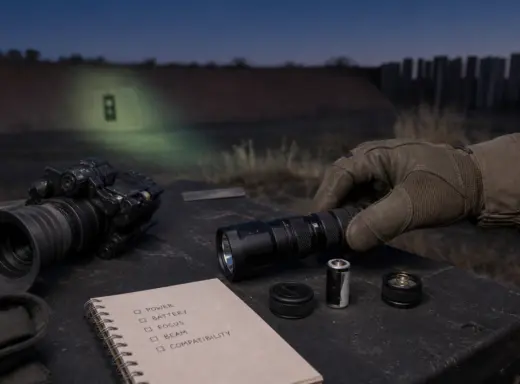
IR Illuminator Not Working With Night Vision? Beam, Battery, Focus and Compatibility Check.
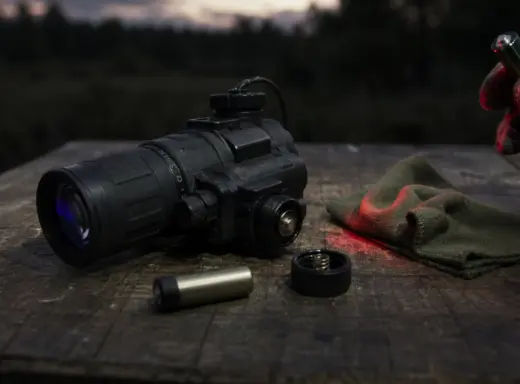
Is your NV not turning on? Battery, Contacts, Mount and Tube-Safe Troubleshooting
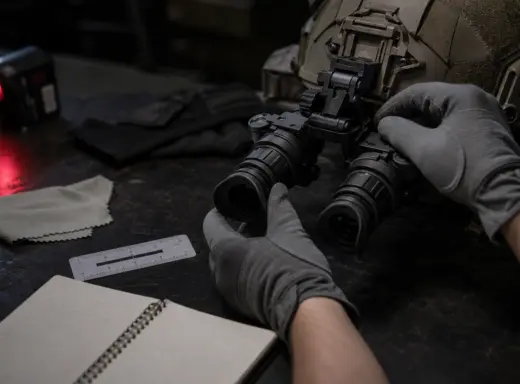
Night Vision Collimation and Alignment: Fix Double Vision, Eye Strain and Dual-Tube Setup Issues