
April 6, 2026
Thermal Refresh Rates Explained: 30Hz vs 50Hz vs 60Hz
What is a Thermal Refresh Rate?
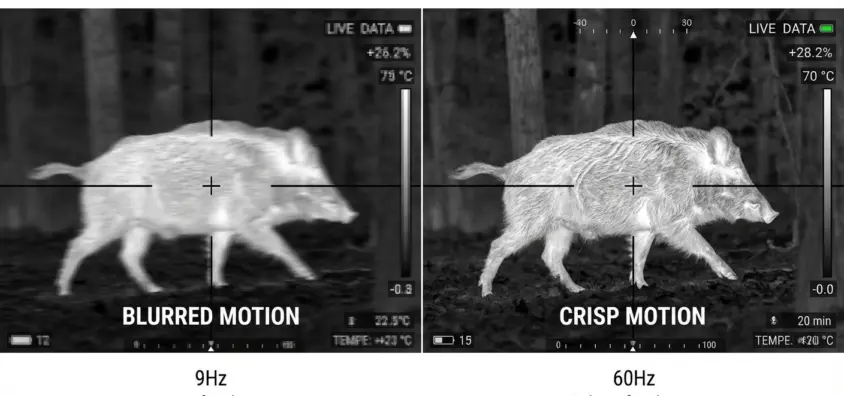
When researching thermal imaging devices, specifications like resolution and NETD often dominate the conversation. However, the refresh rate (measured in Hertz, or Hz) fundamentally dictates the user experience, particularly when observing dynamic scenes. The refresh rate indicates how many times per second the thermal sensor captures a new image and updates the digital display. A 30Hz rate updates 30 times per second, while a 60Hz rate updates 60 times per second. Understanding these differences is crucial for anyone using thermal optics for hunting, security, or observation.
30Hz: The Baseline for Entry-Level Optics
In the early days of commercial thermal imaging, 9Hz was common due to export restrictions (ITAR). Today, 30Hz serves as the functional baseline for entry-level and budget thermal optics. A 30Hz refresh rate is perfectly adequate for observing stationary objects or slow-moving targets. If you are scanning a field for bedded deer or monitoring a stationary perimeter, a 30Hz device will provide a clear, usable image without issue.
However, the limitations of 30Hz become apparent during rapid panning or when tracking fast-moving subjects. When a hunter sweeps a 30Hz scanner quickly across a tree line, the image will momentarily blur or “tear”—a phenomenon known as image latency. As detailed in our guide on how thermal imaging works, this latency requires the user to pause their scanning motion to allow the image to stabilize and render.
50Hz: The Global Standard for Hunting
A 50Hz refresh rate has become the industry standard for mid-to-high-tier thermal scopes, particularly those manufactured in Europe (such as Pulsar) or utilizing European sensor technology. A 50Hz update rate provides a fluid, real-time video feed that closely mimics natural vision.
For hunters, the transition from 30Hz to 50Hz is significant. According to field reports on Night Vision Forum UK, a 50Hz refresh rate eliminates the “ghosting” effect seen when tracking a running target. A user tracking a sprinting fox at 150 yards noted that the 50Hz scope allowed for precise lead calculation, whereas a 30Hz scope created a trailing blur behind the animal’s heat signature. This fluidity reduces eye strain during prolonged observation periods, making 50Hz the recommended minimum for active hunting applications.
60Hz: The Premium American Standard
Primarily found in units utilizing American-made cores (such as BAE or early FLIR sensors) and increasingly in high-end Asian imports, 60Hz represents the top tier of commercial refresh rates. The difference between 50Hz and 60Hz is subtle but noticeable in highly dynamic environments.
For operators conducting vehicle-borne scanning or tracking targets from moving platforms, 60Hz provides the sharpest edge retention. A 60Hz display ensures the reticle remains perfectly synchronized with the underlying thermal image, even under rapid recoil and immediate follow-through. While 50Hz is sufficient for 95% of hunting scenarios, 60Hz offers an absolute zero-latency experience.
The Impact of Refresh Rate on Eye Fatigue
Viewing a digital screen in complete darkness induces eye fatigue. A low refresh rate exacerbates this issue. When the brain processes a choppy, 30Hz image over several hours, it actively works to “fill in the gaps,” leading to headaches and dark adaptation issues.
Law enforcement officers operating thermal drone payloads frequently report severe eye strain when monitoring 30Hz feeds during extended manhunts. Upgrading to 50Hz or 60Hz monitors dramatically reduces cognitive load, allowing the observer to focus entirely on the scene details rather than processing the image presentation.
Refresh Rate vs. Sensor Calibration (NUC)
It is important to distinguish refresh rate from Non-Uniformity Correction (NUC). NUC is the mechanical process where the thermal device briefly freezes the image, drops an internal shutter, and calibrates the sensor to remove static artifacts and thermal noise.
A high refresh rate (60Hz) does not eliminate the need for NUC. Even with a 60Hz scope, the image will momentarily freeze during a calibration cycle. Some modern optics offer “shutterless” NUC technology, which performs calibration via software algorithms without freezing the image, maximizing the benefit of high refresh rates during critical moments.
Conclusion: Which Refresh Rate Do You Need?
If your primary use case involves stationary observation, property surveillance, or spotting slow-moving animals at bait sites, a 30Hz thermal device offers a cost-effective solution without compromising detection capability. However, if your application involves tracking running predators, rapid vehicle scanning, or extended hours behind the optic, prioritizing a 50Hz or 60Hz device is highly recommended to ensure accurate engagement and minimize eye fatigue.
IR Illuminator Not Working With Night Vision? Beam, Battery, Focus and Compatibility Check.
Is your NV not turning on? Battery, Contacts, Mount and Tube-Safe Troubleshooting
Night Vision Collimation and Alignment: Fix Double Vision, Eye Strain and Dual-Tube Setup Issues