
March 28, 2026
How Night Vision Affects Your Eyes: Dark Adaptation and Eye Fatigue
Night vision equipment does something unusual to the visual system that most users don’t fully understand until they’ve spent time in the field: it disrupts the same dark adaptation process that your eyes use to see in low light natively. Understanding this relationship makes you a more effective NV user and helps explain why some configuration choices — monocular vs. biocular, which eye to run NV on, how to transition back to unaided vision — matter more than they might seem.
This guide explains the optical and physiological mechanisms involved, and the practical field implications for hunters and tactical users. For context on night vision specifications and what the numbers on a spec sheet mean for actual performance, see the night vision specs guide. The night vision detection range guide covers how ambient light levels affect device performance.
Dark Adaptation: The Baseline Your NV Works Against
The human eye adapts to darkness through two mechanisms that operate on different timescales:
Cone adaptation (photopic → mesopic transition): In the first 5–10 minutes after entering darkness, cone cells in the central retina shift their sensitivity threshold. This covers the initial transition from bright to dim light. Cone cells handle color vision and fine detail.
Rod adaptation (mesopic → scotopic transition): The rod cells distributed throughout the peripheral retina contain rhodopsin (visual purple), a photosensitive protein that regenerates in darkness over 20–45 minutes. Full rod-based dark adaptation takes approximately 45 minutes of complete darkness to reach its peak sensitivity. Rods detect light-dark contrast but not color.
The combined effect is that after 45 minutes in near-darkness, the human eye can detect photons at levels roughly 1 million times lower than the daylight threshold. This is the unaided vision baseline you’re working with when you put on NV equipment.
What Image Intensifier Tubes Do to Dark Adaptation
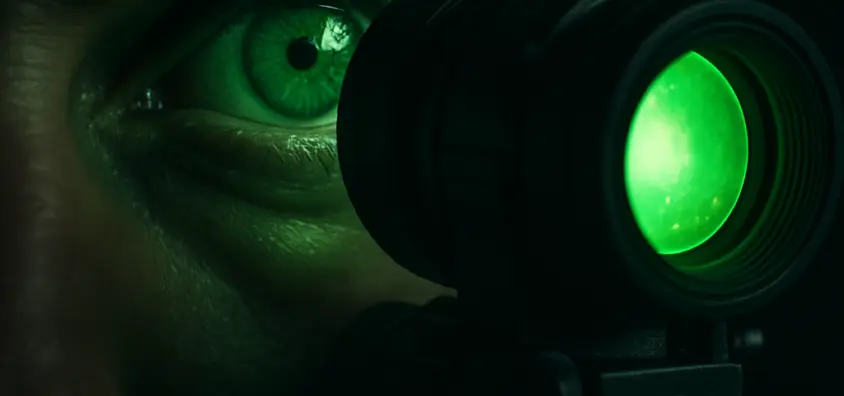
Here’s the part that catches users off guard: looking through an image intensifier tube disrupts dark adaptation in your NV eye.
Image intensifier tubes amplify available light and display it on a phosphor screen, which emits green light. That phosphor output — even though it’s dim compared to daylight — contains enough photon energy to partially reset the rhodopsin regeneration cycle in the viewing eye.
The practical consequence: if you run a monocular on your dominant eye for an extended period, then remove it and need to use that eye unaided in the dark, your dark adaptation in that eye may be 20–30% degraded for 10–15 minutes while rhodopsin regenerates.
This is why the standard military protocol runs monoculars on the non-dominant eye:
- Dominant eye remains adapted for unaided CQB
- NV eye handles detection and identification tasks
- Transitioning to unaided vision relies on the already-adapted dominant eye
For hunters, this translates to a practical recommendation: determine which eye you naturally favor for shooting and keep that eye off the NV tube.
Monocular vs. Biocular vs. Binocular: Visual Impact
Single Monocular (PVS-14 configuration)
A single monocular creates a rivalry between the two eyes that many new users find disorienting at first. One eye sees the amplified NV image; the other sees natural darkness. The brain struggles to suppress the non-dominant input, which produces visual confusion during the learning period.
After 4–8 hours of field use (typically 2–3 outings), most users adapt and the brain learns to prioritize the NV image. At this point the monocular configuration becomes natural and the dark-adapted free eye provides useful peripheral awareness.
The adaptation period is real — if you’re a new NV user going into a critical situation, plan for the fact that your depth perception and spatial awareness will be compromised until you’ve accumulated adaptation time.
Eye strain from monocular use comes primarily from the accommodation-vergence mismatch: your NV eye is focused at infinity (the image on the phosphor screen appears distant), while your free eye is focusing on near-field objects. This creates a neurological conflict that produces fatigue in extended use.
Biocular (PVS-7, GPNVG-18)
Biocular devices present the same amplified image to both eyes simultaneously from a single tube. This eliminates the rivalry problem but means both eyes experience the same phosphor illumination effect. Dark adaptation is degraded in both eyes equally when you remove the device.
Binoculars (separate tubes for each eye, true stereoscopic image) provide the best user experience and depth perception but come at significant cost — dual-tube systems typically run $8,000–$15,000+ for quality units.
Exit Pupil and Eye Relief: How They Affect Your Experience
Exit pupil (the diameter of the light cone exiting the eyepiece) should match your eye’s pupil diameter for maximum light transmission. At night, your fully dark-adapted pupil dilates to approximately 7mm. Most NV monoculars have an exit pupil of 7–12mm, which means some light is wasted but the full field of view is accessible without precise eye alignment.
Eye relief — the distance from the eyepiece lens at which the full image is visible — matters for rifle-mounted NV and for users who wear eyeglasses. Most monoculars have eye relief in the 25–30mm range. Glasses-wearers lose several mm of effective eye relief from the lens.
For helmet-mounted use, improper J-arm positioning that forces the eye too far or too close from the eyepiece creates eye strain from sustained effort to maintain the image. Correct J-arm setup positions the eyepiece at the unit’s specified eye relief when your head is in a natural position.
Green vs. White Phosphor: Does It Affect Eye Strain?
The phosphor color debate has practical relevance for eye fatigue:
Green phosphor (P43 phosphor, peak emission ~550nm): Green is located near the peak sensitivity of human scotopic vision under mesopic lighting. The eye’s rod cells are maximally sensitive in the 500–550nm range. This means green phosphor images appear brighter at given gain settings.
White phosphor (P45 phosphor): White phosphor distributes emission across a broader spectrum, producing a black-and-white image that more closely resembles natural vision. Users transitioning between NV and unaided vision report less perceptual confusion with white phosphor because the image contrast pattern is more similar to natural low-light vision.
Eye fatigue comparison: For extended use (3+ hours), white phosphor users typically report less eye strain. The green phosphor image’s narrow spectral peak creates a specific adaptation in the viewing eye that can make white light sources appear slightly pink for a short period after removal — this is a transient effect and resolves in minutes.
For hunting applications where NV is used for 1–4 hours in a session, the difference is minor. For extended operations, white phosphor has an ergonomic advantage. For a comprehensive breakdown see the white phosphor vs green phosphor guide.
Digital Night Vision and Eye Fatigue
Digital night vision scopes (CMOS sensor + display screen) produce eye fatigue through a different mechanism than image intensifier tubes. Instead of a phosphor screen, digital NV uses a miniature LCD or OLED display close to the eye.
Screen proximity: The screen is typically 2–3cm from the eye, requiring accommodation to a near focal distance. Looking through a digital NV scope for extended periods forces the eye to maintain focus at near distance, which fatigues the ciliary muscles — the same fatigue you experience from extended screen use.
Blue light from LCD panels: LCD displays emit significant blue light even when showing a predominantly white/gray image. Blue light (400–500nm) is more disruptive to melatonin production and dark adaptation than longer wavelengths. After extended use of a digital NV scope, users often report difficulty readapting to full darkness.
OLED vs. LCD: OLED displays in quality digital NV scopes emit less blue light at similar brightness levels and have better contrast, which allows lower display brightness settings that reduce overall fatigue.
Practical Field Protocols for Minimizing Eye Fatigue
1. Warm-up period. Before entering your hunting area, spend 15–20 minutes in complete darkness (or near-darkness) without NV to build initial dark adaptation. This maximizes your NV-free eye’s sensitivity and reduces the demand on the NV system.
2. Match illuminator power to range requirements. Running maximum IR output when it isn’t needed produces a brighter-than-necessary image on the phosphor screen. Dial back illuminator power to the minimum needed for the task.
3. Alternate eyes for extended sessions. If you must use NV for 4+ hours continuously, alternating which eye views the device distributes the dark adaptation impact. This requires practice.
4. Remove the device before transitioning to lighted environments. Removing NV while entering any lit area — even briefly — wastes the dark adaptation you’ve built. Cover the objective or put the device in standby before stepping into lit spaces.
5. Recovery period before unassisted shooting. If you remove NV and need to use unaided vision immediately, close the NV eye for 2–3 minutes while navigating with the dark-adapted free eye. Dark adaptation recovers faster in complete darkness.
Common Questions
Does using night vision damage your eyes?
No, image intensifier tubes do not emit ultraviolet or high-energy radiation that damages the retina. The phosphor output is low-intensity visible light. The only risk is direct exposure to bright lights through the device, which can cause temporary after-images. Quality NV devices include automatic brightness control and bright source protection to limit this.
Can I use night vision with one eye that has worse vision?
Night vision performance depends primarily on the device optics, not the user’s visual acuity. The eyepiece is a lens system that presents a focused image to the eye regardless of refractive error up to a point. Users with significant myopia or astigmatism may need to adjust focus settings; most monoculars have adjustable diopter settings.
How long does dark adaptation take to return after NV use?
After 30–60 minutes of continuous NV use in the viewing eye, full dark adaptation returns in approximately 15–20 minutes in complete darkness. The recovery is proportional to how long the eye was exposed to the phosphor image.
Summary
Night vision equipment and natural dark adaptation interact in ways that affect both your performance with the device and your unaided night vision. Running monoculars on the non-dominant eye, understanding the adaptation period for new users, managing illuminator power, and knowing how digital vs. analog displays affect different aspects of visual fatigue all contribute to effective NV use.
These aren’t abstract concerns — they’re the difference between a NV setup that integrates smoothly into a night hunt and one that leaves you stumbling back to the truck with impaired unaided vision and eye strain. Understand the system, and it performs.
For more foundational NV knowledge, the night vision beginners guide and the understanding night vision limits guide cover the practical and technical factors that matter most for new buyers.
IR Illuminator Not Working With Night Vision? Beam, Battery, Focus and Compatibility Check.
Is your NV not turning on? Battery, Contacts, Mount and Tube-Safe Troubleshooting
Night Vision Collimation and Alignment: Fix Double Vision, Eye Strain and Dual-Tube Setup Issues