
March 24, 2026
Night Vision Detection Range: How Far Can You Actually See?
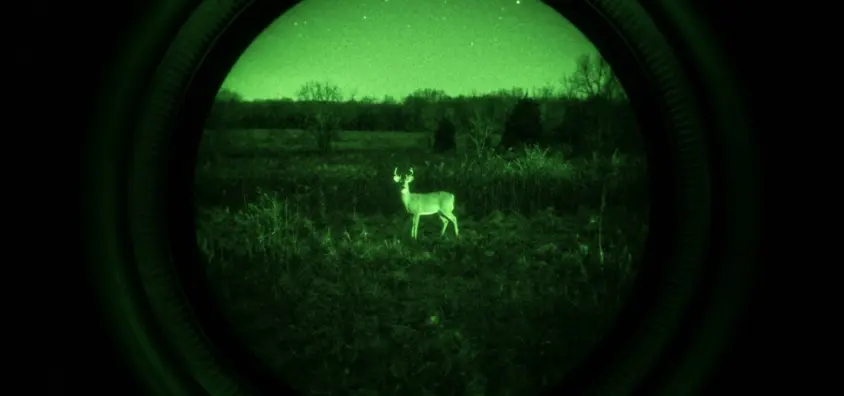
Manufacturers advertise detection ranges that look impressive on a spec sheet: 1,350 meters, 2,000 meters, sometimes more. Then hunters get into the field and wonder why they can’t reliably identify what they’re looking at beyond 200 yards. The gap between advertised range and real-world performance is one of the most common disappointments in night optics. Understanding why that gap exists — and what range numbers actually mean — changes how you shop and how you hunt.
This guide explains how night vision and thermal detection range actually works, what the limiting factors are in real conditions, and how to calculate what you can realistically expect from a given piece of equipment. For context on how these specs fit into a complete purchase decision, see our guide to How to Read Night Vision Specs.
Detection Range vs Recognition Range vs Identification Range
This is the first and most important distinction. Manufacturers advertise detection range. Hunters need recognition or identification range. These are very different numbers.
Detection Range
Detection range is how far away you can see that something is there — a heat signature, a movement, a shape. This is what the spec sheet cites. At detection range, you know something exists. You do not know what it is.
Recognition Range
Recognition range is how far away you can determine the general class of object — is it an animal or a vehicle? Is it a deer-sized animal or a dog-sized animal? This is typically 50-60% of detection range for thermal, and somewhat shorter for image intensifier night vision depending on ambient light.
Identification Range
Identification range is how far away you can confidently confirm the target — is it a buck or a doe? A hog or a dog? A person or an animal? This is the range that actually matters for ethical, legal hunting. Identification range typically runs 25-35% of the advertised detection range.
Example with a 384-sensor thermal scope (1,350m detection range):
- Detection: 1,350m — you see a heat signature
- Recognition: 650-800m — you see a large animal shape
- Identification: 300-400m — you can confirm it’s a hog, not a dog
This is why experienced hunters with quality thermal optics hold their ethical maximum engagement distance to 300-400 yards, even when the spec sheet claims detection past 1,000 meters.
Factors That Limit Real-World Night Vision Range
For Image Intensifier Night Vision (Gen 2/Gen 3)
Ambient Light Level
Image intensifier (II) night vision amplifies available light. No light means no image. The moon phase, cloud cover, and whether you’re under tree canopy versus in open fields dramatically affects how far you can see. A Gen 3 PVS-14 performs very differently on a full moon in an open field versus a new moon in dense hardwoods.
Starlight-rated performance (what manufacturers quote as the standard) assumes 0.002 lux — roughly a clear night with full stars but no moon. Add moonlight and performance improves substantially. Remove ambient light entirely (overcast, dense cover, underground) and the device stops working without an IR illuminator.
IR Illuminator Range
When ambient light is insufficient, IR illuminators extend usable range. The key variable: IR illuminator range rarely matches the optic’s advertised range. A built-in IR illuminator on a budget monocular might push usable range to 80-100 yards in darkness. A quality external illuminator like the MAWL can extend that to 300+ yards. Our IR Illuminator Guide covers this in detail.
Sensor Resolution and Tube Quality
Higher line pairs per millimeter (lp/mm) and better signal-to-noise ratio (SNR) on the image intensifier tube directly translate to greater recognition and identification range at equivalent light levels. A Gen 3 tube with 64+ lp/mm performs noticeably better than a 52 lp/mm tube when trying to identify what you’re looking at at 200+ yards.
Objective Lens Size
A larger objective lens collects more light. A 50mm objective on a night vision scope gathers significantly more photons than a 27mm objective. For low-light use, that difference is meaningful in practical detection and recognition range.
For Thermal Imaging
Atmospheric Conditions
Thermal radiation is affected by humidity, fog, rain, and temperature inversions. Fog and heavy rain can reduce thermal detection range by 30-50% compared to ideal conditions. On humid summer nights in the Southeast, don’t expect spec-sheet range performance. Our guide to Night Vision in Bad Weather covers how different conditions affect thermal performance.
Temperature Differential
Thermal imaging detects heat differences. When ambient temperature is close to the target’s temperature — common in hot summer conditions when ground temperature approaches animal body temperature — contrast decreases and detection range drops. This is why thermal works better on cold nights than warm ones.
Detector NETD (Noise Equivalent Temperature Difference)
NETD measures how small a temperature difference the detector can distinguish. A 25mk NETD sensor picks up a 0.025°C temperature difference. A 50mk sensor needs a 0.05°C difference. In real conditions with partial target concealment or warm ambient temperatures, lower NETD directly translates to longer recognition and identification range.
Pixel Pitch and Resolution
12μm pixel pitch with 640×480 resolution produces a much finer image than 17μm with 384×288 resolution when viewed at the same magnification. Higher resolution sensors produce usable images at greater magnification, extending recognition range. This is why 640-sensor thermals identify targets at 400 yards when 384-sensor units show a pixelated blob.
How to Calculate Your Actual Usable Range
A more useful framework than relying on advertised detection range:
For Thermal Scopes
Take the advertised man-sized detection range and apply these multipliers for identification range:
- Ideal conditions (cold night, clear air, large warm target): multiply by 0.35-0.40
- Average conditions (moderate temperature, some humidity): multiply by 0.25-0.30
- Poor conditions (warm night, foggy, partial target concealment): multiply by 0.15-0.20
Example: Scope with 1,800m detection range in average conditions: 1,800 × 0.27 = 490 yards practical identification range. Round down for ethical hunting: call it 400 yards.
For Image Intensifier Night Vision
Range is more variable because it depends heavily on light conditions. A rough practical framework:
- Clear night, full moon, open terrain: 300-400+ yards with quality Gen 3
- Clear night, quarter moon, open terrain: 150-250 yards
- No moon, no illuminator, open terrain: 50-100 yards (identification range)
- Dense cover regardless of moon: add IR illuminator, cut open-terrain range by 40%
Night Vision Range by Generation
Gen 1
Maximum practical identification range in good conditions: 75-100 yards. In poor conditions, usable range drops to 30-50 yards. Gen 1 requires an IR illuminator in anything less than bright moonlight. The advertised ranges for Gen 1 units assume a very large target (vehicle-sized) in ideal conditions. For hunting application, plan around 75 yards as the functional ceiling.
Gen 2 / Gen 2+
Identification range in good conditions: 150-200 yards. With a quality external IR illuminator, extended to 200-250 yards. Auto-gated Gen 2+ tubes perform significantly better than standard Gen 2 in variable light conditions. Our guide to Auto-Gated Tubes explains why that matters.
Gen 3
Identification range in good conditions (moonlit, open terrain): 250-350+ yards depending on tube quality and objective size. In poor conditions with IR illuminator: 150-200 yards. The best Gen 3 tubes (white phosphor, 64+ lp/mm, high SNR) approach 400 yards on large targets like deer in favorable conditions.
Digital Night Vision
Digital NV range is highly variable by sensor quality. Budget digital units: 50-100 yards identification range. Quality digital NV with large sensors: 150-200 yards in good conditions. Digital units benefit significantly from IR illuminators because the camera sensor responds well to near-infrared wavelengths.
Practical Range Guidance for Common Hunting Scenarios
Hog Hunting in Open Fields
With quality thermal (384-sensor, sub-35mk NETD): 200-300 yards ethical identification range in average conditions. With a 640-sensor thermal: 300-400 yards. These are the numbers hunters actually use for shot decisions, not the 1,000+ meter detection figures from spec sheets.
Deer Hunting in Hardwoods
Cover reduces effective range dramatically. Even with excellent thermal, tree trunks, brush, and foliage block thermal radiation. In dense hardwoods, 100-150 yards is a realistic practical identification range regardless of what the spec sheet says. The limiting factor is terrain, not optic capability.
Predator Calling (Coyote, Fox)
Coyotes are smaller targets than deer or hogs. Detection range is roughly 60-70% of deer-sized target detection range. Identification range for a coyote vs a dog at 200 yards requires better sensor quality than identifying a deer at the same range. Plan accordingly — don’t push range when identifying small predators.
Home and Property Monitoring
For security monitoring, detection range is more relevant than identification range — you need to see that something is there and respond. Detection range numbers on the spec sheet are appropriate for this use case. Thermal cameras mounted at fixed positions can monitor large property areas effectively at distances where identification would be difficult with a handheld unit.
Frequently Asked Questions
Why does my thermal scope seem to underperform its advertised range?
You’re probably comparing your identification range in field conditions against the manufacturer’s detection range in controlled conditions. Apply the multipliers above to get a realistic expectation. Also check whether your conditions were ideal — high humidity and warm nights significantly reduce thermal range.
Does magnification increase effective range?
Higher magnification helps you see more detail at a given distance, but it also narrows your field of view and amplifies any image noise or pixelation. There is a practical maximum magnification for a given sensor resolution — beyond it, you’re magnifying noise rather than information. For 384-sensor thermals, the sweet spot is typically 4-8x. For 640-sensor thermals, 8-16x is workable.
How does IR illuminator range compare to passive night vision range?
An IR illuminator effectively creates an active night vision system. A quality illuminator like the MAWL-C1+ provides usable range extension to 300+ yards for Gen 3 NV. The key limitation: IR illuminators are visible to other people using night vision equipment. For tactical or security applications, this matters. For hunting, it generally doesn’t.
Do I need Gen 3 for hunting, or is Gen 2 enough?
For most hunting at under 200 yards with some ambient light, quality Gen 2+ tubes perform adequately. The upgrade to Gen 3 is most justified when you’re hunting in very dark conditions, need identification range beyond 200 yards, or are in applications where the extra sensitivity is a meaningful tactical advantage. Our complete comparison is in the Gen 2 vs Gen 3 Night Vision Guide.
Summary
Advertised detection range is not the number you hunt by. Recognition range — knowing what kind of animal you’re looking at — is roughly half of detection range. Identification range — confirming the target for an ethical shot — is 25-35% of the advertised figure in average conditions. In challenging conditions (warm nights, fog, dense cover), cut those numbers further.
Buy optics based on the identification range you actually need for your terrain and hunting application. Match the sensor quality and NETD to your conditions, not to the best-case scenario on the spec sheet. That approach produces less disappointment and better hunting outcomes than chasing the highest advertised range number at a given price point.
IR Illuminator Not Working With Night Vision? Beam, Battery, Focus and Compatibility Check.
Is your NV not turning on? Battery, Contacts, Mount and Tube-Safe Troubleshooting
Night Vision Collimation and Alignment: Fix Double Vision, Eye Strain and Dual-Tube Setup Issues