
May 21, 2026
Clip-On Thermal vs Dedicated Thermal Scope: Which Should You Buy?
Choosing between a clip-on thermal and a dedicated thermal scope is one of the most important decisions hunters face before buying thermal optics. Both systems can work. Both can detect heat. Both can help you hunt at night. But they are not built for the same kind of shooter.
A clip-on thermal mounts in front of your daytime riflescope and turns your existing optic into a thermal aiming system. A dedicated thermal scope replaces your daytime optic entirely and works as a complete standalone thermal riflescope.
The right choice depends on how you hunt, how many rifles you use, how much you care about keeping your daytime optic, and whether you want a simple all-in-one thermal setup or a more flexible system.
For many hunters, a dedicated thermal scope is easier to use. For others, especially those who already have a good daytime optic and want to keep the same rifle setup, a clip-on thermal makes more sense.
What Is a Clip-On Thermal?
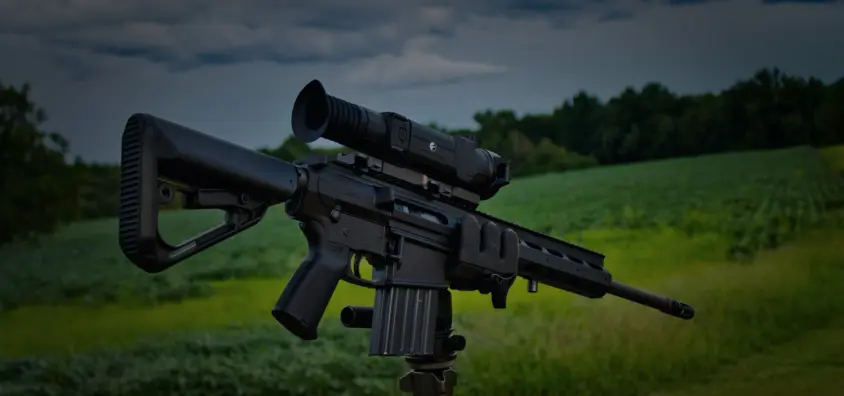
A clip-on thermal is a thermal imaging device mounted in front of a traditional daytime riflescope. Instead of looking directly through a thermal riflescope, you look through your normal scope and see the thermal image projected through the clip-on device.
That is the main advantage: you can keep your existing rifle, daytime optic, reticle, eye relief, and shooting position. In theory, you can move the clip-on between compatible rifles or use the same rifle during the day and at night with fewer changes.
Pulsar describes the Krypton 2 as a front attachment that transforms daytime optics into a thermal imaging riflescope. AGM describes the Rattler TC35-384 as a clip-on system that quickly transforms day optics into a thermal imaging device without special tools or equipment. Burris positions the BTC35 v3 as a thermal clip-on that can switch from standard to thermal use quickly.
That tells you the core idea: clip-ons are about preserving your daytime optic while adding thermal capability.
What Is a Dedicated Thermal Scope?
A dedicated thermal scope is a complete thermal riflescope. It has its own sensor, display, reticle, mount, controls, zeroing system, and usually several weapon profiles or zeroing distances.
Examples include the AGM RattlerV2 35-384, Pulsar Thermion 2 LRF XG50, and ATN ThOR 5 640. These are not attachments. They are full thermal scopes designed to sit directly on the rifle.
The advantage is simplicity. You mount the thermal scope, zero it, configure your reticle and profiles, and use it as the primary optic. There is no daytime scope in the optical path, no front-adapter alignment, and no need to balance two separate optical systems.
Dedicated thermal scopes also tend to include more hunting-focused features in one package: onboard recording, multiple reticles, zeroing profiles, laser rangefinding, ballistic tools, recoil-activated video, Wi-Fi, and integrated battery systems depending on model.
Clip-On Thermal: Main Advantages
The biggest advantage of a clip-on thermal is that it lets you keep your daytime scope. If you already have a high-quality LPVO, hunting scope, or precision optic that you trust, a clip-on can preserve that setup.
That matters if your rifle is already dialed in. You do not need to remove your daytime scope every time you want to hunt at night. You also do not need to rebuild the rifle around a dedicated thermal scope.
A clip-on can also be useful if you want one thermal device to support more than one rifle. With the right mounts and compatible day optics, one clip-on can be moved across different setups more easily than a dedicated scope that must be zeroed like a primary optic.
Another advantage is daytime flexibility. You can use the rifle normally during the day, then add the clip-on for night hunting. For hunters who do not want a rifle permanently set up as a thermal gun, this is a serious benefit.
Clip-ons can also work well for hunters who prefer their existing reticle. Instead of learning a new thermal reticle system, you continue using the aiming reference in your daytime optic.
Clip-On Thermal: Main Tradeoffs
The main downside of a clip-on thermal is complexity. You are not using one optic. You are combining a thermal device, an adapter or mount, and a daytime scope. Alignment matters. Mount quality matters. Optical compatibility matters.
Magnification is another limitation. Clip-ons generally work best with lower to moderate magnification on the daytime scope. If you crank the daytime optic too high, the thermal image can become less useful because you are magnifying the display image rather than resolving more true thermal detail.
That is why clip-ons often make more sense with LPVOs or moderate-power optics than with very high-magnification scopes. If your hunting style requires constant high zoom, a dedicated thermal scope may feel cleaner and more predictable.
Weight and balance can also be an issue. A clip-on sits in front of the daytime scope, adding weight forward on the rifle. Pulsar emphasizes compact and balanced design on the Krypton 2, but any front-mounted thermal device still changes the feel of the rifle.
Battery life varies by model. Burris lists the BTC35 v3 with two rechargeable 16340/RCR123 batteries and a battery life of at least 2 hours at 25°C. Pulsar lists up to 11 hours for Krypton 2 with its rechargeable battery system. That is a large difference, so battery system should be checked model by model.
Dedicated Thermal Scope: Main Advantages
A dedicated thermal scope is usually the simpler option. You mount one optic, zero one optic, and use one system. For many hunters, that is the better field experience.
Dedicated thermal scopes are also designed around thermal shooting from the start. The reticle, display, controls, zeroing profiles, recording, and battery system are all built into the same device.
The AGM RattlerV2 35-384, for example, is a dedicated thermal riflescope with a 384×288 sensor, 35mm lens, 3x base magnification, 50Hz refresh rate, and 1,800 m/yd detection range for a 6-foot object. It includes rechargeable batteries and a standard rifle-scope package.
The Pulsar Thermion 2 LRF XG50 goes further, combining a 640×480 sensor, 50mm F/1.0 objective lens, 3-24x magnification, 50Hz frame rate, AMOLED display, integrated laser rangefinder, multiple zeroing profiles, and waterproof housing.
Dedicated thermals are also often better for hunters who want built-in recording or smart features. ATN’s ThOR 5 platform focuses heavily on video recording, streaming, recoil-activated video, reticles, and ballistic tools. That kind of integrated feature set is easier to manage in a dedicated scope than in a clip-on setup.
Dedicated Thermal Scope: Main Tradeoffs
The biggest tradeoff is that a dedicated thermal scope replaces your daytime optic. If you want to use the same rifle during the day with traditional glass, you either need to swap optics, use a different rifle, or accept that the rifle is now primarily a thermal setup.
That can be fine for hunters who have a dedicated night rifle. It is less convenient for hunters who want one rifle to do everything.
Another tradeoff is zero management. A dedicated thermal scope must be zeroed as its own optic. Many models support multiple profiles, but if you move the scope between rifles, you still need to manage those profiles carefully.
Dedicated thermal scopes can also be expensive. A good 384-core model is often more affordable than a premium clip-on, but high-end 640 dedicated scopes with rangefinding and smart features can cost significantly more.
Which Is Better for Hog Hunting?
For hog hunting, a dedicated thermal scope is usually the easiest recommendation. Hogs are often hunted around feeders, fields, or brush lines, and many hunters use rifles dedicated to night hunting.
A dedicated thermal scope gives you faster operation, cleaner ergonomics, and fewer alignment issues. If you are scanning and shooting at realistic hog hunting distances, a good 384-core dedicated scope can be enough.
A clip-on can still make sense if you want to keep your daytime optic or use the same rifle for day and night. But for most hog hunters who want the simplest setup, dedicated thermal is easier.
Which Is Better for Coyote Hunting?
Coyote hunting is more mixed. Coyotes are smaller than hogs and often hang up farther out. Identification and field of view both matter.
A dedicated thermal scope with the right base magnification can be excellent for coyotes, especially if it has a 384 or 640 sensor and a good lens. The AGM RattlerV2 35-384, Pulsar Thermion 2 LRF XG50, and ATN ThOR 5 640 are examples of dedicated systems that make sense for predator hunting depending on budget and feature needs.
A clip-on can be useful for coyote hunters who already use a daytime optic with a reticle they trust. It can also be useful when a hunter wants to keep one rifle configured for both daytime and nighttime predator control.
The main warning is magnification. If your daytime optic is too high-powered, the clip-on may not feel as clean as a dedicated thermal scope at night.
Which Is Better for Multiple Rifles?
This is where clip-ons become more attractive.
If you own several rifles with good daytime optics and want one thermal device that can move between them, a clip-on may be the smarter investment. You can preserve each rifle’s daytime configuration and add thermal when needed.
However, this only works well if the rifles and optics are compatible with the clip-on’s mounting system and optical requirements. You still need to confirm alignment, height, adapter fit, and practical point-of-impact behavior.
A dedicated thermal scope can also move between rifles if it supports multiple zero profiles, but it still functions as the primary optic. That means removing and remounting it, managing profiles, and accepting that each rifle becomes a thermal rifle when the scope is installed.
Which Is Better for Beginners?
Most beginners should start with a dedicated thermal scope.
The reason is simple: fewer variables. A beginner already has to learn thermal image interpretation, zeroing, palettes, focus, refresh behavior, battery management, and target identification. Adding clip-on alignment, adapter fit, daytime optic compatibility, and magnification limits makes the learning curve steeper.
A dedicated thermal scope is more straightforward. Mount it, zero it, learn the controls, and hunt.
A clip-on is better for a more experienced shooter who already understands their daytime optic and wants thermal capability without changing the rifle’s core setup.
Image Quality: Clip-On vs Dedicated
Image quality depends more on sensor, lens, NETD, processing, display, and magnification than on the format alone.
A high-end clip-on can outperform a cheap dedicated thermal scope. A premium dedicated scope can outperform an entry-level clip-on. The format matters, but it is not the only factor.
For example, the Pulsar Krypton 2 FXG50 uses a higher-resolution sensor than many older or budget clip-ons, while the Burris BTC35 v3 uses a 400×300 VOX sensor with 50Hz refresh rate and 35mm F1.0 lens. AGM’s Rattler TC35-384 uses a 384×288 sensor and 35mm lens.
Dedicated thermal scopes also vary widely. A 384-core AGM RattlerV2 35-384 is a practical mid-range hunting optic, while a Pulsar Thermion 2 LRF XG50 is a premium 640-core rangefinding riflescope.
The better comparison is not “clip-on vs dedicated” in general. The better comparison is model vs model at the same price and intended use.
Zeroing and Point of Impact
Dedicated thermal scopes are usually easier to zero because the thermal optic is the sighting system. You adjust the thermal reticle to match point of impact.
Clip-ons are different. Since the daytime scope remains the aiming system, the clip-on needs to align properly with the day optic and preserve point of impact as much as possible. Good clip-ons are designed for this, but mounting and alignment quality matter.
Pulsar highlights point-of-impact stability for the Krypton 2. AGM describes the Rattler TC35-384 as a quick transformation system for day optics. Burris provides specific mounting interfaces for the BTC35 v3.
Still, clip-on users should expect more setup discipline. Mounting consistency matters more than with a dedicated thermal scope.
Battery Life and Field Use
Battery life varies too much to generalize by format.
Pulsar lists up to 11 hours for Krypton 2. AGM’s RattlerV2 dedicated scopes can also offer long runtime depending on model and battery system. Burris lists the BTC35 v3 at at least 2 hours at 25°C with two rechargeable 16340/RCR123 batteries. Pulsar Thermion 2 LRF XG50 lists 10 hours with its battery system.
The practical lesson is simple: do not assume clip-on or dedicated automatically wins on battery. Check the exact model.
For long night hunts, external power support, replaceable batteries, and quick-swap battery systems matter more than the category name.
Final Verdict
Buy a clip-on thermal if you already have a good daytime scope, want to keep your rifle’s normal setup, and value flexibility across day and night use. A clip-on also makes sense if you want one thermal device that can support multiple compatible rifles.
Buy a dedicated thermal scope if you want the simplest hunting setup, cleaner controls, easier zeroing, integrated reticles, recording, multiple profiles, and fewer mounting variables. For most new thermal hunters, this is the safer choice.
For hog hunting, a dedicated thermal scope is usually the most practical option. For coyote hunting, either format can work, but a dedicated scope is easier while a clip-on is more flexible. For hunters with multiple rifles and expensive daytime optics, a clip-on deserves serious consideration.
The real decision is not just clip-on vs dedicated. It is how you actually hunt. If you want flexibility, choose clip-on. If you want simplicity, choose dedicated thermal. If you want the best answer, compare specific models at the same price and match the optic to your rifle, terrain, and hunting distance.
IR Illuminator Not Working With Night Vision? Beam, Battery, Focus and Compatibility Check.
Is your NV not turning on? Battery, Contacts, Mount and Tube-Safe Troubleshooting
Night Vision Collimation and Alignment: Fix Double Vision, Eye Strain and Dual-Tube Setup Issues