
May 25, 2026
The Top Thermal Monoculars to Scan Before Taking the Shot
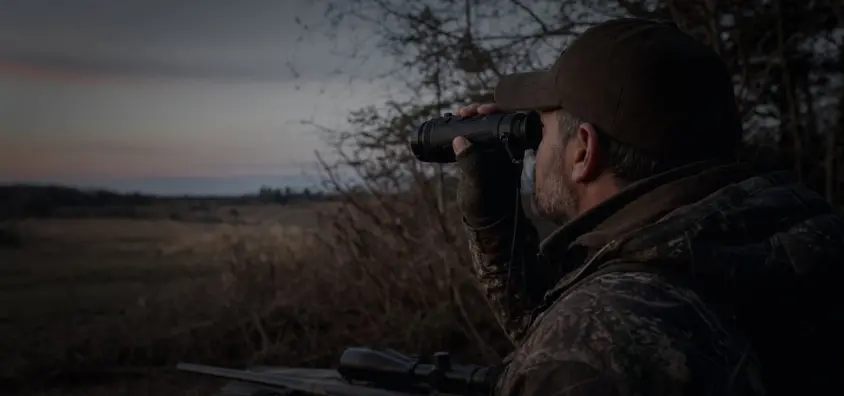
A thermal rifle scope is made for aiming at targets. Thermal monoculars are made for scanning and locating animals before mounting the rifle.
The difference matters more than some hunters realize. When using the scope mounted on your rifle, you have to direct the barrel wherever you look, and that’s uncomfortable, tiring, and inconvenient. By using a handheld thermal monocular, you will scan any area and move your rifle only if needed.
Thermal monoculars can be as useful as scopes themselves when hog hunting, hunting predators, and observing other animals on your property.
What is the best thermal monocular for scanning before the shot? Not all hunters need a costly 640-class device, and there are many other factors to consider.
Why Use Thermal Monocular for Scanning Before the Shot?
A thermal monocular allows scanning for heat signatures before shouldering a hunting rifle.
That is the main advantage of monoculars when scanning. There is no need to aim everywhere, because a scanner makes you observe the whole area and move when necessary.
Moreover, a handheld thermal can be used in different ways. You can set it up in a blind to scan all the way to your target, you can check for animals along fences, feeders, creek bottoms, and bushes – a scanner is handy in almost any situation before the shot.
This is one of the reasons why many thermal hunters use two pieces of equipment: a monocular for scanning, and a scope for aiming.
Detection vs. Identification Still Matters
Manufacturers list the detection range of their thermal monoculars.
The detection range shows how far the monocular can spot the heat signature. It doesn’t necessarily mean that you can identify the animal.
Monoculars can detect deer-sized objects even at 1,300 meters, 1,800 meters or more, but the identification range depends on sensor resolution, objective lens diameter, NETD, magnification, field of view, background temperature, humidity, and your skills when identifying thermal images.
For scanning, detection is helpful because it points you to an interesting direction. But when hunting, the identification range is crucial.
What to Look for in a Great Thermal Monocular to Scan?
For scanning before the shot, you need a comfortable, quick, and wide enough thermal monocular.
Field of view is critical for a scanning monocular, because it is the ability to detect everything around you in the current moment. Narrow field of view can make scanning uncomfortable.
Base magnification of a scanner is also important. While some monoculars have high base magnification, lower magnification is recommended for scanning because it makes the field of view wider. However, if you scan in open spaces, high magnification may be more comfortable.
Sensor resolution should be considered as well. Lower-resolution monoculars can detect a heat signature, but 384×288 and 640×512 sensors provide better details for confident identification.
Battery life is important too, because thermal monoculars can be used for many hours in order to spot an animal.
Quick Comparison of the Best Thermal Monoculars for Scanning Before the Shot
Best overall: Pulsar Axion 2 XQ35 Pro.
Sensor: 384×288.
Lens: 35mm F/1.0.
Best for: serious hunters who want an advanced scanning monocular.
Main disadvantage: higher price compared to entry-level devices.
Best value: AGM Taipan TM15-384.
Sensor: 384×288.
Lens: 15mm.
Best for: hunting and scanning at moderate distance.
Main disadvantage: less detection range.
Best wide-field of view monocular: HIKMICRO Lynx Pro LH19.
Sensor: 384×288.
Lens: 19mm F/1.0.
Best for: mixed terrain hunting and scanning.
Main disadvantage: less detailed images at long distance.
Best premium 640-class monocular: InfiRay Finder FH35R V2.
Sensor: 640×512.
Lens: 35mm F/0.9.
Best for: premium scanning and hunting at long distance.
Main disadvantage: costly.
Best budget option: ATN OTS LT & OTS-XLT series.
Sensor: varies by model.
Lens: varies by model.
Best for: thermal detection on a budget.
Main disadvantage: low-res sensors may not be ideal for hunting.
Best recreation thermal monocular: FLIR Scout TKx.
Sensor: entry-level thermal detector.
Lens: compact fixed-lens design.
Best for: observation and short-distance scanning.
Main disadvantage: identification range is limited.
The Best Monocular to Scan Before the Shot: Pulsar Axion 2 XQ35 Pro
The Pulsar Axion 2 XQ35 Pro is one of the best scanners for hunting on a premium level.
This monocular is designed with a 384×288 sensor, 17-micron pixel pitch, NETD below 25 mK, 35mm F/1.0 objective lens, 2x to 8x magnification, 50Hz frame rate, AMOLED display, detection range of 1,300 meters, IPX7 protection, and up to 11 hours of battery life.
All of these parameters make it perfect for scanning, because 384×288 is enough resolution for many applications, and a 35mm lens makes it more reachable. Low base magnification makes it easy to use for scanning at reasonable range.
The battery life is also important for a scanning device because many hours of scanning are necessary for a successful hunt.
Best for: serious hunters who need an effective thermal scanning monocular and don’t mind buying premium-level hardware.
Main drawback: it is quite costly compared to low-budget devices, plus it is 384 rather than 640.
Top Budget-Friendly Monocular for Scanning: AGM Taipan TM15-384
When looking for a 384 scanning monocular for hunters on a budget, we recommend the AGM Taipan TM15-384.
This thermal monocular comes with a 384×288 sensor, 12-micron detector, 15mm lens, 1.5x to 12x magnification, detection range of 710 m/yd for a 6-foot object, Wi-Fi, video/image recording, 8GB built-in storage, and up to 7.5 hours of battery life.
Its advantages include affordable price and great detection range, and the main advantage is the ability to use a monocular with a small base magnification (1.5x), which is comfortable to use for scanning.
It is less powerful than many premium 384 scanners (with longer lenses), but it is a good choice for hunters who hunt at moderate distances.
Best for: hunters who need to scan at moderate distances and detect animals comfortably.
Main drawback: the detection range is less compared to 35mm lenses.
Top Budget-Friendly Scanning Monocular: ATN OTS LT/OTS-XLT series
ATN is also among brands offering decent scanning thermal monoculars.
The manufacturer describes its OTS series as a compact and lightweight handheld thermal scanner featuring simple controls, white hot/black hot modes, and up to 10+ hours of battery life. The OTS-XLT series adds extra features, including video/photo recording, various color modes, and rangefinder-type distance measurements.
Its main advantages include affordability and versatility, and that’s why it can be bought by hunters on a budget.
However, when choosing ATN OTS monoculars, you should pay attention to the sensor resolution. The company produces thermal monoculars with low-resolution sensors as 160×120, and it won’t allow for comfortable identification.
Best for: hunters who don’t mind purchasing an affordable thermal scanner.
Main disadvantage: it is less effective in image identification because of the lack of pixels.
Top Recreational Monocular for Scanning: FLIR Scout TKx
When looking for a pocket-sized thermal monocular to observe animals, consider the FLIR Scout TKx.
The manufacturer describes this model as a pocket-sized thermal vision monocular allowing users to see people, objects, and animals in total darkness at more than 90 meters / 100 yards away. The Scout TKx supports image capturing and video recordings.
This is a good option for observing wildlife and using it in any situation when thermal imaging helps a lot, but it can’t be used for confident identification of hunted species.
Best for: non-hunters who want a convenient scanning device.
Main disadvantage: this thermal monocular isn’t ideal for scanning animals before the shot.
Top Wide-Field of View Monocular: HIKMICRO Lynx Pro LH19
The HIKMICRO Lynx Pro LH19 is another high-quality scanning monocular, which is worth considering when searching for the best scanner for hunting.
This thermal device is equipped with a 384×288 sensor, 19mm F/1.0 lens, 1.86x optical magnification, 18.0° x 13.55° field of view, NETD below 35 mK, 50Hz frame rate, 1280×960 LCOS display, IP67 protection, and detection range around 900 meters.
Wide FOV, together with 19mm lens, makes it perfect for observing animals at moderate distance and scanning feeders and fields. This monocular has a great ratio between detection range and field of view.
Best for: hunting at medium distances and scanning before the shot.
Main disadvantage: it doesn’t have much long-range detailing, compared to premium 384 and 640 monoculars.
Best Premium Thermal Monocular for Scanning: InfiRay Finder FH35R V2
Among premium thermal monoculars, the InfiRay Finder FH35R V2 stands out with outstanding features for hunters who want a good scanning device.
This thermal monocular uses 640×512 sensor, 12-micron pixel pitch, NETD ≤20 mK, 50Hz frame rate, 35mm F/0.9 objective lens, 2x to 8x magnification, 10.5° x 7.9° field of view, AMOLED display, 1,800-meter detection range, replaceable batteries, IP67 protection, 32GB memory, Wi-Fi, microphone, and 800-meter laser rangefinder.
F/0.9 objective lens is the most important feature in this product. With it, you’ll get additional 20% thermal energy before the lens processings.
It is a perfect thermal monocular for coyote hunters and hunting at long distances, because of high resolution, F/0.9 lens, long detection distance, and rangefinding functions.
Best for: premium hunters looking for a high-resolution thermal scanner.
Main drawback: it’s pretty expensive.
384-Class vs. 640-Class for Scanning Monoculars
If you plan to purchase a thermal monocular for scanning, choose 384 sensors and lens.
This will be sufficient for many hunters, who don’t hunt too long distance and can detect animals comfortably. In addition to the price, there will be less power consumption, making thermal imaging devices work longer.
If your main activity involves long-range hunting or scanning, 640 thermal monoculars will be more effective in these tasks due to high-resolution images and digital zooming. With it, you can confidently identify small animals.
In other cases, 384 sensors are sufficient for hunting.
Field of View and Detection Range of Thermal Monoculars
Don’t rely on the detection range parameter when searching for a scanning monocular.
Long detection range sounds cool, but it often means that the thermal device has narrow field of view. You will spend more time searching for animals and less time scanning.
In some cases, a wider field of view is essential. For instance, when searching for hogs or coyotes, a narrow field of view slows down the scanning significantly. Wide FOV is crucial because of frequent changes of direction.
When choosing a scanning monocular, find out the detection range of the thermal monocular, and the field of view.
Battery Life and Field Usage of Monoculars
Battery life is also important for a scanning device.
While scopes for hunting are used only when shooting, thermal monoculars can be used during a long hunting process. Therefore, battery life is a significant feature to consider.
Pulsar lists up to 11 hours of battery life for the Axion 2 XQ35 Pro. AGM says its Taipan TM15-384 is capable of up to 7.5 hours of operation. According to ATN, OTS thermal monoculars work for 10+ hours per battery charge. InfiRay lists replaceable batteries with up to 5.5 hours.
Therefore, you have to find out what type suits you. If you hunt for a long time, it’s better to go for replaceable batteries. In other cases, it depends on your preferences.
Should a Monocular Have a Built-In Laser Rangefinder?
It is not necessary to purchase a thermal monocular with rangefinder function.
If you are a hunter who always wants to estimate distances accurately, a rangefinder in a monocular is a great advantage. Without it, it is hard to measure distance on your own, especially in case of hunting at far distance.
On the other hand, if you are not sure that you need the rangefinder or if it’s inconvenient for your hunting methods, a rangefinder isn’t required for scanning devices.
The most expensive thermal monoculars are equipped with laser rangefinders; however, you can always purchase a dedicated rangefinder and mount it next to a thermal scope or monocular.
Best Monocular for Hog Hunting: 384-class
For hog hunting, a thermal scanner doesn’t have to be 640-class.
Hog is bigger than a coyote and therefore, you won’t need much image detail. Hogs often live around feeders, in crop fields, and creek bottoms. In all these cases, wide field of view is the priority, compared to reach of a monocular.
AGM Taipan TM15-384 and HIKMICRO Lynx Pro LH19 can be perfect for hog hunting. If you are ready to invest money, go for the Pulsar Axion 2 XQ35 Pro thermal monocular.
Best Monocular for Coyote Hunting: Premium Choice 640-class
Coyotes are the smallest predators. Therefore, the monocular for their hunting should have a 640-class image sensor to ensure clear imaging and accurate distance measuring.
The best options in this category are 640-class thermal monoculars with 35mm lens and F/0.9 or F/1.0. Such devices include the Pulsar Axion 2 XQ35 Pro (384-class) and InfiRay Finder FH35R V2 (640-class).
Best Thermal Monocular for Beginners: 384-class with Good Features
If you are planning to start hunting, don’t buy a cheap thermal monocular and then complain about the results.
You shouldn’t purchase cheap thermal monoculars because of low pixel pitch. Entry-level models aren’t suitable to observe and recognize hunted species. Instead, you should choose a more serious scanning monocular, preferably with 384×288 image sensor.
The simplest models for beginners are thermal monoculars with affordable prices and basic features.
Final Verdict
The best thermal monocular for scanning before the shot is dependent on your hunting preferences and goals.
For general hunting at moderate distance, the Pulsar Axion 2 XQ35 Pro is the best choice. This is a compact yet powerful device with many advantages.
For hunting in a farm field or feeder, the AGM Taipan TM15-384 is the best value 384-class thermal monocular.
The HIKMICRO Lynx Pro LH19 is also worth considering for hunting at a moderate distance.
The premium choice is the InfiRay Finder FH35R V2, featuring F/0.9 objective lens, 640×512 thermal imager, and rangefinder functions.
When looking for budget solutions, try the ATN OTS LT and OTS-XLT series thermal monoculars.
FLIR Scout TKx is worth considering for recreation only; it isn’t a good choice for serious hunting.
IR Illuminator Not Working With Night Vision? Beam, Battery, Focus and Compatibility Check.
Is your NV not turning on? Battery, Contacts, Mount and Tube-Safe Troubleshooting
Night Vision Collimation and Alignment: Fix Double Vision, Eye Strain and Dual-Tube Setup Issues