
May 26, 2026
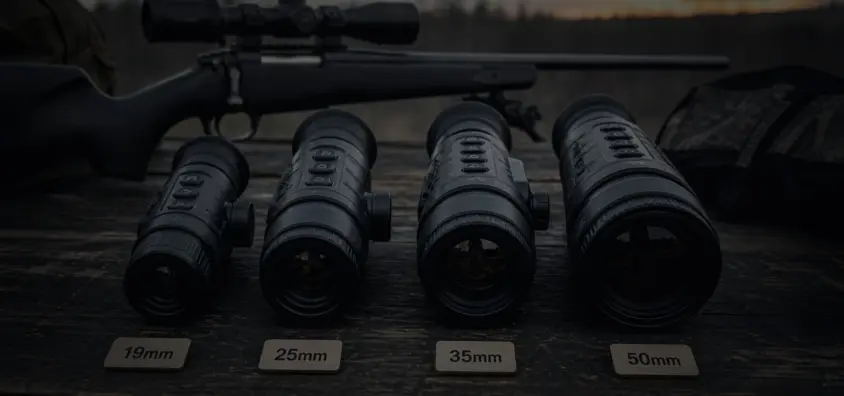
Thermal Scope Lens Size: 19mm vs 25mm vs 35mm vs 50mm
There are many factors that could contribute to the feeling of difference between two thermal scopes despite identical specifications. However, the size of the germanium thermal scope lens may stand out the most among such factors.
For instance, a 25mm lens may seem more agile and wider than a 50mm counterpart. A 50mm thermal scope lens is more powerful but also tends to produce images that are harder to interpret at closer distances.
The quick answer is simple – a bigger lens equals a more powerful image, while a smaller lens allows seeing a wider area at a glance. However, it is worth noting that what hunters should consider is less about the exact size printed on the box and more about specific hunting circumstances and preferences.
Generally speaking, 35mm thermal scope lens tends to be the most practical option. However, 25mm is preferable for closer hunting at feeders and in woods, while 50mm provides longer detection range. 19mm is more specific, but it has its unique advantages.
How Does Lens Focal Length Impact Thermal Imaging?
When thermal imaging equipment is sold with such parameters as 19mm, 25mm, 35mm, or 50mm lenses, that refers to the focal length of the germanium objective lens system. It does not mean the same as an objective lens in a standard day vision riflescope.
In thermography, there are numerous optical factors, including the size of the thermal detector, sensor format, image processing, and more that impact the actual capabilities of the optic. That is why the exact same focal length in lenses from different manufacturers may produce slightly different results in terms of magnification or field of view.
However, the basic relation stays consistent – shorter focal length produces a wider viewing cone. As a result, the animal is seen as smaller compared to the wider area. Meanwhile, longer focal length results in a narrower viewing cone with higher image scale.
| Lens focal length | Viewing cone width | Animal size | Hunting behavior |
|---|---|---|---|
| 19mm | Very wide | Small, but visible | Scanning and tracking close distances |
| 25mm | Wide | Moderate | Hunting in forests, mixed terrains |
| 35mm | Standard | Big, but still discernable | Hunting over varied distances |
| 50mm | Narrow | Very big | Open fields, distance hunting |
It is important to remember that 19mm, 25mm, 35mm, or 50mm focal lengths represent the size of the optical lens itself. However, that does not necessarily mean that all of them provide the same amount of usable data for hunters. Lens focal length is a factor, but it is far from being a defining parameter.
As such, a 35mm thermal scope with a high-resolution detector will likely capture more details and provide a wider viewing angle than a cheaper alternative with a shorter focal length. Again, there are always other optical parameters to consider.
Comparing 19mm, 25mm, 35mm, and 50mm Lenses on Thermals
| Lens focal length | Typical magnification | Field of view | Target ID window | Hunting applications |
|---|---|---|---|---|
| 19mm | Low | Ultra-wide | Short | Tight forests, feeders, close hunts |
| 25mm | Low to medium | Wide | Short to moderate | Mixed terrain, feeder sites, hog hunts |
| 35mm | Medium | Average | Moderate | General hunting, mixed terrain, coyotes |
| 50mm | High | Narrow | Moderate to high | Open terrains, coyotes, long-range targets |
The ranges above provide general guidelines on the capabilities of thermals in terms of distance hunting. Of course, there are exceptions to every rule because other factors play their role. These include weather conditions, humidity level, image processing, NETD, shooter skill, and target visibility.
19mm Thermal Lenses for Quick Scans and Short Hunts
Most 19mm thermal lenses produce low magnification and ultra-wide viewing angles. This may be helpful when hunters need to spot animals on relatively short distances, usually below 100 yards.
The key advantage of thermal scopes with 19mm focal length lies in quick detection. Wider field of view means that it is easier to spot and track animals even in tough conditions like thick forest, dense brushwood, or agricultural lands.
However, this lens focal length also means that there is less data available about the target at longer ranges. As a result, it may be quite difficult to identify the animals beyond certain distances and take reliable shots. That is why 19mm is generally considered to be impractical for distance hunting.
Choose this lens focal length if hunting distances are generally short and hunters prefer lightweight rifles. However, do not opt for 19mm when hunting on crop fields or large areas of pastures.
25mm Thermal Lenses Are Ideal for Hunting Near Feeders
Compared to 19mm lenses, 25mm thermals feature a narrower viewing angle. However, the field of view is still relatively wide and makes these optics suitable for hunting in varied conditions.
That is why most midrange or budget models use 25mm objective lenses. This focal length allows using thermal scope for scanning feeders, hogs, crop protection in the field, and more.
Also, a thermal optic with 25mm lens is great to use as a scanner and a shooting scope. When hunters have no extra devices in hand, it can help with tracking and shooting on-the-move.
The downside is that it might be tricky to spot smaller animals at longer distances due to limited magnification. Coyotes and other predators may require additional identification efforts because of low image scale.
Pick 25mm when most shots are taken within 150 yards and the scope will be used for scanning and shooting.
35mm Thermal Scope Lenses for Balanced Hunting
The most versatile lenses are found in 35mm thermal scopes. This optical configuration tends to offer a balanced combination of magnification and field of view that is optimal for various situations.
In particular, most experienced hunters prefer thermals with 35mm lens for hunting hogs, coyotes, predators, etc. Also, it is often the best solution if the shooter has a dedicated scanner and needs to switch to a riflescope to identify the prey and take a shot.
384 resolution vs 640 resolution debate may become particularly important when discussing lenses of 35mm focal length. In some cases, a 35mm lens with 384 detectors is enough to get a practical hunting optic. Meanwhile, 640 resolution may provide additional data.
35mm lenses may work the best if shooters need versatile scopes that are suitable for varied hunting conditions in different ranges.
50mm Lenses Provide Long-Range Image Magnification
High magnification requires higher lens focal length – that is when the 50mm lens comes into play. This configuration provides hunters with a narrow field of view but significantly increases magnification.
This way, 50mm lenses work best with open spaces that allow for long-distance shooting. However, if the shooter is familiar with the hunting area and knows where the hogs typically move, 50mm is a great option. For example, this lens is ideal for long bait lines.
One of the main drawbacks of 50mm scopes is that they provide narrow field of view, which might be problematic if hogs come out of the woods on short distances. It also tends to feel less convenient if the thermal scope serves as a scanner and is used for hunting.
Opt for a 50mm lens if the hunter scans the area with a handheld device, then aims at the target with a 50mm riflescope. This is particularly applicable for large agricultural terrains, open fields, pastures, and longer shots.
Do Not Overlook Detector Resolution in Your Decision-Making Process
Focal length is not the only consideration to take into account. Lens size plays a major role in thermal imaging performance, but resolution is another vital parameter.
The truth is that higher-resolution detectors and sensors are capable of providing better thermal imaging in almost all circumstances. Even if the lens focal length is the same, 640-resolution lens tends to perform better than 384-resolution equivalent.
To prove the idea that lens size and detector resolution are interconnected and have to be considered in correlation, it may be interesting to analyze some official data from major manufacturers. AGM, Armasight, ATN, InfiRay, iRayUSA, and Nocpix all confirm this principle.
That is why it is crucial to remember that 384-resolution and 640-resolution models with the same lens focal length will work differently. Digital zoom also makes this question particularly important.
Thermal Scope Detection Range vs Recognition vs Identification
Marketing efforts often mention detection range as the key benefit of a thermal scope, which is also the easiest parameter to improve with lens size. But while detection is simply confirming a heat signature, recognition means being able to identify the type of object. Identification is making the shot confidently.
Many factors affect detection distance – humidity, rain, fog, ground temperature, background temperature, target size, lens focus, netd, display quality, and image processing.
What really matters in hunting is identification, and while an optic with a large lens is likely capable of detection from afar, it may lack the resolution necessary to positively identify the target.
Which Size of Lens Is Best for Hog Hunting?
Hog hunters should first look at thermal scope options with 25mm or 35mm optics.
While hogs are larger than coyotes and tend to travel in packs, they also move faster and change direction rapidly. Hogs are often hunted around feeders and fields. The importance of having an ample field of view is evident here since hogs run in a pack or move from feeder to feeder through the property and around crop damage spots.
25mm scope lens is usually sufficient for hog hunting within 150 yards, while a larger 35mm lens works great when there are open fields on the property or more confidence in target identification is desired before taking a shot.
A 50mm lens works well when hog hunting in open fields but doesn’t automatically make for the best scope for hogs.
Which Lens Is Ideal for Coyote Hunting?
Coyote hunters need to consider scopes with a 35mm or 50mm lens.
Coyotes tend to run faster and further away than hogs. More magnification helps the hunter assess the target’s shape, actions, and overall movement. This is why very low-magnification scopes like 19mm or even 25mm may not be sufficient for serious predator hunting.
A 35mm lens is the best choice for a mixed predator hunting scenario, which is great if the hunter needs a single scope for coyote hunting and hog hunting in fields. If the coyotes are commonly hunted over open fields, 50mm scope offers more image scale needed at longer distances.
The problem is that too much magnification can be too much magnification. When using a 50mm lens and running over open terrain for predators, the field of view might get too narrow, thus making the optic difficult to operate.
Which Lens Is Best for Beginners?
The best thermal scope for beginners shouldn’t have the biggest lens, nor the smallest one.
The former is difficult to use at long ranges and requires more advanced skills. The latter offers too little base magnification and can limit a beginner’s hunting abilities, especially at distance.
25mm or 35mm lenses strike a nice balance for most newbies. 25mm is friendly for close-range hog hunting and hunting on small properties. 35mm lens is more versatile and gives better results on hunts involving both pigs and predators. However, it’s also important to keep in mind the factors of magnification, focus, palette, scanning technique, and more.
Common Mistakes That Hunters Make While Buying a Thermal Scope Lens Size
Buying a 50mm lens because it sounds impressive is often the first mistake hunters make. Even if a 50mm scope is great and can work wonders in the right conditions, too much base magnification limits its versatility. 50mm thermal scope may prove too narrow if used in wooded environments or with fast moving targets.
Choosing a lens size without considering the resolution is another mistake often made by hunters. Since the scope lens diameter and resolution go hand in hand, it’s important to understand that two thermal scopes with the same lens diameter, such as a 35mm, may not behave similarly when using digital zoom.
Overestimating the detection range also happens to some extent as not all hunters realize that their primary interest lies in positive identification and target acquisition rather than the detection itself.
Failing to pay attention to the field of view is perhaps the last common mistake people often make while choosing the size of a lens for their scope.
Even though most hunters are interested in learning how far a scope can see, many shots are missed because the animal was hard to spot but not because the scope had insufficient detection distance.
Practical Buying Advice
Use the following rule of thumb for choosing the lens of a thermal scope:
Choose a 19mm lens for fast and close woods hunting, where most of the time the hunting takes place under the tree canopy.
Choose a 25mm lens for close-range hog hunting and feeder work. Great thermal scope for newbies.
Choose a 35mm scope lens for hog hunting and predator hunting, when a single thermal scope is preferred.
Choose a 50mm lens for hunting in open country terrain when the targets are at long range. Preferable when the hunting scope is not the only thermal device in use.
References Used to Verify the Information
This guide has been created using verified information from the following sources:
AGM Rattler V2 specifications
Armasight thermal scope specifications
ATN thermal weapon sight specifications
InfiRay/iRayUSA RICO specs
Pulsar Thermion specs
Nocpix FOV guide
Edmund Optics – field of view and focal length explanation
What all these manufacturers have confirmed is that the longer the lens focal length (in inches), the higher the base magnification and lower the field of view. And vice versa, the smaller the focal length – the more field of view a thermal scope offers.
The exact numbers differ depending on the lens focal length, the type of sensors (resolution), detector size, and display quality.
Verdict
The best thermal scope lens size doesn’t always have to be the largest one the hunter can afford or find. Instead, the best lens size for thermal scopes depends greatly on the environment and shooting distance as well as the target animal and the scanning technique used by the hunter.
IR Illuminator Not Working With Night Vision? Beam, Battery, Focus and Compatibility Check.
Is your NV not turning on? Battery, Contacts, Mount and Tube-Safe Troubleshooting
Night Vision Collimation and Alignment: Fix Double Vision, Eye Strain and Dual-Tube Setup Issues