
May 28, 2026
Understanding Base Magnification vs Digital Zoom of a Thermal Scope
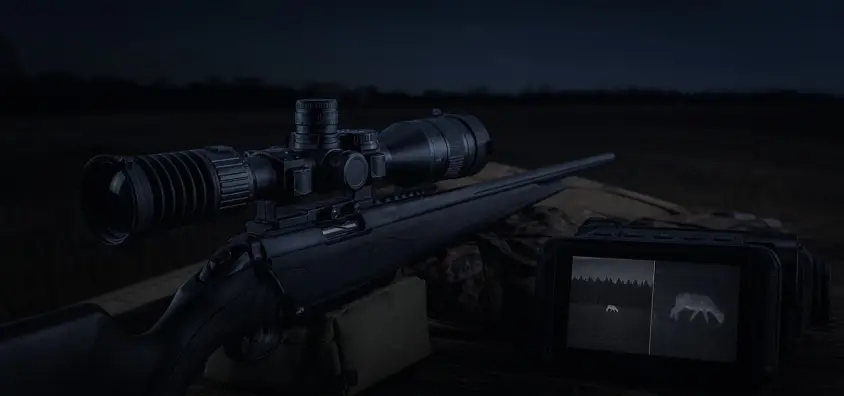
When buying a new thermal scope, it is easy to be confused by advertised magnification ranges such as “2-16x” or “3-24x”. Those numbers look similar to daylight rifle scope specs, but thermal optics work differently. For a thermal riflescope, the critical number is usually base magnification, not the maximum zoom printed on the box.
Base magnification determines the starting view before digital zoom is applied. Digital zoom can still be useful, especially for checking a target or zeroing, but it does not create new thermal detail. Understanding the difference helps hunters choose a scope that matches the way they actually hunt.
What Base Magnification Means
Base magnification is the default magnification level at which a thermal scope operates without digital zoom. A scope with 2x base magnification displays the scene at roughly twice naked-eye size. A scope with 4x base magnification starts closer, but it also shows less of the scene.
This is why two thermal scopes with similar sensor resolution can feel very different in the field. Lower base magnification gives more field of view for scanning and detecting movement. Higher base magnification gives a larger starting image for recognizing and identifying distant targets.
N-Vision lists the HALO with 1.75x base magnification and the HALO-LR with 3.5x base magnification. Both use 640×480 thermal sensors, but the HALO has a wider field of view, while the HALO-LR is designed for more reach. Armasight gives another clear example: the Contractor 640 2.3-9.2×35 is listed with 2.24x optical magnification and 1x-4x digital zoom.
What Digital Zoom Actually Does
Digital zoom does not collect extra thermal data from the scene. It electronically enlarges a selected portion of the thermal image that the sensor already captured.
At 2x digital zoom, the scope crops into the image and stretches that smaller section across the display. At 4x digital zoom, the crop is more aggressive. The target appears bigger, but the image usually becomes softer, blockier, or noisier because fewer sensor pixels are being used to build the displayed image.
That does not mean digital zoom is useless. It can help when a hunter has already found the animal and needs a closer look before taking a shot. It can also help during zeroing. Pulsar’s manuals explain that higher magnification can make reticle adjustment finer during zeroing because the displayed reticle movement step becomes smaller.
The key tradeoff is simple: digital zoom increases target size on screen, but it does not improve the original thermal information captured by the sensor.
Base Magnification vs Digital Zoom in Hunting Conditions
Base magnification affects how the scope feels every time it is used. Digital zoom is a tool that should be applied when the situation calls for it.
A low base magnification of around 1.5x to 2.5x is usually better for scanning wide areas, close-range hog hunting, hunting in woods, and tracking moving animals. A medium base magnification of around 3x to 4x is often better for open fields, coyotes, bait sites, and situations where target identification matters more than wide scanning.
High base magnification can be useful across open terrain, but it can feel restrictive at short range. If a hog steps out at 40 yards, too much base magnification can make it harder to find, track, and follow up.
In most cases, the practical method is to scan at base magnification, identify the heat signature, and then use digital zoom only when a closer look is needed.
Why 640 Sensors Handle Digital Zoom Better Than 384 Sensors
Sensor resolution matters because digital zoom spends pixels. A 640 thermal scope generally holds up better at 2x digital zoom than a 384 thermal scope, assuming similar lens quality, sensor sensitivity, display quality, and image processing.
A 384 thermal scope can still be very effective, but it should rely less on digital zoom if the goal is to preserve usable image quality. Heavy zoom on a lower-resolution sensor makes softness and pixelation appear sooner.
This is why a 384-resolution scope with sensible base magnification can feel more useful than a lower-resolution setup that depends too heavily on digital zoom. If a hunter regularly needs to zoom hard just to identify targets, the scope may not have the right base magnification, lens, or sensor resolution for that hunting distance.
For many hunters, 2x digital zoom is the most useful setting. 4x can still be usable, especially on 640-class scopes, but it should not be the main reason to buy a thermal scope.
How Pixel Pitch Changes the View
Resolution is only part of the story. Pixel pitch also affects how magnification and field of view feel in a thermal scope.
Pixel pitch is the physical size or spacing of the sensor pixels, usually measured in microns. Older thermal sensors were often built around 17-micron pixels, while many modern hunting scopes use 12-micron sensors.
With the same sensor resolution and the same lens size, a 12-micron sensor usually gives a narrower field of view and higher base magnification than a 17-micron sensor. That can help with reach and target identification, but it can also make the scope less forgiving at close range.
This is why thermal scope specifications can confuse inexperienced buyers. A 384 sensor is not just a 384 sensor, and a 35mm lens is not the whole story. Sensor resolution, pixel pitch, lens size, display quality, thermal sensitivity, and image processing all work together.
Why NETD Matters When You Zoom
Digital zoom makes image flaws easier to see. If the thermal image is already flat, noisy, or low contrast, zooming in will not fix it. It usually makes those problems more obvious.
NETD helps explain this. NETD stands for noise equivalent temperature difference. In simple terms, it describes how small a temperature difference the sensor can detect. Lower numbers are generally better.
A high-quality thermal scope with strong sensitivity can preserve more usable detail when the environment makes imaging difficult. Rain, fog, humidity, warm nights, and low thermal contrast between the animal and the background can all make the image harder to interpret.
Many high-end modern thermals advertise NETD values around <25 mK, and some list even lower numbers. Scopes around <35-40 mK can still be very useful depending on the lens, sensor, software, and conditions. The important point is that digital zoom cannot create contrast that the sensor did not capture.
Lens Size Influences Base Magnification
Lens size often affects base magnification and field of view. A larger objective lens commonly gives higher base magnification and better reach, but it usually narrows the field of view. A smaller objective lens usually gives a wider view, which helps when scanning and tracking moving targets.
This is why 25mm and 50mm thermal scopes can both be good, but for different jobs. A 25mm model may be faster and easier in thick cover or around feeders. A 50mm model may be better across open fields where the hunter needs more image scale at distance.
Do not choose lens size by detection range alone. Think about how far the shot actually is, how much scanning is done through the riflescope, and whether the terrain is thick, open, or mixed.
Picture-in-Picture Can Be a Good Compromise
Picture-in-picture mode can help solve one of the common problems with digital zoom. It displays a smaller zoomed section of the thermal image, often around the reticle, while the main image remains wider.
Pulsar describes this kind of function in its manuals: the magnified area can be shown separately while the rest of the image remains at the base view. For hunting, this is useful because it lets the shooter keep awareness of the surrounding field while still getting a closer look at the aiming area.
If a scope has picture-in-picture, it is often more practical than running the entire display at high digital zoom.
Clip-On Thermals Are Different
Clip-on thermals require extra caution because the hunter is using a day optic behind the thermal device.
A dedicated thermal scope handles the sensor, display, reticle, and magnification as one system. With a clip-on, the day scope magnifies the clip-on’s displayed image. That means screen resolution, optical alignment, and the manufacturer’s recommended day-scope magnification range matter a lot.
Increasing magnification on the day scope usually does not reveal more thermal detail. It magnifies the clip-on display and its pixels. At higher day-scope magnification, the image may become dimmer, narrower, or more pixelated because the day optic is enlarging the displayed thermal image.
ATN’s TICO LTV manual shows why setup matters. In clip-on mode, digital zoom can retain zero only when the system is configured correctly. The manual also warns that ballistic reticle subtensions can become incorrect when digital zoom is applied. This means hunters should not assume high digital zoom on a clip-on behaves like normal magnification on a day scope.
With clip-ons, follow the manufacturer’s recommended magnification range and confirm zero with the exact setup that will be used in the field.
How Much Magnification Do Hunters Need?
More magnification is not always better for night hunting.
At close ranges and in the woods, low base magnification is usually preferred because it lets the hunter cover more ground at once. For many hog hunts inside 150 yards, 1.5x to 2.5x base magnification can be very practical.
At longer distances and in open areas, 3x to 4x base magnification may be more helpful because it can assist with recognizing and identifying targets at distance. This is especially relevant for coyote hunting, open-field hunting, and bait sites where the animal may appear farther away.
For long-range thermal use, magnification is only one part of the equation. Sensor resolution, lens quality, NETD, focus, display quality, and image processing are just as important. A blurry high-zoom image is worse than a clean lower-zoom image.
Tips for Choosing a Thermal Scope
When shopping for a thermal scope, avoid focusing only on maximum magnification. Instead, compare the following points:
- Base magnification
- Field of view at base magnification
- Sensor resolution, especially 384 vs 640
- Pixel pitch, such as 12-micron or 17-micron
- NETD value listed by the manufacturer
- Usability of 2x digital zoom
- Picture-in-picture support
- Expected scanning distance and identification distance
- Terrain type, such as woods, open fields, bait sites, or mixed ground
- Manufacturer’s recommended day-scope magnification range for clip-on models
A good thermal scope should meet the hunter’s real needs before it impresses with a large zoom number.
Conclusion
Base magnification is the real starting point of a thermal scope. Digital zoom is an electronic tool that enlarges part of the thermal image. Base magnification affects field of view, target acquisition, and how natural the scope feels in the field. Digital zoom helps when a closer look is needed, but image quality usually drops as zoom increases.
Sensor resolution matters, but it is not enough to evaluate a thermal scope. Pixel pitch, lens size, NETD, display resolution, processing, picture-in-picture, and clip-on compatibility can all change how usable magnification feels during a hunt.
For most hunters, the best thermal scope is not the one with the biggest advertised zoom. It is the one with the right base magnification, enough sensor resolution, good sensitivity, a usable field of view, and digital zoom that remains clear enough at real hunting distances.
References Used to Verify the Information
This article was checked against official manufacturer manuals and specification pages, including Pulsar Thermion 2 LRF manual, ATN TICO LTV manual, Armasight Contractor 640 specifications, AGM’s base magnification guide, N-Vision HALO specifications, and InfiRay thermal scope manual data.
IR Illuminator Not Working With Night Vision? Beam, Battery, Focus and Compatibility Check.
Is your NV not turning on? Battery, Contacts, Mount and Tube-Safe Troubleshooting
Night Vision Collimation and Alignment: Fix Double Vision, Eye Strain and Dual-Tube Setup Issues