Last updated: March 2026
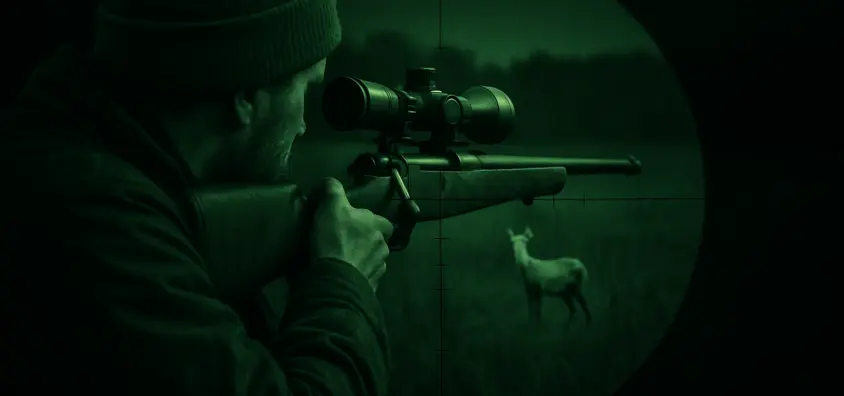
Magnification is the specification buyers focus on first when looking at night vision rifle scopes, and it is also the specification most often misunderstood. The instinct to want more magnification — the assumption that higher means better — leads to real-world performance problems that frustrate hunters who did not account for how magnification interacts with image quality, field of view, and target acquisition speed in actual field conditions.
Fixed and variable magnification scopes each have genuine advantages for specific applications. This guide covers what those advantages are, where each design type struggles, and how to make the right choice based on your hunting situation rather than what looks impressive on a spec sheet.
How magnification affects night vision image quality
In daylight optics, increasing magnification is largely a matter of bigger is better up to a practical limit — you gain detail at the cost of field of view and, eventually, image stability when held by hand. Night vision changes this relationship because the underlying image source is a sensor or image intensifier tube with a fixed resolution. When you increase magnification, you are enlarging a fixed-resolution image, not capturing more photons or more sensor pixels.
This means digital zoom in night vision scopes — the zoom function that goes beyond the fixed optical magnification — works by interpolating the existing sensor resolution across a larger display area. The image does not contain more information at 6x digital zoom than at 3x optical zoom from the same sensor. It shows the same data spread over more pixels, which reduces apparent detail and introduces visible pixelation. Physical optical zoom, where lens elements move to change the focal length, provides true optical magnification without this limitation but adds complexity, cost, and typically length to the scope.
For image intensification (traditional analog NV) scopes, the relationship is similar. An intensifier tube has a fixed resolution ceiling. A 2x optical magnifier ahead of the tube physically enlarges the target image hitting the tube’s photocathode, which means more photons from the target area reach the tube — a genuine image improvement. But beyond the tube’s resolution capability, no magnification increase will reveal more detail. You are working with the tube’s limiting resolution as an absolute ceiling.
Fixed magnification: the case for simplicity
Fixed-magnification night vision scopes eliminate the variable zoom mechanism. The optical design is locked at one magnification — typically 3x, 4x, or 6x for hunting scopes — and the field of view and image quality are optimized for that single configuration. The advantages of this approach are real and underappreciated:
Optical clarity: A fixed-magnification design has fewer lens elements than a variable-power scope optimized across a wide power range. Fewer elements means fewer air-to-glass surfaces, less transmission loss, and a design that can be fully optimized for the target magnification without the engineering compromises required to maintain acceptable performance across a 4x or 6x zoom range.
Weight and balance: Fixed-magnification scopes are typically lighter and more compact than variable equivalents at the same magnification level. On rifles where forward weight affects balance and fatigue during long hunts, this matters.
Reliability: No moving optical elements means fewer mechanical failure points. In cold temperatures, lubricants in zoom mechanisms thicken and can make adjustment stiff or cause the mechanism to bind. Fixed scopes do not have this failure mode.
Cost: At equivalent image quality levels, fixed-magnification scopes cost less than variable-power scopes because they require less optical engineering to achieve consistent performance.
The limitation of fixed magnification is exactly what the name describes — you cannot adjust. A scope fixed at 3x that is ideal for close-range work in brush is not optimal for 300-yard shots across open pasture. If you hunt in variable terrain requiring genuinely different magnification levels, a fixed scope forces you to accept a compromise that may not work in either extreme.
Variable magnification: what the zoom range actually gives you
Variable-magnification night vision scopes offer a zoom range — typically 2-8x, 3-12x, or similar configurations. The appeal is adaptability: lower power for close-range work with a wider field of view, higher power for identification and longer-range shots. This flexibility is genuine and valuable in the right hunting context.
The practical caveat is that variable-power scopes in the mid-price range often show meaningful image quality degradation at the extremes of their zoom range. A scope rated 2-8x optical zoom may deliver excellent image quality at 4x — the middle of its range — and noticeably softer images at 2x or at 8x. This is a known optical engineering challenge: designing a zoom lens that maintains consistent sharpness, contrast, and transmission across its full range requires either large, heavy, expensive optics or accepting that performance will peak in the middle of the range.
In thermal scopes, variable magnification is almost always digital zoom applied to a fixed-resolution sensor after the 1x optical setting. A thermal scope marked as “1-8x” typically has a 1x fixed optical focal length and the 2x through 8x settings are digital interpolation of the sensor image. The image at 8x on this type of scope is the same sensor data the 1x view shows, just enlarged and pixelated. Knowing whether a scope’s zoom is optical or digital — and for thermal, understanding that true optical zoom in thermal requires physically moving lens elements — is essential before interpreting a variable-magnification spec.
Identifying the right magnification range for your application
The useful starting point is understanding the maximum shot distance your hunting terrain actually requires, not the maximum distance you imagine you might attempt. Most property-level hog, coyote, and deer hunting in the continental US involves shots under 250 yards. Open-terrain predator hunting in the Western states regularly produces 300-400 yard opportunities. Long-range varmint shooting in specific geographies — flat Texas pasture, Montana rangeland — involves 500+ yard targets as a routine matter.
At 100 yards, 4x optical magnification provides a target image that fills the typical scope field of view with enough detail for positive identification and a confident shot on any normal big game or predator target. At 200 yards, 6x is generally the practical magnification for comfortable shot confidence. At 300 yards with a quality sensor, 6-8x allows the detail needed for reliable identification of predator-class targets. Beyond 300 yards, 10x and above becomes relevant if your sensor resolution supports it — using high magnification on a low-resolution sensor creates the pixelation problem discussed earlier rather than showing useful additional detail.
The field of view tradeoff
Higher magnification reduces field of view proportionally. A scope at 4x showing 8 degrees of horizontal field of view will show 4 degrees at 8x. This is not just a numbers exercise — the practical effect is that at high magnification, a moving target exits the field of view quickly and requires active tracking to stay on. For predator hunting where the animal is moving from a call response, high magnification makes the initial acquisition and tracking genuinely more difficult.
The standard field technique for variable-power hunting is to acquire the target at lower magnification, track and confirm the identification, then increase magnification for the shot. This requires the scope’s low-power setting to provide a wide enough field of view for practical scanning and initial acquisition. A scope with a 2x minimum setting covers roughly twice the angular field of view at that setting compared to 4x minimum — meaningful for spotting a coyote entering the far end of a field and tracking it before it reaches shooting position.
For understanding how specs translate to real field performance, the article on field testing vs specs in night vision provides the framework for evaluating any optic specification against actual hunting utility, including how magnification claims are tested under standardized conditions that may not reflect your specific hunting environment.
Fixed vs variable: the practical decision guide
Choose a fixed-magnification scope when:
Your hunting is primarily at one type of range and terrain — stand hunting over bait at known distances, for example, where you set up for a specific shot opportunity and the target presentation does not vary significantly. A fixed scope at the right magnification for your typical shot will deliver better image quality than a variable scope of equal price at the same power level.
Weight and simplicity matter more than flexibility. A lightweight fixed 4x scope on a rifle you carry for miles puts the weight where you need it rather than in optical mechanisms you might use twice a season.
Your budget is limited and you want to maximize image quality within it. Fixed-magnification scopes deliver more optical performance per dollar because the budget is not split between quality and mechanism complexity.
Choose a variable-magnification scope when:
Your hunting involves genuinely different range requirements in the same session or across the same property. Moving from close-range brush work to open-field shooting in the same hunt is the clear case for a variable scope — the low end covers navigation and short-range target acquisition, the high end supports longer shots.
Target identification at range is a priority. The ability to magnify up for species confirmation before committing to the shot is a genuine safety and ethics consideration, especially in areas where multiple species may be active at the same time.
You are hunting with a single rifle system across multiple applications — hog hunting, predator calling, and property patrol in the same season. A variable scope allows you to optimize the setup for each application without changing equipment.
Magnification on thermal vs image intensification scopes
The fixed-versus-variable decision plays out differently for thermal and traditional NV. Thermal scopes with higher sensor resolution (640 and above) can tolerate digital magnification reasonably well because there are more sensor pixels to work with before the interpolation becomes visually degrading. A 640×480 thermal sensor at 2x digital zoom is still showing 320×240 pixels of original data per equivalent field view — acceptable for identification work. The same approach on a 320×256 sensor at 2x digital zoom is showing 160×128 original pixels per equivalent field, which becomes noticeably rough on small targets at distance.
Image intensification scopes with variable power almost always use true optical zoom, which avoids the digital interpolation problem but adds optical elements and cost. The image quality benefit of optical zoom in image intensification is real — physically enlarging the photon input to the tube provides genuine improvement. The tradeoff is the scope’s optical performance characteristics across the zoom range, as discussed above.
For comprehensive context on how these technical specifications map to real-world buying decisions, the guide to reading night vision specifications covers the full spec sheet interpretation process, including how to evaluate magnification claims in the context of sensor resolution, field of view, and the other numbers that define what a scope will actually do in the field.
Summary
Fixed magnification delivers optimized image quality at a single power level with less weight, greater reliability, and lower cost. Variable magnification provides adaptability across shot distances and hunting situations but requires understanding whether the zoom is optical or digital, where the scope’s image quality peaks in its range, and whether the flexibility is genuinely needed for your specific hunting. For most hunters hunting one type of terrain at predictable distances, a well-chosen fixed-magnification scope outperforms a variable of equivalent price by concentrating the design budget on image quality rather than zoom mechanism. For hunters with genuinely variable requirements across the same hunt, variable magnification earns its cost and complexity.