
March 31, 2026
IR Laser vs IR Illuminator: What Night Vision Users Need to Know
The terms IR laser and IR illuminator are sometimes used interchangeably in night vision discussions, but they describe fundamentally different devices with different functions, different legal considerations, and different roles in a night optic setup. Understanding the difference is not a technicality — it affects whether your setup performs as intended, whether you’re operating within applicable regulations, and whether you’re using your equipment safely.
This guide explains what each device is, what it does in the context of a night vision setup, when each is useful, and what you need to know before mounting either one on a rifle or using it with NV equipment.
What an IR Illuminator Is
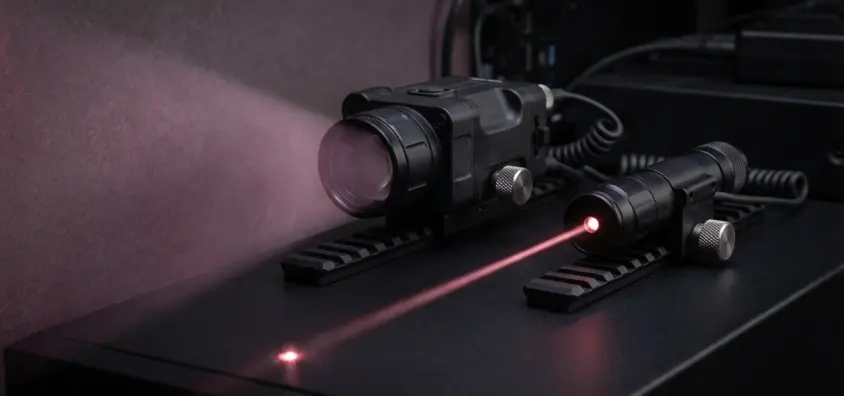
An IR illuminator is a source of infrared light — typically operating in the 850nm or 940nm wavelength range — that illuminates a scene for a night vision device to amplify. It functions exactly like a white-light flashlight or weapon light, except the emitted wavelength is invisible to the naked eye.
A night vision scope, monocular, or goggle can amplify ambient light — moonlight, starlight, reflected infrared from other sources — to produce a usable image. But in low-ambient-light conditions (dense canopy, enclosed spaces, heavy overcast), there’s not enough photon input for the NV device to amplify. An IR illuminator solves this by flooding the scene with infrared light that only NV-equipped users can see.
Key characteristics of IR illuminators:
- Emit a cone or beam of IR light (divergent, not coherent)
- Multiple IR photons spread across the illuminated area
- Do not designate or mark a specific point
- Legal for civilian use in virtually all U.S. jurisdictions for hunting applications
- No ITAR restriction on civilian illuminators
- Eye hazard is minimal at typical field use distances (similar to a flashlight)
Our complete IR illuminator guide covers wavelength selection, illuminator output levels, and mount configurations in detail.
What an IR Laser Is
An IR laser is a coherent, collimated beam of infrared energy. Unlike an illuminator, a laser concentrates its energy into a single point or tight beam rather than flooding a scene. In a tactical context, IR lasers serve two primary functions: target designation (pointing the exact location of a target) and aiming (using the laser as a fire control reference).
An IR laser used as an aiming device works as follows: mount the laser on your rifle, align the laser point with your point of impact at a given distance, and use the visible laser point through your NV device as your aiming reference, eliminating the need for a traditional scope or red dot sight.
Key characteristics of IR lasers:
- Coherent, collimated beam — single point of energy concentration
- Point the laser, point the rifle
- Can be seen only with NV equipment (certain classes)
- Significantly higher power than illuminators per unit of energy output
- Subject to ITAR/export restrictions for certain output levels
- Serious eye safety considerations
The Legal Divide: Class IIIA vs. Class IIIB Lasers
This is where the subject becomes critical for civilian users in the United States.
Class IIIA lasers (below 5 mW output) are commercially available without restriction and are found in pointing devices, training aids, and lower-power aiming lasers. These present eye hazard only with prolonged direct stare and are generally legal for civilian ownership and hunting use. Most commercial IR lasers marketed to hunters fall into this category.
Class IIIB and Class IV lasers (5 mW and above) represent the military-grade IR laser tier — devices like the AN/PEQ-15 and its civilian equivalents. These are genuine ITAR-controlled items in their full-specification versions. Civilian-legal versions with reduced output exist and are commercially available. Military-export-grade versions of these devices are ITAR-restricted and not legal for civilian import or ownership without specific licensing.
The civilian hunting context: For hunting applications, a Class IIIA IR laser in the 1-5 mW range is sufficient for practical use with a standard Gen 2 or Gen 3 NV setup. The aiming point is visible through the NV device at hunting distances, the device is civilian-legal, and the eye safety profile is manageable with appropriate protocols.
Purchasing IR lasers marketed as military grade or full power without verifying civilian-legal output levels is a route to owning a restricted device. Verify laser class and output power before purchase. For context on what ITAR restrictions mean for civilian NV purchases broadly, see ITAR and night vision for civilians.
Eye Safety: The Critical Difference Between Illuminators and Lasers
This cannot be overstated. IR lasers pose genuine eye injury risk that IR illuminators do not.
An IR illuminator spreads its output across a broad area — similar in energy density to ambient light. Looking into an IR illuminator from a normal standoff distance is not a meaningful eye hazard.
An IR laser concentrates energy in a coherent beam. If a Class IIIB or higher IR laser strikes the eye, it can cause permanent retinal damage. Crucially, because IR wavelengths are invisible to the naked eye, the eye’s normal blink and aversion response does not engage the way it would with visible light. You don’t see the beam; your eye doesn’t close to protect itself; the retinal damage occurs without warning.
The risk is compounded because night vision users are often scanning broadly, pointing equipment around a property, and sweeping laser-equipped rifles across backstops and berm lines during setup. Safe IR laser protocol requires:
- Never sweep a rifle-mounted IR laser across any person or pet
- Muzzle discipline identical to loaded-firearm protocols
- Awareness that all NV-equipped personnel in the area can see the beam
- Know your target and beyond — the beam passes through targets
These protocols are not excessive caution. Retinal damage from IR laser exposure is documented, irreversible, and occurs at power levels below what most people associate with serious lasers.
When You Need an IR Illuminator
The common NV setup: Most hunters using a night vision scope or monocular benefit from an IR illuminator in low-ambient conditions. The illuminator extends the effective operating range of the NV device by providing additional photon input for amplification.
Typical applications:
- Hunting under heavy cloud cover (no moonlight or starlight available)
- Dense forest or canopy environments
- Barn or structure interiors
- Feeder monitoring in total darkness
- Detection enhancement beyond the NV device’s ambient-light range
Most NV scopes include a built-in IR illuminator. For hunting applications, a built-in illuminator is often sufficient for extending the scope’s range modestly. Dedicated weapon-mounted or handheld IR illuminators provide higher output and longer range than built-in options. For information on how NV devices use this incoming light at the sensor level, the image intensifier tube guide explains the amplification process.
When You Need an IR Laser
The tactical/hunting case for IR lasers: An IR laser on a rifle eliminates the need to align eye with scope in fast-target presentations. With an IR monocular or NV goggle, the shooter sees the IR laser dot at the point of impact — quick, body-indexed shooting becomes practical in close-range scenarios.
This is the specific use case for IR lasers in hunting:
- Hog hunting from a fixed position where targets present at close range (30-75 yards)
- Running a pistol or non-scoped rifle with NV goggles for close work
- Shooting from unconventional positions where traditional scope alignment is awkward
For precision rifle work with a dedicated NV scope, an IR laser adds little value — the scope itself provides the aiming reference and magnification. The IR laser shines for helmet-mounted or monocular setups where the shooter doesn’t have a primary NV scope.
Combining Both in a Setup
A complete advanced NV setup often includes both: an IR illuminator to flood the scene with invisible light, and an IR laser for aiming reference. This combination — illuminator providing ambient NV boost, laser providing aiming dot — is standard in military NV configurations and translates to hunting setups.
For hunting, the typical implementation is:
- Forward-mounted IR illuminator (high-output, flood pattern) for scene illumination
- PEQ-style IR laser on the upper rail for aiming reference
- NV monocular or goggle at the eye
This setup allows the hunter to engage targets without bringing a rifle-mounted NV scope to the eye — advantageous in fast-paced, multiple-target scenarios like high-volume hog hunting, where quick shots in close terrain are common.
Wavelength Considerations: 850nm vs. 940nm
This applies to illuminators, not lasers, but is worth addressing in this context.
850nm illuminators produce visible dim red glow from the LED element when viewed without NV equipment. At close range (within 20-30 feet), the LED dot is faintly visible to the naked eye. This is a consideration when hunting species that have visual sensitivity extending into the near-IR range.
940nm illuminators are truly covert — no visible glow from the LED. The tradeoff is that 940nm output is less efficient and typically produces less photon output for the same power input compared to 850nm. The NV device must work harder with 940nm illumination.
For most hunting applications, 850nm is the practical choice — better range and performance. For applications where concealment from game with possible near-IR sensitivity is a concern, 940nm is the conservative choice.
Selecting an IR Illuminator: What Matters
Beam pattern: Flood vs. spot. A flood illuminator covers wide angles at shorter range; a spot illuminator concentrates output for longer range but narrower coverage. Adjustable-beam illuminators (flood-to-spot adjustment) provide the most flexibility.
Output power: Higher output means more range. Commercial hunting IR illuminators typically run 100-500mW output. This is well below laser eye-hazard levels (IR illuminator beam divergence means energy density at 50+ yards is extremely low).
Wavelength: 850nm for maximum performance; 940nm for covert applications.
Battery type and runtime: IR illuminators on separate weapon mounts use CR123, 18650, or AA cells. Know your runtime at operating temperature — cold weather reduces battery capacity significantly.
Selecting an IR Laser: What Matters for Civilians
Verify output class: Confirm the device is Class IIIA or civilian-legal Class IIIB with documented output levels. Request documentation from the seller.
Illuminator integration: Many civilian IR laser units combine an IR aiming laser with an IR illuminator in a single housing (AN/PEQ form-factor devices). This combination is practical for compact setups.
Activation controls: Pressure pads, momentary switches, and remote activators. For hunting, a momentary-on pressure pad allows activating the laser only when needed, extending battery life.
Zero durability: The laser requires zeroing to your point of impact, similar to a red dot. Verify that the unit maintains zero through recoil cycles on your specific rifle platform. Budget laser/illuminator units sometimes lose zero after heavy recoil calibers.
Summary
An IR illuminator is a light source — it illuminates scenes for NV devices. An IR laser is a pointing device — it designates the exact point your weapon is aimed at. Both are useful tools in night hunting setups; they serve different functions and are often used together in advanced configurations.
The key distinctions to internalize:
- Illuminators are essentially unrestricted for civilian hunting use
- High-power IR lasers are ITAR-controlled in full military spec; civilian-legal versions are available
- IR lasers carry genuine eye safety risk that illuminators do not
- IR lasers are most valuable in monocular/goggle setups, not dedicated NV scope setups
- IR illuminators are beneficial for virtually any NV hunting application in low-ambient conditions
Understanding this distinction is foundational for anyone equipping a serious NV hunting setup.
IR Illuminator Not Working With Night Vision? Beam, Battery, Focus and Compatibility Check.
Is your NV not turning on? Battery, Contacts, Mount and Tube-Safe Troubleshooting
Night Vision Collimation and Alignment: Fix Double Vision, Eye Strain and Dual-Tube Setup Issues