
March 19, 2026
Night Vision Battery Life: Maximizing Runtime in the Field
Battery life figures in NV device specifications are measured in controlled conditions: room temperature, fresh batteries, typically with IR illuminators off or at minimum power, and sometimes at reduced display brightness. Field conditions produce different numbers. Understanding the gap between spec-sheet battery life and real-world runtime helps you plan hunts and avoid the specific failure mode of a device shutting down mid-operation.
This guide covers battery chemistry, the factors that reduce runtime, and practical steps to maximize operational life from a charge or a fresh set of cells.
Battery chemistries used in NV devices
Alkaline (AA, AAA)
Alkaline batteries are the default for many NV monoculars and observation devices. AA alkalines are universally available, inexpensive, and easy to carry as spares. Their limitation is cold-weather performance: alkaline chemistry loses capacity rapidly below freezing. At 0°F, a fresh AA alkaline may deliver only 20–30% of its rated room-temperature capacity.
Alkaline cells also have a declining discharge curve — voltage drops progressively as the cell depletes rather than maintaining a stable voltage until near-empty. Some NV devices handle this gracefully; others begin to show image quality degradation before the battery indicator signals low.
CR123A lithium
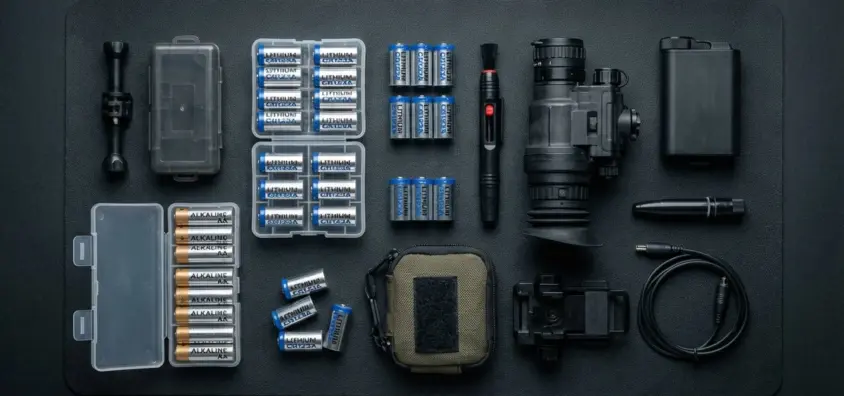
CR123A lithium cells are the standard choice for serious NV use. They maintain capacity in cold weather significantly better than alkalines — lithium chemistry retains approximately 80% capacity at 0°F compared to alkalines’ 20–30%. They have a flat discharge curve, meaning the device runs normally until the cell is nearly depleted, then drops off quickly.
CR123As cost more per cell than alkalines and aren’t available everywhere. Carrying a dedicated supply rather than expecting to resupply at a rural gas station is standard practice for hunters running CR123A-dependent devices.
Rechargeable lithium-ion (18650, 16340, RCR123A)
Many newer NV and thermal devices run rechargeable lithium-ion cells — either 18650 format or proprietary packs. Lithium-ion has excellent energy density and recharge cycles, but cold-weather performance falls between CR123A lithium and alkaline. At very low temperatures, lithium-ion cells can temporarily reduce capacity, recovering when the cell warms.
Warming a lithium-ion powered device (in a pocket or inside a pack) before use in extreme cold restores much of the lost cold-weather capacity. Practical cold-weather practice for lithium-ion devices: keep the device inside your outer layer until needed, operate it, return it inside when not actively in use.
Which chemistry to choose
For most hunting use: CR123A primary lithium for devices that accept it, because cold performance is significantly better than alkalines. For devices running AA cells, carry lithium AAs (Energizer Ultimate Lithium or equivalent) rather than alkalines if you hunt in cold climates. They’re more expensive but the cold-weather capacity retention justifies the cost on a per-hunt basis.
What actually drains batteries
Image intensifier tubes (analog NV)
The image intensifier tube is the primary power draw in analog NV devices. Higher-performance tubes — Gen 3 vs Gen 2 — are not necessarily less efficient, but devices with higher photocathode voltage requirements draw more current. Battery life figures vary widely between devices: some monoculars claim 50+ hours on a pair of AAs; others specify 10–15 hours on the same cells. These differences are real and reflect actual circuit and tube design differences, not just marketing variance.
IR illuminators
The built-in IR illuminator in most analog NV devices is a significant power draw — often equal to or greater than the tube itself. A device rated at 40 hours with illuminator off may deliver only 12–15 hours with the illuminator running at full power. This isn’t a footnote in the specifications; it’s the operational reality for anyone hunting in conditions that require active illumination.
For illuminator-heavy use, carry spare batteries and plan your expected runtime with the illuminator on, not off. The spec-sheet figure with illuminator off is nearly irrelevant for dense-canopy or total-darkness hunting scenarios.
Thermal sensors
Thermal devices draw significant current continuously — the sensor must be maintained at operating temperature (some require periodic non-uniformity correction cycles that consume additional power) and the image processing electronics run constantly. Thermal devices typically specify 4–8 hours of runtime on internal batteries, compared to 20–50 hours for passive analog monoculars. Plan accordingly: thermal devices require battery management strategies that analog monoculars don’t.
Display type and brightness
Devices with high-brightness OLED or high-resolution LCD displays draw more power than devices with basic phosphor screen outputs. Reducing display brightness where conditions allow is a meaningful power-saving step for devices with adjustable display settings. Some devices auto-adjust brightness; others require manual adjustment.
Wi-Fi and Bluetooth
Smart NV devices — digital scopes with app connectivity, ATN’s X-Sight line, and similar products — run wireless radios that draw power whether you’re actively using the feature or not. Disable Wi-Fi and Bluetooth when you’re not using ballistic apps or recording, especially on all-night sits.
Strategies to extend runtime
Use illuminators at minimum necessary power
Most IR illuminators offer multiple power settings. Start at the lowest setting that produces usable image quality. High-power illuminator modes are for specific applications — total darkness at extended range — not default operation. Matching illuminator power to actual conditions rather than running maximum power all night is one of the most effective battery-saving practices.
Power down between active observation periods
If your hunting involves extended periods of waiting between observation events, powering down the device when not actively glassing is the single largest battery-saving measure. A device with 8-hour runtime that’s powered on for a 10-hour sit will die before the sit ends. The same device powered on only during active observation periods extends that runtime significantly.
Image intensifier tubes take approximately 1–2 seconds to reach full performance from a powered-off state. Thermal devices take 30–90 seconds for sensor initialization. Know your device’s startup time before relying on quick power-cycling in situations where fast target acquisition matters.
Keep batteries warm
Carry spare batteries in an inner pocket against your body in cold weather. Cold batteries in a cold pack perform worse than room-temperature batteries. Swapping in freshly warmed spares adds operational time compared to running cold spares.
For devices that allow battery removal during storage, store the device without batteries when not in use. This prevents slow self-discharge from parasitic loads in standby mode.
Understand your device’s specific draw profile
The only accurate battery-life figure for your specific hunting setup is the one you measure in your actual hunting conditions. Run a test: charge your device fully or load fresh batteries, set up in conditions similar to your hunts, and time how long it runs before low battery notification. Do this before the season, not during it.
Document the result against the conditions: temperature, illuminator settings, display brightness. This becomes your operational planning baseline.
Carry strategies for the field
One spare battery set is a minimum for any night hunt. Two sets is standard for all-night operations. Pre-labeled batteries (date of purchase) help you rotate stock and avoid using expired cells. Alkalines degrade in storage; lithium primary cells (CR123A) have much longer shelf lives — 10 years for quality cells.
A dedicated battery pouch in your hunting kit, pre-loaded with the right cells for each device, prevents the specific failure mode of having the right batteries in the wrong pocket. If you run multiple NV devices — a monocular, a thermal scope, and a rangefinder — pre-kit the spares for each device separately.
Reading the device’s actual battery indicator
Battery indicators on NV devices vary in accuracy. Some devices display a three or five-segment indicator that updates as voltage drops. Others display “low battery” only when voltage has already dropped below functional threshold — giving minimal warning before shutdown.
Understand where your device’s indicator is on the warning-to-shutdown timeline. If your device shows “1 bar” at 80% capacity remaining, that’s very different from a device that shows “1 bar” at 10% capacity remaining. The only way to know is to watch the indicator across a full discharge cycle under controlled conditions.
Review the limits of night vision guide and the field testing vs specs breakdown for more on calibrating spec-sheet claims against real operational performance.
Summary
Battery management for night vision is a planning discipline, not a reactive one. The hunters who run into dead devices mid-hunt are the ones who relied on spec-sheet figures in conditions that don’t match the test scenario. Know your chemistry, know your device’s real draw at your operational settings, and carry enough spares to cover your planned hunt duration with margin for the unexpected.
Running a device to dead battery in the field is avoidable. It just requires thinking about power as a consumable resource that requires the same planning as ammunition, food, and water.
IR Illuminator Not Working With Night Vision? Beam, Battery, Focus and Compatibility Check.
Is your NV not turning on? Battery, Contacts, Mount and Tube-Safe Troubleshooting
Night Vision Collimation and Alignment: Fix Double Vision, Eye Strain and Dual-Tube Setup Issues