
March 11, 2026
NETD Explained: Why This Spec Matters More Than Resolution
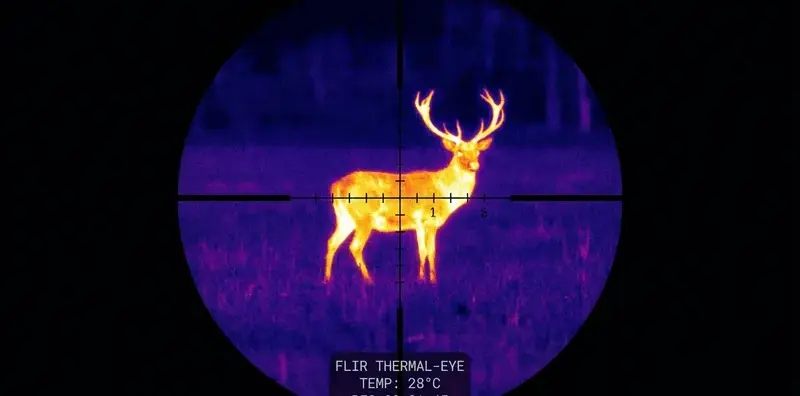
Resolution gets all the attention. Buyers compare 384 vs 640 the way they compare megapixels on phone cameras, assuming more pixels automatically means a better image. The spec that actually determines whether you can pick out a deer in a brushy draw at 5:30am is NETD, and most buyers barely know what it means.
What NETD measures
NETD stands for Noise Equivalent Temperature Difference. It’s measured in millikelvin (mK). The number tells you the smallest temperature difference between two objects that the sensor can distinguish from background noise.
Every sensor has a noise floor. Random variations in electron movement create what appears to be temperature variation when there isn’t any real thermal difference present. NETD tells you how much actual temperature difference you need before a real signal rises above that noise floor and becomes a usable element in the image.
A sensor with 25mK NETD can resolve a temperature difference of 0.025 degrees Celsius from background noise. A sensor at 50mK needs twice that real temperature difference before it shows you anything useful. In high-contrast conditions — cold night, warm animal against cold ground — both sensors perform well. In marginal conditions, the 25mK sensor shows you details the 50mK sensor shows as visual texture or random noise.
For a broader starting point on how thermal imaging works within the larger context of night vision technology, the night vision beginners guide covers the basic physics before getting into spec comparisons.
Lower is better, but there are real costs
Better NETD comes from better detector material, tighter manufacturing tolerances, and better electronics for reading the signal off the focal plane array. These cost money. A detector at 25mK costs significantly more to produce than one at 40mK. This is why you find 25mK on mid-to-high-end units and budget thermal runs at 50mK or higher.
When a manufacturer charges extra for a lower-NETD variant of the same unit, you’re paying for either a better-sorted detector from the same production run, or a fundamentally different detector material or design process. Both represent real engineering costs, not just a number someone decided to put in the specs.
Why NETD beats resolution in specific conditions
Resolution determines how finely the sensor samples the thermal scene. NETD determines whether the differences it’s sampling are meaningful or just noise. These two things interact in ways that surprise buyers who haven’t thought through it carefully.
A 640×512 sensor at 50mK is taking 327,680 individual samples of a scene. But if many of those samples fall below the sensor’s detection threshold, the extra samples don’t add useful information. The image looks detailed but contains less actual signal about what’s in front of you. You’re seeing a high-resolution picture of noise.
A 384×288 sensor at 25mK is taking 110,592 samples, but each one more reliably represents a real temperature difference. In a situation where contrast is marginal — warm morning, animal in tall grass, sun starting to come up — the lower-resolution, higher-sensitivity sensor can show you a clear animal outline where the higher-resolution, lower-sensitivity sensor shows you texture that might be anything.
This shows up in military thermal procurement testing going back decades. Detection range doesn’t scale linearly with resolution. The sensitivity floor matters at least as much, especially during the transitional light conditions that define most real hunting situations. The full breakdown of what specs actually predict in practice is covered in the night vision technology overview.
Dawn and dusk: where NETD matters most
The performance gap between a 25mK sensor and a 50mK sensor is small when you’re hunting at midnight in January with fresh snow on the ground. Both sensors see a hot animal against cold ground clearly. The gap opens up during the two windows that define most hunting.
At dawn, ground temperatures are close to air temperature and animal body temperatures. The thermal contrast between a deer and the ground it’s standing on narrows. Meanwhile, sunlit objects are beginning to warm and create competing signatures. The scene becomes low-contrast and cluttered at the same time.
At dusk, earth warmed during the day is radiating stored heat. Roads, bare rock, and open ground can read nearly as warm as an animal. The sensor has to find the temperature edge between a deer’s body and a sun-warmed field behind it. NETD determines whether your sensor can make that distinction or loses the animal in background clutter.
If you’re using a thermal device primarily for scouting at first light, NETD is the spec to prioritize. If you’re hunting deep at night with maximum contrast, the resolution advantage matters more. For a look at how manufacturer-claimed specs compare to performance in actual field conditions, the discussion in field testing vs. spec sheets is worth reading before making a final decision.
Pixel uniformity and what it hides
NETD interacts with another spec buyers often miss: pixel uniformity, or non-uniformity correction (NUC). The focal plane array in a thermal sensor is an array of individual detector elements, and each one has slightly different sensitivity characteristics. NUC processing corrects for these variations to produce a uniform image.
A sensor with poor NUC will show “fixed pattern noise” — a subtle grid or texture overlaid on the image that comes from the inconsistent pixels. This pattern becomes more visible in low-contrast scenes, where background texture matters more because there’s less real signal to look at. Good NETD paired with poor NUC produces a sensitive but visually messy image in certain conditions. When you’re evaluating a unit, looking at it in low-contrast conditions rather than pointing it at a warm person in a cold room reveals the actual NUC quality.
The 25mK vs 12mK question
Military and professional thermal is pushing below 20mK now, with some detectors reaching 12-15mK. For hunting applications, the real-world benefit of going from 25mK to 15mK is smaller than the benefit of going from 50mK to 25mK. Below 25mK you’re already well above the noise floor for most conditions a hunter encounters.
The meaningful thresholds for consumer thermal roughly break down as:
- Above 50mK: acceptable in ideal conditions, marginal in difficult ones
- 35-50mK: functional across most conditions, some weakness in low contrast
- 25-35mK: performs well in the transitional light conditions hunting actually happens in
- Below 25mK: diminishing hunting returns at a significant cost increase
If you’re trying to upgrade a thermal’s performance in marginal conditions, going from 40mK to 25mK is a meaningful step. Going from 25mK to 15mK at two or three times the cost is not, for most hunting applications.
How manufacturers obscure the number
Some manufacturers publish typical NETD rather than worst-case NETD. Typical NETD is an average across the sensor array. Worst-case is the outlier pixels. A unit with good average NETD but poor worst-case will have visible hot or cold pixels in low-contrast scenes — small persistent bright or dark points that aren’t real objects in the scene. These are sometimes called “stuck pixels” and they’re most obvious when the scene has low thermal contrast.
If a spec sheet doesn’t specify which measurement they’re publishing, assume it’s typical. This is one of the areas covered in the limits most buyers overlook, where spec sheets consistently show the favorable number unless you know to ask about the other one.
The practical takeaway
When comparing units at similar price points, ask specifically about NETD and whether it’s typical or worst-case. A manufacturer who provides both is being more transparent about actual performance than one who only provides the average.
For the buying decision itself: a 384×288 at 25mK will outdetect a 640×512 at 50mK in the conditions hunting actually happens in — low contrast, transitional light, animals partially obscured. If you’re choosing between these two on a budget, buy the better sensor. You can scale up resolution later. You cannot fix a bad NETD floor with software processing.
IR Illuminator Not Working With Night Vision? Beam, Battery, Focus and Compatibility Check.
Is your NV not turning on? Battery, Contacts, Mount and Tube-Safe Troubleshooting
Night Vision Collimation and Alignment: Fix Double Vision, Eye Strain and Dual-Tube Setup Issues