
April 27, 2026
Night Vision Reticle Types: What Hunters Need to Know
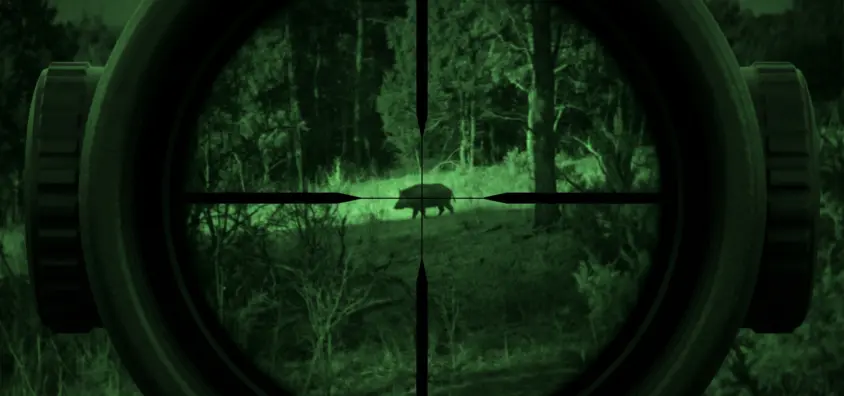
Pick up two riflescopes at random and the reticle inside each one probably looks different. That difference barely registers during daytime hunting \u2014 your eye finds the crosshairs, you aim, you shoot. But mount those same scopes on a night rig, behind a phosphor tube or a digital sensor, and reticle choice suddenly decides whether you connect or miss. Low light shrinks your margin for error. A reticle that is too thin vanishes against dark fur. One that is too thick covers your target at distance. The wrong brightness setting washes out whatever contrast you had.
\n\n
This guide walks through the reticle types you will actually encounter in night vision and thermal scopes, how they behave under NV conditions, and which ones make sense for specific hunting situations.
\n\n
Why reticle choice matters more under night vision
\n\n
Daytime shooters pick reticles based on preference. Night hunters pick them based on necessity. Three factors change the equation.
\n\n
First, field of view through a night vision device is already narrow. Most Gen 3 tubes deliver a 40-degree FOV, and scoped magnification cuts that further. A cluttered reticle with multiple stadia lines and hash marks eats into the already limited sight picture. You want enough information to hold over, not a ruler printed on your lens.
\n\n
Second, contrast is reduced. Even with a good white phosphor tube, you are working with shades of green or gray against a dark background. Thin wire reticles that are perfectly visible at noon disappear at midnight. You need a reticle that maintains visibility without overwhelming the image.
\n\n
Third, detection range under NV is shorter than most shooters expect. Identifying a target at 200 yards through a Gen 3 monocular is doable. Making a clean shot at that range requires a reticle you can see and align precisely. The reticle has to work at your realistic engagement distance, not some theoretical maximum.
\n\n
Common reticle types
\n\n
Duplex (or German #4)
\n\n
The duplex reticle is the most widely used pattern in hunting scopes, and for good reason. Thick posts on three sides taper to thin crosshairs at the center. Your eye naturally gravitates to the intersection. Under NV, the thick outer posts remain visible even when the thin center lines get lost. This makes duplex reticles a practical choice for close to mid-range night work, roughly out to 150 yards.
\n\n
The downside is limited holdover information. A duplex tells you where the center is, not where to hold for a 200-yard shot. If you plan to shoot at multiple distances under NV, you will need to know your drops and hold by memory.
\n\n
Mil-dot
\n\n
Mil-dot reticles place small dots along the crosshairs at mil-radian intervals. Each dot represents a specific holdover point. For shooters who know their ballistics, this translates to precise long-range aiming without dialing turrets.
\n\n
Under NV, the dots can be difficult to see if they are too small. Illuminated mil-dot reticles solve this but add battery dependence. The reticle also tends to look busy through a tube with limited FOV. If you shoot at varying distances under NV and you have your drop chart memorized, mil-dot works. For fast close-range work, it is more information than you need.
\n\n
BDC (bullet drop compensator)
\n\n
BDC reticles use hash marks or circles calibrated to specific bullet trajectories at set distances. Common configurations mark 100, 200, 300, and 400 yards. The idea is simple: know your distance, pick the right mark, squeeze the trigger.
\n\n
The catch is that BDC calibration assumes a specific load, barrel length, and atmospheric condition. Your actual trajectory may not match the reticle’s marks, especially with subsonic ammunition or suppressed rifles common in night hunting setups. BDC reticles work well when you have verified the marks against your actual load at the range. They are unreliable when used straight from the box without confirmation.
\n\n
Illuminated reticles
\n\n
Illumination adds a powered light source, usually an LED, to the reticle. Brightness is adjustable. In NV applications, illumination becomes essential for many reticle types because the ambient light through the tube is not enough to see fine crosshairs.
\n\n
The risk with illumination is bloom. Turn the brightness too high and the reticle glows outward, covering the center of your target. At night, you typically need the lowest or second-lowest setting. Some scopes designed for NV use have dedicated night-vision-compatible brightness settings that dim below what a daytime shooter would use.
\n\n
Digital reticles (electronic NV and thermal)
\n\n
Digital night vision scopes and thermal imagers render the reticle as an overlay on the display. This changes everything. The reticle is no longer a physical etching on glass. It is software.
\n\n
Digital reticles offer multiple pattern options, color choices (red, white, green, black), and adjustable thickness. You can switch from a simple crosshair to a mil-dot to a BDC pattern with a few button presses. Some thermal scopes even allow custom reticle designs or multiple zero profiles for different loads.
\n\n
The trade-off is that digital reticles are only as good as the display. On a low-resolution thermal sensor, the reticle may appear pixelated at high magnification. Battery life also becomes a factor since the reticle draws power continuously.
\n\n
Reticles for analog NV scopes
\n\n
Analog night vision scopes \u2014 those using Gen 2 or Gen 3 image intensifier tubes \u2014 use traditional glass-mounted reticles. These come in two varieties.
\n\n
Etched glass reticles are laser-etched onto a lens element inside the scope. They are durable and do not shift with recoil. Under NV, etched glass reticles benefit from illumination because the etched lines are subtle. Most quality NV-compatible scopes use etched glass.
\n\n
Wire reticles use thin metal wires stretched across the tube. They are simpler and cheaper but less durable under heavy recoil. Wire reticles are rare in scopes designed for NV use because the wires are difficult to see through an image intensifier without heavy illumination.
\n\n
If you are shopping for an analog NV scope, etched glass with adjustable illumination should be on your checklist. Wire reticles are acceptable on budget options for low-recoil calibers, but expect to run illumination at higher settings to compensate.
\n\n
Reticles for digital NV and thermal scopes
\n\n
Digital scopes handle reticles entirely in software. This is both an advantage and a source of confusion for shooters coming from traditional optics.
\n\n
Color choice matters on a digital display. White reticles show up well against dark thermal backgrounds but wash out against hot targets. Red reticles provide good contrast on most thermal palettes but can blend into white-hot targets. Green reticles work well on black-hot palettes. Many experienced thermal shooters keep two or three color options configured and switch between them based on conditions and palette selection.
\n\n
Reticle thickness is another consideration that does not exist with glass reticles. Thin digital reticles give you precision at distance. Thick reticles are faster to pick up for close-range targets but cover more of the image. Some scopes offer a “dual thickness” reticle that is thin at the center and thick on the outer posts, mimicking a duplex pattern in digital form.
\n\n
First focal plane vs second focal plane in NV
\n\n
In a first focal plane (FFP) scope, the reticle grows and shrinks with magnification. This means your holdover marks are always correct regardless of zoom. In a second focal plane (SFP) scope, the reticle stays the same size while the image scales. Holdover marks are only accurate at one magnification setting, usually maximum.
\n\n
For NV hunting, FFP has a practical advantage if you change magnification in the field. The reticle calibration stays true. But the reticle appears thicker at high magnification, which can obscure small targets. At low magnification, the reticle may become difficult to see through a tube.
\n\n
SFP reticles are more common in hunting scopes. They maintain a clean, consistent appearance across all magnification levels. If you zero at one magnification and leave it there, SFP works fine. The holdover marks only line up at max power, but many NV hunters pick a single magnification and stick with it.
\n\n
The choice between FFP and SFP under NV comes down to whether you adjust magnification while hunting. If you do, FFP saves you from mental math. If you do not, SFP is simpler and the reticle looks cleaner at any zoom level.
\n\n
Choosing the right reticle by hunting type
\n\n
Hog hunting
\n\n
Hog hunters typically engage at close to medium range, often between 30 and 150 yards, frequently from elevated stands or vehicles. Shots are fast. Targets move quickly. A simple duplex or illuminated crosshair reticle is ideal. You do not need holdover marks at these distances with most calibers. What you need is a reticle you can pick up instantly and place on a moving target. Illumination on a low setting keeps the crosshair visible without bloom.
\n\n
Coyote hunting
\n\n
Calling coyotes at night produces shots at varying distances. A coyote might come in to 40 yards or hang up at 250. You need a reticle with holdover capability. A mil-dot or BDC reticle gives you options. The BDC is faster if you have verified it with your load. The mil-dot is more flexible if you shoot different loads or engage at non-standard distances. Illumination is essential for both, and a solid zero is the foundation everything else builds on.
\n\n
Deer hunting
\n\n
Deer hunting under NV tends to be more deliberate. Shots are taken at known distances from prepared positions. A duplex reticle works for most deer hunting scenarios under NV because engagement distances are typically within 200 yards and shot placement matters more than holdover. If you hunt fields where deer appear at 300+ yards, a BDC reticle calibrated to your load gives you the extra reach.
\n\n
Reticle brightness and eye strain
\n\n
Eye strain is an under-discussed problem in night vision hunting. Staring at a green phosphor screen for hours fatigues the eye. A bright reticle compounds this by adding a concentrated light source at the center of your field of view.
\n\n
The correct approach is to run your reticle illumination at the lowest setting where the crosshair is still visible against your target. This is usually one or two settings above minimum. If you can see the reticle clearly with both eyes open, it is bright enough. If it is glowing or leaving afterimages when you blink, turn it down.
\n\n
Some digital NV and thermal scopes offer an auto-dimming feature that adjusts reticle brightness based on scene illumination. This is worth using if available, as it prevents the reticle from becoming a distraction when you transition between darker and lighter areas of your hunting ground.
\n\n
Take breaks. Periodically look away from the scope and let your eyes adjust to ambient darkness. This is not just comfort advice. Fatigued eyes make worse shot-placement decisions, and shot placement is already harder under NV conditions.
\n\n
Frequently asked questions
\n\n
Can I use a standard daytime reticle with a night vision device?
\n
You can, but results vary. Thin crosshairs that are perfectly adequate during the day often disappear under NV. If your scope has illumination, a daytime duplex reticle can work for close-range shooting. For consistent results at varying distances, look for reticles specifically designed or tested with NV equipment.
\n
\n\n
What reticle color is best for thermal scopes?
\n
There is no single best color. It depends on your palette. Red reticles contrast well against black-hot and many color palettes. White reticles disappear against white-hot targets. Green reticles work on most palettes but can blend into certain color schemes. Many thermal shooters switch between red and green depending on conditions. Configure your scope so switching takes one or two button presses.
\n
\n\n
Do I need an illuminated reticle for night vision hunting?
\n
For analog NV scopes, yes in most cases. The light coming through an image intensifier tube is not bright enough to make thin crosshair lines visible. Illumination bridges that gap. For digital NV and thermal scopes, the reticle is always illuminated because it is rendered on a display. The question becomes brightness level, not whether to illuminate.
\n
\n\n
Is first focal plane better than second focal plane for night hunting?
\n
Neither is inherently better. FFP is useful if you change magnification during a hunt because holdover marks stay calibrated at all zoom levels. SFP maintains a consistent reticle appearance but holdover marks are only accurate at one magnification setting. Most NV hunters pick a magnification and stay with it, which makes SFP practical and common.
\n
IR Illuminator Not Working With Night Vision? Beam, Battery, Focus and Compatibility Check.
Is your NV not turning on? Battery, Contacts, Mount and Tube-Safe Troubleshooting
Night Vision Collimation and Alignment: Fix Double Vision, Eye Strain and Dual-Tube Setup Issues