
March 28, 2026
Night Vision Accessories Guide: Mounts, Adapters, and Add-Ons Explained
The night vision device is the beginning, not the end. Whether you’re running a monocular on a head mount, a scope on a rifle, or a clip-on in front of a daytime optic, the accessories you choose determine whether the system actually works in the field. A $3,000 PVS-14 running on the wrong mount is less useful than a mid-grade setup configured correctly.
This guide covers the complete accessories ecosystem for night vision equipment: mounts, adapters, IR illuminators, battery systems, and supporting gear. For a foundation on the technology itself before diving into accessories, see the night vision beginners guide. The IR illuminator buyer’s guide goes deep on the illuminator category specifically if that’s your primary need.
Mounting Systems for Monoculars
Monoculars like the PVS-14 and its commercial equivalents are designed to mount on helmets, head mounts, or weapons. The mounting interface matters as much as the device itself.
J-Arm and Breakaway Shroud (Helmet Mounting)
The standard military mounting interface for tube-based monoculars uses a J-arm (the curved aluminum or polymer bracket that connects the device to a helmet shroud). The J-arm determines:
- Bridge height — how far the optic sits from your face
- Forward throw — standoff distance from the helmet
- Breakaway function — some J-arms include a tension-based disconnect that allows the monocular to break free on impact, protecting the tube
For civilian use with bump helmets (MICH, FAST, ACH), a standard J-arm with a NOROTOS or Wilcox-style mount is the correct setup. The critical measurement is the interpupillary distance and eye relief — this is set by the J-arm’s positioning along the shroud.
Budget J-arms (Norotos clones from overseas suppliers) are mechanically functional but use softer alloys that strip threads under repeated adjustment. The pivot point is the failure point to inspect — look for wobble before trusting it in the field.
Quality J-arms from Wilcox Industries, NOROTOS, or Ops-Core use aircraft-grade aluminum and have a tighter fit tolerance. Price difference is significant ($80–$200 vs $25–$40), but the functional difference under hard use is also significant.
RHINO Mount
The RHINO mount was originally developed for the PVS-7 biocular and adapts to single-tube monoculars via a dovetail interface. It provides a lower profile than the J-arm configuration and is preferred by some users for vehicle operations and tight-space work. The RHINO interface is not universal — verify compatibility with your specific monocular dovetail pattern.
Skull Crusher Strap
For users who want head-mounted NV without a helmet, the skull crusher headband mounts directly to the skull with a metal frame and foam padding. The name is accurate at first — the clamping pressure needed to keep it stable during movement is uncomfortable until the foam breaks in. Skull crushers work but are not suitable for extended wear. For situational awareness and navigation use cases, they are adequate.
Rifle Mounting for Monoculars and Clip-Ons
Offset Arm / Dovetail Rail Adapter
Mounting a monocular on a rifle for aided aiming requires an offset or straight arm that positions the device in front of the eye at the correct eye relief for your rifle stock. The most common configuration uses a Picatinny (MIL-STD-1913) rail mount with an adjustable arm.
Key specifications:
- Eye relief from tube to eye: Monoculars have specified eye relief ranges — the mount must position the tube within this range for your specific stock length
- Cant adjustment: Most quality mounts allow rotational adjustment so the NV image is level
- QD vs fixed: Quick-detach mounting allows fast transition between head mount and rifle mount; fixed mounts are more rigid but slower to transition
Clip-On Compatibility
Clip-on night vision mounts ahead of a daytime scope and uses the scope’s reticle for aiming. The key requirement is objective bell clearance — the clip-on housing must clear the objective bell of your daytime scope, and the focal plane needs to align correctly.
Most clip-ons are designed around specific scope objective diameters. A clip-on rated for 50mm objectives may not seat correctly on a 56mm objective without an adapter ring. Verify the objective bell diameter of your scope before purchasing a clip-on. See the night vision rifle mounting guide for the full setup procedure.
IR Illuminators: Types and Applications
IR illuminators are active light sources that project near-infrared light invisible to the naked eye but visible through NV devices. They extend the effective range of NV in conditions where ambient light is insufficient for passive operation.
Built-In vs. External Illuminators
Most monoculars and digital NV scopes include a built-in IR illuminator. Built-in units are convenient but limited in output power and often fixed at a specific wavelength. For routine close-range use (inside 100 yards), built-in illuminators are adequate.
External illuminators allow you to add significantly more IR power:
Flood illuminators — wide-beam units that illuminate a broad area. Useful for general situational awareness, navigation, and short-range hunting. The PEQ-15 and MAWL replicas offer adjustable flood/spot settings in a weapon-mount package.
Spot illuminators — narrow-beam units that project intense IR at long range. For hunting applications past 200 yards where you need to illuminate a specific area, a spot illuminator mounted separately provides range that no built-in unit can match.
Wavelength considerations: 850nm illuminators are standard and provide the best range, but the diode is slightly visible as a faint red glow to human eyes and some animals. 940nm illuminators are completely invisible to both, but provide less range per watt of output.
Adapter Rings and Optical Interfaces
Dovetail to Picatinny Adapter
Some older NV monoculars (particularly surplus units) use a dovetail mounting pattern rather than Picatinny. Dovetail-to-Picatinny adapters allow these units to mount on modern rails. Quality matters here — a loose adapter creates parallax shift and defeats the purpose of a rigid weapon mount.
J2 / Data Port Adapters
Some NV monoculars include a data port (commonly called J2 or J-4 on military-spec units) that allows digital recording, power input, or remote operation. The J2 interface is not standardized across all manufacturers, even when the physical connector appears compatible. Verify adapter compatibility with your specific unit’s documentation.
Magnifier Adapters
Attaching a 3x or 5x magnifier behind a monocular increases effective identification range. Key consideration: the magnifier must be parfocal with the NV device at the magnification setting you’re using, or the image will be soft.
Night vision image quality degrades with magnification — doubling magnification roughly halves apparent resolution. A quality 1x image at 200 yards becomes a marginal 2x image at 400 yards. Know what you’re trading before adding magnification.
Battery Solutions
AA vs. CR123A vs. Proprietary Rechargeable
Most civilian NV monoculars run on AA or CR123A batteries:
AA alkaline: Widely available, inexpensive, but lose capacity rapidly in cold weather. Below 20°F, expect 40–50% of rated capacity. Below 0°F, alkaline batteries fail.
AA lithium (Energizer L91): More expensive but maintain capacity down to −40°F. The correct choice for winter hunting. Lithium AAs run longer per cell than alkaline in cold, which matters for multi-day hunts.
CR123A lithium: High energy density and excellent cold weather performance. Used in many tactical and military NV devices. Less universally available than AA but more energy-dense per gram.
Proprietary rechargeable packs: Most modern thermal and digital scopes use manufacturer-specific lithium rechargeable packs. These are convenient for daily hunting use but carry risk for remote trips where charging is unavailable. Carry at least one spare pack.
Protective Equipment and Cases
Protective Caps
Objective and eyepiece protective caps protect the lens coatings when the unit is not in use. Lens coating damage from debris — especially in the objective — significantly reduces image quality on Gen 3 tubes. Original equipment caps tend to be the best fit; aftermarket caps sometimes fit loosely and fail to stay attached.
Hard Cases
For transport, a hard case rated to IP67 or better protects tubes from moisture and physical shock. Pelican and SKB cases with custom foam cutouts are standard. Do not ship NV equipment in soft cases — the tube inside is a glass vacuum vessel and does not tolerate impact.
Anti-Reflection Devices (ARD)
ARD sleeves fit over the objective bell of a monocular and dramatically reduce the distance at which the tube’s lens is visible as a point of light when illuminated from outside the field of view. Rarely used by hunters but useful for situations where remaining undetected is a priority.
Cleaning and Maintenance Accessories
Lens Cleaning Protocol
NV objective and eyepiece lenses have specialized coatings that are damaged by standard lens tissue and isopropyl alcohol. The correct approach:
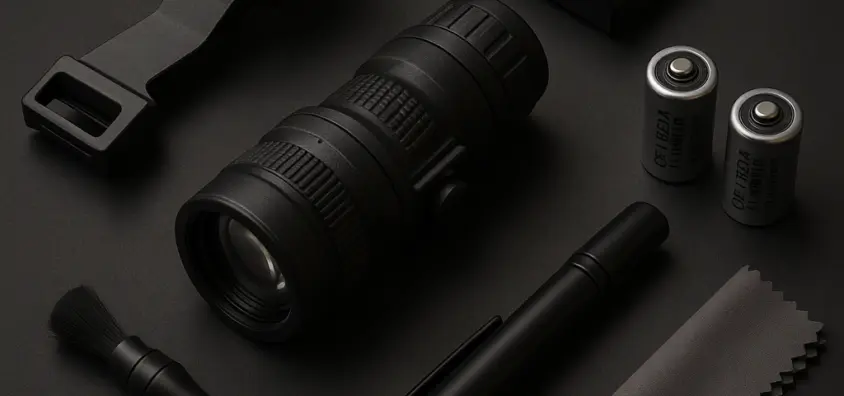
- Air blast first — remove loose particulates with a hand blower (not compressed air, which can contain oil)
- Lens pen — camel hair brush end removes remaining dry debris
- Lens tissue + optics-specific cleaning solution — not general-purpose glass cleaner
Never use paper towels, clothing, or abrasive surfaces on NV lenses. The coatings are significantly more delicate than standard optics coatings.
What to Buy First: Priority Order
If you’re building a complete NV system from scratch, this is the accessory priority order:
- Correct mounting system for your intended use — helmet, rifle, or handheld
- Spare batteries / battery system appropriate for your climate
- IR illuminator if you need range beyond your device’s built-in
- Hard case for transport
- Lens cleaning kit
- Magnifier if identification range is a limiting factor
- Advanced adapters and interfaces based on specific mission requirements
The common mistake is buying accessories out of this order — investing in a high-powered external illuminator before having the mounting solution dialed in means carrying extra gear that can’t be used effectively.
For a complete overview of NV specifications to understand before making any accessory purchase, read the how to read night vision specs guide.
IR Illuminator Not Working With Night Vision? Beam, Battery, Focus and Compatibility Check.
Is your NV not turning on? Battery, Contacts, Mount and Tube-Safe Troubleshooting
Night Vision Collimation and Alignment: Fix Double Vision, Eye Strain and Dual-Tube Setup Issues