
July 13, 2026
PVS-14 vs Dual-Tube Night Vision: Monocular, Binocular, and Budget Tradeoffs Explained
Many new buyers are misled when they try to choose between the PVS-14 and the dual tube night vision scope. A PVS-14-type monocular can make a significant field tool. Dual tube NV has a better comfort level and is easier to move around with. There are no "right" answers to either of these questions.
If I had to work with a first time civilian buyer, I’d build a long term system or a helmet or train with it or go walking rough ground or hunt from a set up, in that order. While tube count is important it isn’t the complete system. Just as important are tube quality, helmet fit, mount stability, battery planning, training time and legal use.
This guide examines PVS-14 vs binocular night vision, and informs you in practical terms which one to choose without purchasing unnecessary equipment.
The short answer: PVS-14 vs Dual-Tube Night Vision.The short answer to the question of PVS-14 vs Dual-Tube Night Vision is that most beginners should start with the best single-tube setup they can afford unless they already know they need long-duration movement comfort.
Unless the beginner has first-hand experience of requiring long-duration movement comfort, they should begin with the best single-tube machine available to them. A good Night Vision Monocular for a beginner used properly on a good helmet will bring about the basics, but not the most expensive category of Night Vision Monocular from the beginning.
Dual tubes are best suited to heavy walking, scanning, navigating or NV working during long sessions. They are not magic. They don’t make poor tubes good, nor are they substitutes for practice.
If your budget, flexibility, and learning are your top priorities, opt for a PVS-14.
The first system is typically more versatile, a PVS-14 type monocular. Helmet mount it, handhold it, use it as a scanner, give it to someone else, or put it in the collection bag for use later. For a lot of property owners and hunters, that’s more important than having two tubes.
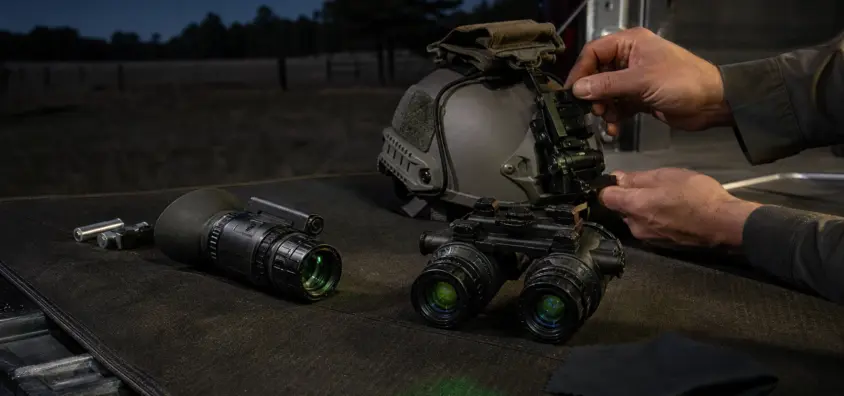
A helmet PVS monocular also helps maintain an overall more manageable system. This is important because the device is just part of the deal. Helmet / headborne platform, mount, J-arm / dovetail interface, counterweight (where applicable), spare batteries, retention / storage, time to train.
If comfort and mobility are paramount, opt for dual tubes.
Dual-tube night vision enhances the night vision for both eyes. That’s typically more comfortable during walking, scanning, crossing rough terrain and spending hours under night vision. Comfort can make a difference when using it for long rural property checks, security work, frequent night training or rough terrain.
But, the question is, are dual tubes better? Basically, it’s "are dual tubes worth it for what I do?"
When selecting a tube, don’t just look at the number of tubes.In choosing a tube, don’t only look at the number of tubes.
A good PVS-14 will come in more handy than a bad dual tube NVG with substandard tubes, poor equipment and an uncomfortable helmet. When purchasing, know the fundamentals of how tubes work: generations, S/N ratio, resolution, and image quality. If you still need some help understanding the spec sheet, NV Guide USA has a great night vision technology guide to help you out.
What you will actually have with a PVS-14 setup.
PVS-14 is a monocular with one tube. The device is viewed with one eye. The other eye is left alone unless it is closed, covered or allowed to function in ambient light. Yes, that’s a restriction, but that’s also what has made the platform so popular for so long.
Single tube, single eye, reduced overall system cost.
Normally the entry level cost is lower with one tube and one housing than with a dedicated binocular system of comparable tube quality. I don’t like to get into price arguments, because the price of night vision varies depending on the grade of the tube, housing, warranty, used-market condition, and vendor support. The stable part is this: see a full system, not just a device list.
A good night vision budget setup should consist of:
- Non-wobbling helmet or head harness.
- A stable mounting and arm.
- Counterweight/battery solution if necessary.
- Spare batteries and protective storage.
- Safe practice time – on legal property or a range.
The common error is using all the money on the tube, and then attaching it to substandard support equipment. Having a clear picture won’t do much good if the monocular bounces, sags or is in the wrong position. For the helmet side of the system, please refer to the NV Guide USA guide on night vision helmet setup: https://nvguideusa.com/blog/night-vision-helmet-setup/
The monocular remains a formidable night vision device for several reasons.There are a number of reasons why the monocular is still a serious night vision device.
When the use case is real, a PVS-14 for hunting or property monitoring or just plain old night viewing may be sufficient. When stationary, a monocular allows you to observe the terrain, track movement, walk short distances, control gates or equipment, and be aware.
It also frees up your free eye. Some users appreciate this feature as they may still be able to utilize the ambient light, vehicle lights, porch lights or close-up tasks through the non-night vision eye. Some people find the combination image exhausting. It’s personal and typically evident with actual use.
A PVS-14 has limits in the field.In the field, a PVS-14 can feel limited when movement becomes more complicated.
The restrictions become more apparent when movement becomes more complicated. Monocular use is more challenging in the presence of uneven terrain, brush, fences, equipment, and for long walking sessions. While moving well with one tube is possible, it means the brain must merge a bright intensified image from one eye with a darker natural image from the other.
The perceived separation can impact night vision depth perception and tiredness. It might seem like a lot of work but it’s manageable, and just takes practice. If you want more of a breakdown of how night vision can affect your eyes, dark adaptation and eye fatigue, NV Guide USA has a separate article on it.
What Dual-Tube Night Vision Changes
When each eye is provided with its own intensified image, dual-tube night vision, or sometimes referred to as binocular night vision, can be used. This can help to make the image look more natural and less like "working out how to interpret the terrain".
Improved natural viewing and reduced visual conflict.
Both eyes operate in a similar brightness and image style with dual tubes. This minimizes the "one eye in daylight, one eye in darkness" sensation that a user can experience with a monocular. This typically leads to greater comfort, but not necessarily to better detection range.
Dual tubes aren’t necessarily twice the visibility. However, detection is still dependent on your ability to identify what you are seeing, weather, terrain, target contrast, supplemental IR, and tube quality.
The gentle motion and scanning facilitate easy movement.The gentle motion and scanning allows for more comfortable movement.
The beauty of dual tubes is that they move. When using binocular NV, walking tends to feel more normal, particularly with regard to steps, slopes, ruts, low branches and obstacles. The scanning can also be smoother as both eyes are used.
This is why night vision goggles for civilians are popular with people who are constantly on the move for extended periods of time, as opposed to just looking at a field edge from one spot.
Dual tubes don’t necessarily double the performance because they do not.So dual tubes don’t double the performance, and that is why.
Two tubes of lesser quality do NOT equal one good tube. Even with a good helmet system, weak ones will make expensive goggles uncomfortable, as can a poorly balanced binocular system which can cause neck strain. Compare the entire system, rather than housing shape.
When making inter-device category purchases use NV Guide USA’s night vision product section and comparison hub to ensure that you are basing your purchase on real device types and not brand marketing.
The differences between monocular and binocular night vision – the field tradeoffs that matter.
This is the real-life comparison I would make before I would shell out any cash.
| Category | PVS-14 / Monocular | Dual-Tube / Binocular |
|---|---|---|
| Cost control | More easily fits into a complete beginner system | Expensive device, same support equipment requirements |
| Weight and bulk | Often lighter on the helmet | Usually heavier, but can be better balanced when properly set-up |
| Comfort | Suitable for shorter sessions and practice | Suitable for longer sessions and movement |
| Depth perception | More visual conflict, more training needed | More natural reading of terrain for most users |
| Training curve | Good for an inexperienced user on the platform but somewhat strange initially | Easier visual experience, still requires training |
| Hunting utility | Very workable from fixed positions and short movement | Better for long walks, tracking and scanning-heavy nights |
| Upgrade path | Remains useful as scanner, loaner or back-up | More complete end-state system, less modular if needs change |
The ability to gauge distances and have confidence about the ground.
The vision that takes place at night is different from daylight vision. Despite having dual tubes, the picture is still not as flattering as natural light and there is also a field of view restriction. Dual tubes can give a degree of confidence as both eyes see a similar image, but they can’t replace slowing down and reading terrain.
Many with a PVS-14 get to know to make use of head movement, shadows, texture and conscious foot placement. That skill matters. Hardware can assist, but under any night vision setup, careless movements can result in falls, noise and bad decisions.
During extended night vision use, users may experience eye fatigue.
Night vision eye fatigue is different for each individual. Some users get used to monocular viewing fairly soon. Others experience headaches or they feel like their eyes are tired after spending a long night. Usually, that strain is diminished with dual tubes, as the brain isn’t having to reconcile so different an image between the eyes.
A monocular might suffice if you only use night vision occasionally, to check around your property. Comfort is a greater factor to consider binoculars if you intend to spend hours moving, scanning and working under the device.
Weight, balance, and helmet strain
Just because a PVS-14 is light doesn’t mean it’s comfortable. With a poor fitting helmet, loose shroud, weak arm or if the counterweight is missing, the monocular can feel worse than a heavier but well balanced binocular setup.
Dual tubes add up to more weight up front. Many users offset this with rear weight or a battery pack. There’s no prize for the lowest spec sheet. The ultimate target is a helmet that is stable, without hot spots or neck strain.
Hunting Use: Is a PVS-14 Enough?
Yes, a PVS-14 may be sufficient for many hunters. The straight answer is that it depends on your style of hunting, how much ground you cover, from a stand or a vehicle accessible area and what your state permits.
From fixed positions – hunting of hogs and predators
PVS-14 can be a valuable piece of observation equipment in conjunction with legal illumination and safe identification procedures for a fixed position hunt for hogs and predators. It can be used to move to position, to see gates, to see field edges and to keep alert.
The aiming method is a separate question. Some hunters employ thermal imaging gear for detection, night vision gear for navigation, or special long-range shooting gear. Never assume that an animal is in view through a PVS-14 is a safe, legal and ethical shot.
Property monitoring and navigation
A helmet-mounted night vision monocular is often the practical starting point for landowners that are conducting a barn check, tree line check, fences, driveways or livestock areas. It’s hands free and doesn’t turn on white light on every occasion.
Dual tubes are more appealing when property checks require a longer walk, rougher terrain, and/or repeated scanning over the course of several hours.
The advantages of dual tubes over a monocular can be seen in specific situations.There are certain situations where dual tubes are more useful than a monocular.
Dual tubes are more easily understood when the job in hand requires movement – from walking on uneven terrain, through heavy cover to working with a partner or having to be in goggles for extended periods. If you spend most of your time at night standing around to observe, then this comfort won’t be worth your money. The argument gets even stronger if your night use is "move for two hours without tripping over everything."
Even if you are a skilled user, you must first ensure compliance with the law.
There are various rules for night vision hunting, which depend on the state, the species, the season, the land type, and the equipment. Artificial light, IR, night vision, thermal and suppressors are different laws in some states. Prior to any night hunting setup, be sure to look at NV Guide USA’s night vision hunting laws by state resource and make sure to check with the correct agency for current regulations.
When making your first purchase, here are some of the features you should focus on.
The most expensive doesn’t necessarily make the best night vision setup for beginners. It’s the setup that the user can afford, install properly and train safely.
A good tube might need no additional housing.If the tube is good, it may not require additional housing.
In most beginner scenarios I would prefer the better tube over a weaker binocular. The quality of the tube will affect the clarity of the picture, usefulness in low-light situations and noise, contrast, and the amount of supplemental IR that may be required.
That is particularly critical with respect to Gen 2 vs. Gen 3 comparison. Do not take it for granted that two lower-tier tubes are better than one higher performing tube – read NV Guide USA’s Gen 2 vs Gen 3 night vision guide first.
The costs of helmet, mount, J-arm and counterweight.
An upgrade path for PVS-14 begins with a solid base. Any helmet design that is substandard or unstable is a waste of money because it makes the helmet more difficult to use. Plan for support equipment when planning for the tube.
This is also where attempting a friend’s configuration can be deceiving. The size of their helmet, the height of the mount, the distance between their eyes, the dominant eye and how they use their helmet may not be what you need.
Hardware upgrades are no match for training time.
A trained user with a monocular can often move better than an untrained user with expensive dual tubes. Start with simple tasks – walk slowly, read terrain, open gates, etc., use maps/phones carefully, and return to white light as necessary.
NV Guide USA’s how-to guides are helpful for building up those fundamentals without making night vision feel like a shortcut.
Do not make the “dual tubes, bad support gear” mistake.Don’t make the ‘dual tubes, bad support gear’ mistake.
Avoid purchasing dual tubes and cutting all the corners on the helmet, mount, retention, batteries and storage. If the entire system is not stable, the additional tube will not correct the system. It is better to have a full monocular setup rather than a partial binocular setup.
The actual difference in cost can be calculated by doing some math.
Device cost vs full system cost
When setting up a night vision budget, always take into consideration the entire kit (device, helmet, mount, arm/interface, counterweight/battery solution, storage, retention, and practice time). The buyer with the lower purchase price for the device, but a more complete system, could end up with the better real-world system.
The following is an indication of the expectations for used PVS-14, new PVS-14, and dual-tube systems.
Attractive used PVS-14s can be found, but condition is a factor. Inquire about tube blemishes, spec sheets, warranty transfer, condition of housing, corrosion of battery compartment, previous use and reputation of the seller. New devices are more expensive, and might have support and better documentation. If it’s a real field issue, dual tubes add cost and complexity, which means the additional dollars should resolve an issue.
Renting, borrowing or trying before buying when it makes sense.
Try out a monocular and a binocular if possible, before purchasing. You can only find out how comfortable, how well balanced, and how eye-fatigue is a problem by trying it on a borrowed night, at a rental event, with a trusted friend’s helmet.
This is an upgrade path from the PVS-14, to avoid getting stuck.
Are there good or bad uses of PVS-14s mounted on bridges?
A binocular style setup can be achieved by some users who are using two PVS-14s in tandem. It can work, if you already have one monocular and buy another. Disadvantages are weight, alignment, level of control and bulkiness versus a dedicated binocular housing.
Bridging can be acceptable if it is used occasionally. Sometimes a dedicated housing is cleaner for a serious long-term binocular system.
A monocular can be kept as a loaner, scanner, or backup.
Eventually you may choose a dual tube solution, but the PVS-14 can still be used as a handheld scanner, partner loaner, back-up device or a lightweight travel device. One reason that the monocular path makes sense for cautious buyers is the retained value.
You should move into a binocular housing when you’ve reached this stage.If you’re at this point, it’s time to buy a dedicated binocular housing.
When your actual use necessitates, sell and move to dual tubes, such as during long sessions, repeated movement, eye fatigue or professional/security needs. Never upgrade due to the internet claiming a monocular is ‘entry level.’ Upgrade because it’s a field use that has revealed a genuine limitation.
Use cases are provided with a decision framework.
If you still can’t find the answer, refer to this context.
The ideal option for those new to civilian use.
Use a good quality PVS-14 style monocular and full helmet setup. Before investing in an expensive binocular system understand the capabilities and limitations of night vision.
Best choice for hunters
PVS-14 may be sufficient in situations where the hunting position is not moving or movement is limited like property checking. If you are going for long walks, tracking, rough terrain, and even a longer scanning, then you may be more inclined to buy the dual tubes. Before using, always check the legality.
Designed for longer patrols or security work, it is the best choice for these applications.
Dual tubes are typically the better device to use for long duration movement and scanning. When equipped with night vision for hours, comfort, reduced visual conflict and terrain confidence are more important.
If you are looking for a home on a tight budget, this is the best option.For those on a budget, this is the ideal choice.
Purchase the highest quality complete monocular system that you can afford! Don’t purchase low quality dual tubes and have to skimp on helmet fit, mount stability, and training.
Best choice for PVS-14 users already having one.Best choice for users who already own a PVS-14.
Continue using until you can identify the limitation. Dual tubes may be the way to go if the restriction is eye fatigue, long movement or constant scanning. If it is poor mounting or focus or lack of practice, fix this first.
When comparing PVS-14 and Dual Tubes, several common mistakes can be made.There are some common mistakes people make when comparing PVS-14 and Dual Tubes.
Typically, the incorrect selection is due to thinking of the gears individually.
Since you have spent all the money on tubes, you ignore the helmet.You spend all of the money on tubes and ignore the helmet.
Night vision is an item of equipment. Any helmet movement results in device movement. Loose mount \= annoying picture. When your balance is not good, your neck suffers. Support gear is a must.
Dual tubes do not correct bad movement habits.Dual tubes do not correct bad movement habits.
Dual tubes can help with the movement but are no automatic. You still have to slow down, turn your head around and check your footing, IR timing, and also don’t be stingy with the light that you’re using.
If you compare a high quality monocular with low quality binoculars, you’re making a disservice to the binoculars.It would be unfair to compare a high quality monocular to low quality binoculars.
Keep comparisons fair. Tube quality, housing quality, warranty, support – all count! Two tubes is not a spec sheet in itself.
Dominant eye, dark adaptation and fatigue are ignored.Dominant eye, dark adaptation and fatigue are not considered.
Some users highly prefer the monocular over one eye. Others must change sides and/or adjust set up. Comfort is influenced by dominant eye, helmet alignment, unaided-eye darkness and session length. Don’t assume anything before trying out the device.
The Bottom Line: What Night Vision Setup to Purchase First?
I would begin with a decent PVS-14 style monocular with a good helmet mount and funds to train with for the first use for a majority of civilians. That way you will have true night vision power, the system will be flexible, and you won’t be over buying until you know what you need.
Dual tubes are an added expense, but if comfort, movement, scanning and long sessions are a primary requirement, then they are beneficial. Binocular night vision may be the more convenient option for frequent walking on rough terrain, long duration under night vision conditions or for security-type work.
Before spending more, find out what really irritates you. Is it because of the one-eye or is the helmet poorly balanced? Is it an issue with depth perception or too fast? Are you restricted by the tube or is the mount unstable? Take some time to reflect on those questions and the PVS-14 vs dual tube night vision choice will fall into place.
IR Illuminator Not Working With Night Vision? Beam, Battery, Focus and Compatibility Check.
Is your NV not turning on? Battery, Contacts, Mount and Tube-Safe Troubleshooting
Night Vision Collimation and Alignment: Fix Double Vision, Eye Strain and Dual-Tube Setup Issues