
June 9, 2026
Thermal Scope Reticles Explained: Which Reticle Should Hunters Use at Night?
By the end of this article, you should be able to understand thermal scope reticles and decide which one is best suited for your hunting needs at night.
A thermal scope reticle is similar to a small menu option until you are behind the rifle at night, and an animal is traversing warm grass. Then it must be conspicuous, provide a clear sightline, and match a zero confirmed in actual use.
Most contemporary thermal scopes come with a variety of digital crosshair or reticle choices: crosshairs, dots, duplex reticles, BDC-style reticles, mil or MOA hash marks, and occasionally ballistic or smart reticles. Not all of the choices work for all hunters. A close-range hog rifle, open-field coyote setup, and multi-rifle thermal scope system may require different reticle settings.
This guide will tell you how to select a real night hunting thermal scope reticle.
The Short Version
For the majority of hunters, a simple center crosshair, duplex-style reticle, or a clean dot-style aiming point that is a high-contrast color is the best option. Zero at the distance you hunt. Only add BDC, mil, MOA, or ballistic references after you have verified the drops on your rifle, ammunition, velocity, zero distance, and real field conditions.
When hunting for hogs up close, simple and visible often trumps complicated. When hunting coyotes in open areas, smaller aiming points and known holdover can be useful, particularly if distance is verified. In all instances, abide by night hunting regulations in your area, be sure to ethically identify the target, and never exceed your personal range of identification or ballistic range.
What Is a Thermal Scope Reticle?
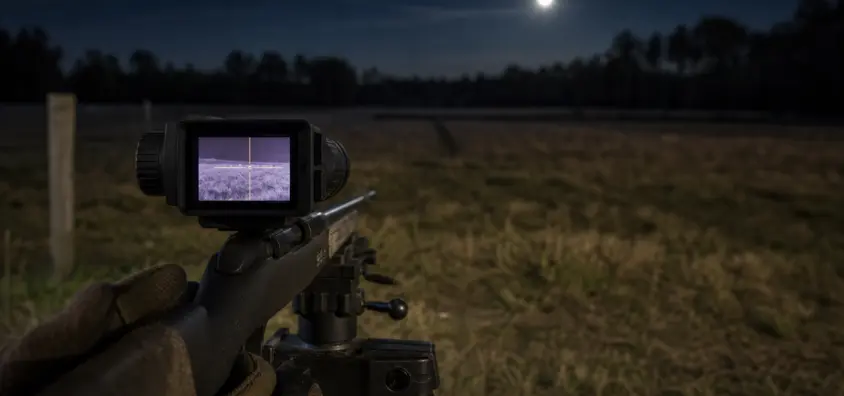
The thermal scope reticle is the aiming reference that is superimposed on the thermal image. On most thermal rifle scopes, it will be simply a digital overlay on the display and not a hard-etched glass reticle as with a traditional scope.
Digital Reticles vs Traditional Scope Reticles
The traditional riflescope reticle is typically permanently set in the optical system. A digital reticle thermal scope allows you to adjust the shape, color, brightness, and in some cases profile behavior through the menu.
The background picture behind the reticle also changes. Thermal scope sight pictures can be influenced by white hot, black hot, humidity, warm ground, brush, display brightness, contrast, and digital zoom.
Reticle Choice Does Not Replace a Proper Zero
The type of reticle you’re using will influence how you aim. Zeroing makes point of aim and point of impact coincide. Those are separate jobs.
Changing from a dot to a crosshair won’t correct the rifle if it isn’t zeroed. When the incorrect zero profile is set on the thermal scope, a clear reticle may still cause the shot to go astray. If you need to go through the zeroing process, begin with how to zero a thermal rifle scope.
Common Thermal Scope Reticle Types
There are various types of thermal scope reticles that address different issues. Select according to visibility, speed, distance, and known information.
Simple Crosshair
The best place to begin for most hunters is to have a simple thermal scope crosshair. It provides a clear center reference with no additional marks to decipher under pressure. A plain crosshair is quick and easy to confirm and is most useful for a thermal scope that is used for hog hunting, particularly in a common close-to-mid-range setting.
A very thin crosshair may vanish when viewing brush, hot ground, or a noisy thermal image. If your optic has line thickness settings, opt for the thinnest line that you are still able to locate quickly.
Center Dot or Fine Dot Reticle
A fine dot or center dot reticle obscures less of the target. That can be beneficial for targeting a small coyote chest or a specific area on a hog’s shoulder. The compromise is that a small dot could disappear in a high-contrast picture.
Before heading out in the field, try out the dot reticle in the evening hours if you prefer that type of reticle.
Duplex-Style Reticle
A duplex reticle will provide you with thicker outer posts and a cleaner center. The posts draw your attention to the middle without overwhelming the entire image.
Duplex is a good compromise between a simple crosshair and a more complex holdover reticle for new thermal users.
BDC-Style Reticle
The thermal scope BDC reticle provides holdover references below the center aiming point. It may be of benefit only if those references correspond with your rifle, the cartridge, the weight of the bullets, the muzzle velocity, the distance to zero, the height of the optic, and the actual distance at which you will be hunting.
Even if the BDC mark appears clean on the display, do not assume that it is accurate. Assume all BDC references are not confirmed until they are verified by live fire.
Mil or MOA Hash Reticle
A thermal scope mil reticle or MOA hash reticle provides angular holds or corrections. These reticles are more flexible than generic BDC patterns, but are only useful if you have confirmed drop data and understand mils or MOA.
If you do not use mil or MOA holds during the day, night hunting is not the best place to learn them under pressure.
Ballistic or Smart Reticles
Certain thermal scopes feature ballistic profiles, rangefinder workflows, or smart aiming references. With the right setup, these can be helpful, particularly with a thermal scope with rangefinder.
Brands and models offer a wide range of features. Ballistic data, range input, zero confirmation, rifle data, and ammunition data are what make a thermal scope ballistic profile trustworthy.
Reticle Color: Why Visibility Matters More Than Looks
Thermal scope reticle color has to do with contrast. The ideal color is the one that can be found instantly without obscuring the aiming point and without straining the eye.
Reticle Color in White Hot Mode
In white hot mode, warmer objects look lighter. A dark or black reticle may show up better on a light-colored animal, and red or green may show up better on a mixed background.
Reticle Color in Black Hot Mode
In black hot mode, hot objects will appear darker. A dark reticle that worked in white hot may blend into a dark animal. A brighter color might stand out, but it can be distracting if it’s too strong.
The white hot black hot reticle decision should be done outside, not on a menu screen.
When Bright Reticles Become a Problem
Reticle over-brightness can result in blooming, overpowering the image, obscuring small aiming details, and eye fatigue. The aim is not brightness; it is thermal scope reticle visibility.
Practical Starting Point for Most Hunters
Choose one primary color for white hot and one for black hot. Do color and palette tests before hunting. When making adjustments in thermal scope settings, such as brightness, contrast, gain, and sharpness, also check reticle visibility.
Matching Reticle Type to Hunting Distance
The type of reticle should depend on the actual problem of the shot.
Close-Range Hog Hunting
A bold, simple, and fast night hunting reticle is recommended for close-range hog hunting. Hogs can be traveling, concentrated in large numbers, or partially obscured by brush. A simple crosshair or duplex type reticle will work better than a busy holdover pattern.
When hunting feeders, senderos, timber edges, or known lanes, don’t add clutter for the sake of having it. Check out NV Guide USA’s best thermal scopes for hog hunting guide for more options on optics.
Open-Field Coyote Hunting
A holdover reference, mil/MOA reticle, or smaller aiming point can be a good improvement for a thermal scope for coyote hunting. Coyotes will stall at unknown distances, and bullet drop becomes significant as the field widens.
This does not imply that all coyote hunters are required to have a complicated reticle. It means distance, zero, and verified holds become more important. The NV Guide USA’s best thermal scopes for coyote hunting guide addresses the larger optic decision.
Mixed Terrain and Unknown Distances
Mixed terrain is where hunters have the tendency to misjudge range. Thermal removes a lot of daylight information, and digital zoom can give an animal a larger appearance without any additional sensor information. Before stretching distance, know the distances for thermal detection, recognition, and identification distances using known landmarks and pre-range lanes when possible.
Reticles, Rangefinders, and Holdover
Thermal scope holdover is only applicable if distance and drop are known well enough to matter. You can get extra reticle marks that can assist, but they can also give false confidence.
Why Distance Is Hard to Judge Through Thermal
Thermal heat can be detected easily, but may make distance more difficult. Shadows, color, texture, and background detail are diminished. Another effect of the field of view is that it alters the perception of movement and distance, making thermal scope field of view relevant.
Built-In LRF and Ballistic Reticles
By providing an inbuilt LRF, this can allow holdover decisions to be made more reliably as you would have a distance read within the shooting workflow. If the optic also includes ballistic information, then it could link range and drop.
However, the LRF does not recognize the animal, read the wind, confirm zero, or prove the ballistic data. Live fire is still required.
Handheld Rangefinder or Scanner Workflow
Many hunters scan or range individually and then go to rifle only after being able to identify the target. That can lead to a simpler rifle reticle, as the range work takes place prior to the shot.
Reticles and Zero Profiles
Profiles that show zero are good, but they become an issue if the hunter over-assumes.
What a Zero Profile Actually Saves
A thermal scope zero profile can store zero coordinates, rifle labels, ammunition labels, reticle settings, distance labels, ballistic data, or all of these. The behavior is dependent on the optic used.
Read the manual, clearly label profiles, and test the thermal scope point of aim to thermal scope point of impact with live fire.
Using One Thermal Scope on Multiple Rifles
Sometimes, one thermal scope can be transferred from one gun to another, but every rifle requires a verified setting. Mount position and rail fit alone can make a difference, then there’s ammunition, recoil, suppressor use, and optic height.
If you have any setup issues that could interfere with your zero, check out how to mount a thermal scope.
When to Reconfirm Zero
Reconfirm zero after remounting, changing ammunition or changing rifles, taking a hard impact, adjusting the mount, making a major seasonal change, or having a miss you can’t explain.
Common Reticle Mistakes Hunters Make
Choosing the Most Complicated Reticle First
Complicated reticles are impressive in the menu but cluttering slows down new users. Start simple.
Trusting BDC Marks Without Verifying Drops
BDC marks are not a fact. Perform live-fire confirmation of meaningful holds at actual distances.
Ignoring Reticle Visibility in Real Conditions
Visibility can change due to humidity, warm ground, brush, rain mist, and palette choice. Test under conditions similar to your hunts.
Forgetting Which Zero Profile Is Active
Wrong profile, wrong rifle, wrong ammunition, and even wrong zero distance can appear to be a reticle issue.
Using Digital Zoom Without Understanding the Reticle
Digital zoom alters the apparent size of the target. Reticle behavior and hold references may be different at different zooms, depending on the model. Understand how your scope works before using hold marks; base magnification vs digital zoom.
Practical Thermal Reticle Setup Checklist
- Choose one main reticle.
- Select a primary color to use for white hot and a primary color to use for black hot.
- Check zero at your primary hunting range.
- Check the reticle on hot targets and warm backgrounds.
- Save and label profiles properly.
- Write the name of the rifle, ammunition, zero distance, reticle type, reticle color, and profile name.
- Check BDC, mil, MOA, or ballistic holds via live fire.
- Before hunting, check the local laws on hunting at night.
- Zero must be reconfirmed prior to the season or following remounting.
Best Reticle Choices by Use Case
Here are some of the best reticle selections based on use case:
| Use case | Practical reticle choice | Why it works |
|---|---|---|
| Beginner hog hunter | Simple crosshair or duplex | Rapid sight picture, less clutter, and easy zero confirmation |
| AR-15 predator hunter | Simple crosshair with optional holdover reference | Clear center with some verified holds |
| Longer field coyote hunter | Fine crosshair, mil/MOA, or verified ballistic reticle | Helps when range and drops are confirmed |
| Multiple-rifle user | Simple reticle and well-labeled profiles | Manages zero in a disciplined manner and prevents confusion |
| Scanner-first hunter | Visible center aiming reticle | Range data is separate, allowing the rifle reticle to remain clear |
Final Verdict
The best reticle for thermal scope hunting is the most rapidly and accurately perceived and the easiest to use in your own environment. For most hunters, that is a basic thermal scope reticle with a high-contrast color and a proven zero.
Verified range and drop data can tie in to advanced reticles when they are of assistance. For those who hunt hogs at close range, the reticle should be bold and simple. When hunting coyotes in open fields, familiarize yourself with your range and make sure of your shots. Easy beats hard, verified beats assumed.
IR Illuminator Not Working With Night Vision? Beam, Battery, Focus and Compatibility Check.
Is your NV not turning on? Battery, Contacts, Mount and Tube-Safe Troubleshooting
Night Vision Collimation and Alignment: Fix Double Vision, Eye Strain and Dual-Tube Setup Issues