
June 11, 2026
Thermal Scope Display Resolution Explained: OLED, LCOS, and Why Sensor Specs Aren’t the Whole Image
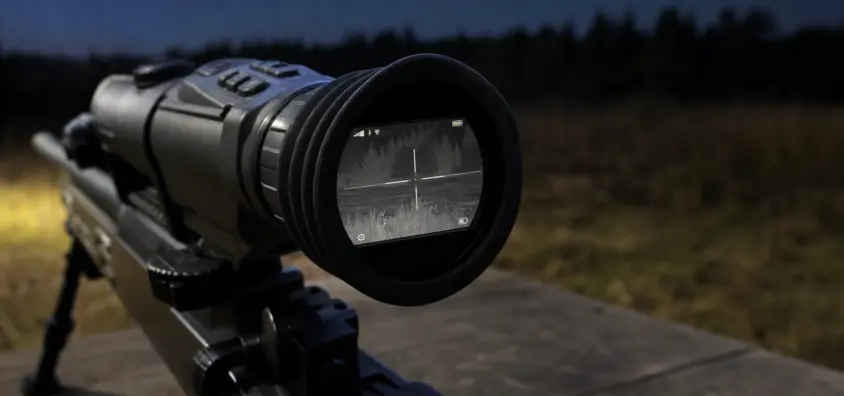
Thermal Scopes are not used to find heat. The sensor and the lens do that. Now, the last place where all of that thermal data translates into what your eye can see is a display, and this is where many hunters don’t realize that display resolution makes a big difference.
When comparing two scopes with similar sensor specs, the eyepiece display can influence the feel of the image, the readability of the reticle, the appearance of digital zoom in a long stand, and eye fatigue. This can make a budget scope appear better in a store than in the field, and it can also make a good sensor feel like it’s not up to scratch because the image is poorly displayed.
The secret is determining what the display can do and what it can’t.
The Short Version
Thermal detail is dependent on the scope’s sensor resolution and lens quality. Resolution of the display and the type of display will affect how well that picture can be viewed by the eye.
An improved thermal scope eyepiece display can assist in:
- Fine aiming points, reticle sharpness.
- Menu text, battery icons, range data and zeroing profiles.
- Use digital zoom to adjust the size of the image.
- Elucidation of eye comfort in long observation sessions
- A contrast/contrast smoothness perception (according to display technology and processing)
It can’t create heat detail that the sensor didn’t record though. Having a 384 sensor doesn’t turn it into a 640 sensor. A 640 sensor can be a mediocre sensor in a mediocre lens with a mediocre focus, thermal setting, eyepiece or on a mediocre display.
If you’re looking for more general content, then begin with understanding thermal sensor resolution explained, and the thermal scope performance comparison between 384 and 640 pixel resolutions. This article is about the screen that you actually read on.
What is Thermal Scope Display Resolution?
Thermal scope display resolution is the number of pixels on the small screen within the scope’s eyepiece. This is the screen which displays the thermal image, reticle, menu, icons, battery level, palette, magnification readout, rangefinder data (if available) and zeroing information.
That display is not the thermal sensor (also known as the microbolometer) itself. The sensor is used for identifying the difference in temperatures. Thermal scope sensors come in 256, 320, 384 and 640 class sizes and above. The display may be 1024×768, 1280×960, 1440×1080, or another format depending on the scope.
The two numbers refer to different components of the system:
- Resolution of a thermal sensor: amount of heat data that the scope collects.
- The number of pixels in the internal eyepiece display used to display the processed image.
This is where many spec sheets cause confusion. A scope can have a higher resolution display and a 384 sensor. That may seem cleaner than a 384 sensor on a coarse display, particularly for menus and reticles, but the detail is still capped by the 384 sensor, lens, pixel pitch, focus and processing.
Display Resolution vs Sensor Resolution
The first and most critical rule of buying is to remember: Display resolution is NOT sensor resolution.
If you consider similar lens quality, pixel pitch, focus, NETD, and processing a 384 sensor captures fewer thermal samples than a 640 sensor. It’s scaling the information from the sensor, and a high resolution display can show that 384 image without any trouble, but it can’t present it without scaling. It cannot show hair, leg position, ear shape, or background separation that was not resolved by the sensor.
At the same time, a 640 sensor is not necessarily a picture-perfect sensor. The 640 sensor can be supported by:
- A lens whose focal length is too small or is not the same size.
- Low accuracy or quick adjustment of the diopter
- Aggressive image processing
- Weak contrast settings
- Low refresh rate
- The display does not correctly display the processed image.
- Uncomfortable or soft looking eyepiece optics
That’s why the thermal scope display resolution is important. The sensor is the source of the detail of the field. The display is the delivery system. Both should be good enough that they will not be undermining.
If you’re looking at the core specs, you should also check out the 12 micron vs 17 micron thermal scope pixel pitch guide and the base magnification vs digital zoom article. These specifications can tell you more about the quality of their real image than just the display resolution.
Why Spec Sheets Make This Confusing
Thermal scope specifications can be misinterpreted, leading people to the wrong conclusion when purchasing a scope. There are multiple resolutions that can be listed on a product page and these can’t be swapped out for each other.
You may see:
- Sensor resolution
- Display resolution
- Video recording resolution
- Photo resolution
- App streaming resolution
- The resolution can be set to HDMI or external output.
One of those is the thermal detector. The screen in the eyepiece is the only one you can view with the display resolution. Resolution recorded can be upscaled or compressed. The limited resolution of an app stream may be due to wireless transfer, phone display, app settings, or file format. An eyepiece scope that looks sharp on a cell phone does not mean that it will resolve more details in the field.
When considering thermal scope image quality, one always should ask: which resolution number are we talking about and where does it occur in the system?
The reasons behind the importance of display resolution in the field
Resolution is important because hunting isn’t on a spreadsheet. You’re reading through an eyepiece in cold weather, possibly with gloves on, and you need to make a quick decision without making a wrong one.
Reticle visibility and fine aiming
One of the most practical issues to consider about the display is thermal scope reticle visibility. Center dots, hash marks, holdover references and small menu indicators can be more easily seen on a higher quality display, but will be distracting if they obscure much of the animal.
It’s important when shooting from sticks, a tripod or an AR-15 at night trying to land a shot on a quartering hog or a coyote that is never a still target. The display does not resolve the target, but it can help to sharpen the target’s image relative to the thermal image.
If you are considering a thermal scope for reticle setup, don’t rely on marketing images, but instead read the thermal scope reticles explained guide.
Digital Zoom Image Quality
Thermal scope digital zoom image quality greatly relies on the sensor, while the display plays a role in the image’s tolerability. Digital zoom magnifies the amount of data available on the sensor. It does not include additional thermal data.
At 384 scope 2x digital zoom can block out rather rapidly, particularly at long range. A good display can make the scaling look cleaner and keep the edges of the reticle readable, but won’t make a distant coyote look like a high detail image. However, on a 640 scope, there’s more information to work with and, if all of the optics are good, the image is likely to hold together better.
This is the reason why open field coyote hunters are more interested in the sensor, lens, base magnification and presentation on the display than a close-range, feeder, timber edge or pasture lane hog hunter.
Readable menus and zeroing
The information which is useless and boring when something goes wrong, is also present on a thermal scope display: battery status, magnification, palette, zero profile, reticle, range data, wireless status and menu text.
A good shot display is useful when confirming the proper zero for a suppressed AR-15, changing loads, or for safety when working in the dark without a guess. It is further beneficial for old eyes. The icons are small, smeared, or difficult to distinguish from the scene, which slows down the scope’s action.
On the settings side, see thermal scope settings explained and how to mount a thermal scope to not depend on display comfort for proper setup.
When observing for extended periods, fatigue may occur in the eyes
The hunters who spend long periods of time in the field understand the importance of comfort. A display that is harsh, flickery, smeared, too bright or hard to see through can strain the eye. This includes the display resolution, but also the refresh rate, brightness adjustment, eyepiece optics, diopter adjustment, palette selection, processor contrast handling, etc.
It’s important for those who shoot for predator control situations in which they spend more time watching empty fields than shooting. A dramatic-looking scope for five minutes at a counter can be exhausting after a complete night.
OLED, AMOLED, LCOS and LCD in Thermal Scopes
Display type is important but it isn’t a magic rank. Implementation matters. While a well-done LCOS display can be better than a poorly implemented OLED system, a well-done OLED screen can be limited by bad processing or eyepiece design.
Thermal Scope OLED Display
Images are displayed using pixels that emit light in a thermal scope OLED display. Simply put, the pixels can illuminate instead of a conventional backlight. OLED displays are frequently recognized for their high contrast ratio, blacks, and fast response time. For thermal scopes, that could mean menus, reticles, and high-contrast thermal scenes appear crisp.
The practical benefit is the presentation of the image. Black or white hot palettes might appear more like a “clean” palette, while fine reticle elements might be more noticeable when the brightness is set appropriately. The downside is that OLED quality is variable and the display cannot compensate for a poor sensor, small lens, poor focus or poor settings.
Thermal Scope AMOLED Display
Thermal scope AMOLED display is an active-matrix display that features an OLED technology. In many instances, AMOLED is regarded as an expensive material, and for many buyers, it can be bright, sharp, and responsive. It’s not a question of “AMOLED or not?,” it’s a question of “AMOLED or not AMOLED?”. It is whether you get a readable picture, comfortable brightness, clear reticle display, and accessible menus when using it in the field.
AMOLED may be a good spec in a scope with a good sensor and lens, but it’s not a good idea to purchase the screen label without paying attention to the thermal core.
OLED vs LCOS Thermal Scope
Another display type employed in a few small viewfinders is liquid crystal on silicon (LCOS). The answer to the question of the OLED vs LCOS thermal scopes is that both can be effective when it comes down to the purchasing decision. The contrast and black levels are frequently mentioned with OLED type displays. When properly designed and executed, LCOS can provide a detailed and stable view.
In the end, what’s important in the eyepiece is the overall performance: resolution, brightness modulation, contrast, apparent size of the screen, refresh characteristics, and optical clarity. If possible, use the scope to view. Otherwise, review authentic field footage and user reports but keep in mind that the footage captured on the camera might not be exactly as it appears on the display.
LCD Displays
Some thermal optics may still have LCD displays, particularly in lower-cost or specific types of devices. They can be useful, but it is important for buyers to take note of the contrast, low temperature performance, brightness range, and clarity of the reticle and menus. Don’t assume LCD will not be usable, and don’t assume OLED will be great. Evaluate the entire viewing system.
What is the adequate screen resolution for use?
For thermal scope buyers, there are no sincere single numbers for the greatest resolution in their display. The distance to be hunted, the digital zoom (using or not), the design of the eyepiece, the base magnification and the sensor are all factors affecting the value of “enough”.
On scopes in the 320 and 384 class, the higher the resolution, the more smooth the image will appear and easier that image will be to read, as well as the menus and reticles. It’s cool, it doesn’t alter the amount of thermal detail captured. When combined with the proper lens and by being used within realistic ranges for identification, these scopes can be very effective when hunting hogs at close range and moderate distances.
With 640 class scopes, screen quality takes precedence as there is more information to be picked up by the sensor. Some of the value of a good display or eyepiece may be lost through being poorly displayed or poorly used. When comparing 640 units, be sure not to end with just sensor resolution. Compare base magnification, lens size, NETD, refresh rate, focus, processing, and 2x and 4x digital zoom capabilities of the display.
The value is based on the scope as a whole, for scopes that have 1280-class sensors or very high resolution eyepiece displays. A sharper display may be more comfortable and more visually appealing, but field identification still depends on captured thermal data, environmental conditions, optics and the shooter’s judgment.
For field of view, use the thermal scope field of view guide for hog and coyote hunting if that is a factor in your decision for a thermal scope. Display resolution will NOT resolve a problem of narrow hunting style.
There are things that Display Resolution does not solve
While it may be helpful to have a better display, it’s not every solution. It does not fix:
- Poor objective focus
- Incorrect diopter adjustment
- Low sensor resolution for the distance
- Weak lens choice
- Bad thermal settings
- Overused digital zoom
- Heavy humidity, rain, fog or thermal cross over conditions
- Poor stability of mounts or zero stability.
- Ethical identification beyond realistic range
This last one is important. “Detection” is not “identification.” Don’t mistake a heat signature for a legal and ethical target. Hunters are expected to abide by the state and local laws, know their property, use safe backstops and confirm what they are shooting before firing. To get that distinction, see thermal detection, thermal recognition and thermal identification distances.
What to consider when comparing thermal scope displays prior to purchase
Do NOT use display specs as the only criteria for buying; use them as part of the process, but not as the final one.
Use this checklist as a starting point:
- Sensor first: 384 or 640 and is that sufficient to your distance and target size?
- Is the scope too base or lens too low to be useful to you for your terrain?
- Display resolution: Do the eye pieces display reticles, menus and present a realistic zoom effect?
- Type of display should be considered based on field display rather than just the label.
- Readability of the reticle: Do you need to obscure much of the target to see the center aiming point?
- Menu clarity: If you have battery, zero profile, magnification, rangefinder and status icons, do they stand out clearly?
- Digital zoom function – Can you zoom in 2x or does the image get grainy right away?
- Brightness/Contrast/Gain/Sharpness/Palette tuning control: Can it be done without battling the menu?
- Comfort: Are you able to see or try to see an hour without eye strain?
- Mount and zero stability: A beautiful display is of no worth if the scope will not zero.
If you’re still adding to your shortlist, take a look at NV Guide USA thermal optics, comparing display specifications only after you’ve considered sensors and lens compromises.
The hunting use case list will display the priorities
Hog Hunting
Comfort and field of view are as important as maximum detail for a thermal scope for hog hunting. Groups of hogs can form, or gather through brush or around a feeder. A well-lit reticle and menu indicators and a non-blooming display are beneficial.
This is very useful at close and moderate distances, and is an example of a 384 scope with a decent lens, proper base magnification, and a clean display. A 640 scope provides more identification and zoom space, however, only if the lens, focus and display afford that.
Coyote Hunting
For a thermal scope to work for coyote hunting, particularly in open fields, the sensor/lens is typically more significant. Coyotes are smaller and tend to be located farther away than hogs. Here, display resolution is important to maintain usability when zooming and aiming, but won’t make up for inadequate sensor detail at distance.
For regular shots of open pasture or crop fields, make sure to focus on sensor resolution, lens focal length, base magnification and realistic identification distance first. Then be sure to not have the display limit the image.
There are three different AR-15 setups, AR-10, and Tripod Setups
A clean display is useful for AR-15s used for close to mid-range predator/hog work as it is helpful for quick reticle acquisition and confidence in the menus. At a longer-range tripod configuration, clarity of displays are more critical for zoom, range readouts, smaller aiming references, and holds.
In both instances, never overlook mounting, eye relief feel, controls and zero profiles. The display on the eyepiece is a component of the shooting system, not a stand-alone spec.
Practical Buying Rule
Purchase sufficient distance sensor and lens for actual hunting distance. Then ensure that the display won’t be wasting what the sensor captures.
For most buyers in the $1,500 to $5,000 range, that means:
- Buying a 640 scope simply because it’s bigger isn’t the right way to go.
- If you purchase a 384 scope, don’t expect the same level of performance as a 640 scope, as the display is more expensive and will not perform as well.
- Look for a display that allows for the use of reticles, icons, menus and 2x zoom.
- Real viewing quality, not buzzwords, when comparing OLED, AMOLED, LCOS and LCD.
- Take into account NETD, refresh rate, lens size, base magnification, pixel pitch, focus, mount quality, and zero stability.
- Do not exceed ethical ID distance, not just detection ID distance.
A thermal scope is a chain of thermal lenses. It’s all about the sensor, the lens, the processing, the display, the eyepiece, the mount, the settings and the shooter judgment. Weakness is most likely to appear in the field.
Final Takeaway
Resolution of the thermal scope is significant, but it is not the cause of thermal detail. It’s the last point of contact between sensor and hunter.
The use of a good display will make the image easier for use. It can enhance the visibility of the reticle, readability of the menus, digital zoom presentation, and eye comfort. Can make a good scope feel faster and more confident in the field. It can’t generate heat data that was never captured by the sensor, lens or processing.
If you want to compare thermal scopes: First look at sensor and lens, then display and eyepiece, and finally settings, reticles, mounting and actual hunting use. It will prevent you from spending more money on the wrong number, and ensure that you select the scope that will work on hogs, coyotes and night shots where the shot must be on target.
IR Illuminator Not Working With Night Vision? Beam, Battery, Focus and Compatibility Check.
Is your NV not turning on? Battery, Contacts, Mount and Tube-Safe Troubleshooting
Night Vision Collimation and Alignment: Fix Double Vision, Eye Strain and Dual-Tube Setup Issues