
June 16, 2026
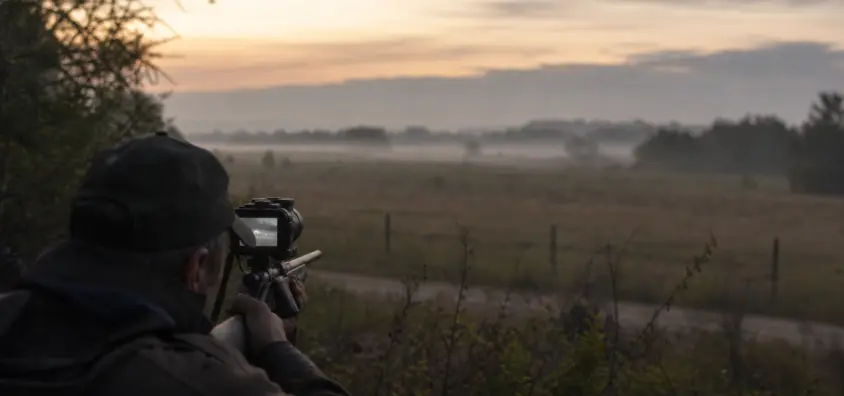
Thermal Crossover Explained: why Thermal Scopes are less contrasty at dawn, dusk and warm, humid, nights.
The Short Version
Unlike a night vision device, a thermal scope does not require moonlight or starlight or an IR illuminator. Constructs an image based on difference in temperature. For this reason, thermal optics are an incredibly beneficial tool for hunting hogs, coyotes, predators, and inspecting open space at night. That’s also the reason why in some cases the image can suddenly appear flat, weak and even a little blurry when the scene is no longer contrasty in the thermal light.
This is known as thermal crossover, the window with low contrast. It occurs when the animal, ground, brush, trees, water, rocks, fences, etc., draw nearer together in temperature. The scope may still be able to pick up a warm shape, but detail of the body, separation of terrain, and identifying features will wash out.
Thermal scope crossover occurs frequently in the morning and evening hours as well as in warm humid evenings, in rain-cooled areas, in foggy weather, and in fields or roads that retain warmth after a sunny day. Contrast can not be generated where it doesn’t exist in the scene with focus and digital zoom. NETD, NUC calibration, and careful adjustment of the gain, contrast, and brightness on the thermal scope can help, but they can never compensate for bad thermal hunting conditions.
A basic field rule is: NEVER use a “bright heat signature” as a positive ID. Thermal is not identification. If it is turning into a "washed out" picture, slow down, reduce the confidence range, and check the target and backstop before taking any shot.
What does Thermal Crossover mean?
Thermal Imaging does not see daylight detail, it sees the difference in temperature.
Image-intensified night vision is a technology that increases the light available. Thermal imaging is not that. It senses the infrared radiation in the long-wave portion of the spectrum from the scene, and transforms temperature variations into a visual picture.
A cold field with a hog in it may be quite noticeable because the hog’s body temperature is greater than that of the ground. Coyotes may exhibit body movement, clean legs and head shape when crossing a frosty pasture. In the field of thermal imaging, this is the best of all pictures: The temperature separation is provided by the scene itself.
As the background temperature increases, or as the animal and terrain are closer to the same temperature, there is less useful separation that the scope can provide. This is thermal imaging low contrast.
Simply put, what is thermal crossover?
Thermal crossover occurs when objects in the scene are at a similar temperature and the thermal image doesn’t have any valuable contrast. It doesn’t imply the scope is damaged. That is, it is flat thermally.
Thermal crossover can cause a good optic to appear mediocre in the field. An animal can be a floppy blob rather than a clear animal shape. The ground can be illuminated nearly as brightly as the target. There may be competition from other objects, such as a stump, fence post, rock or warm place of dirt.
This is why a washed out image in a thermal camera doesn’t necessarily mean a focus issue. Sometimes the scope is reading true for a situation which has a very small temperature range.
This is because most organisms are active around dawn and dusk.
Crossover periods such as dawn or dusk are classic times due to rapid changes in the environment. Dirt, rock, road, feeders, and brush can continue to emit heat from the daytime, around the time of the sunset. Overnight cooled surfaces begin to warm up at varying rates near sunrise.
One of the first reasons to consider if you have ever asked yourself why a thermal scope that was blurry at dusk suddenly looks worse than it did at midnight is thermal crossover.
Thermal Crossover looks washed out through the scope.
Washed-out Background and Weak Animal Edges.
The main sign is a flat background. The background of the scene is not well distinguished between grass, trees, open areas, and the animal itself. Legs merge with the earth. The belly line is less discernable. Ears, snout shape and tail position may be lost.
But focus is important. The scene may be the problem if all the objects at the same distance are not separated and the terrain itself appears to be thermally flat.
Bright hot spots that do not provide useful identification.
Thermal optics are great to capture someone’s attention through heat. That can lead you into error during crossover. The hottest point of an animal’s body may look, but the rest of the animal does not have any shape. One or more patches (head, shoulder, or exposed) may glow or stand out without providing sufficient data to determine the animal.
Bright spot is not a species. It is not a legally target. It does not ensure that a shot is placed safely.
Detection still works before identification does.
Detection, recognition and identification are separate decisions. The definition of detection is the process of becoming aware of the presence of something. Recognition implies the ability to identify the general class of object. ID is when you know with enough certainty what it is and if it is legal and safe to shoot.
When thermal scope images are poor, ID is often compromised, if not ruined, prior to detection. Heat may still be detectable from distance, but may not be able to identify the animal from that distance. For detailed elaboration, please read NV Guide USA’s guide to thermal detection vs recognition vs identification dri distances explained.
Thermal Crossover is not Blur, Grain or bad focus.
A study of how Objective Focus and Diopter may be wrong.
In a real focus issue, sharpness of edges is normally compromised on objects at the focus distance. The first step is to begin on the diopter to ensure that the reticle and menu are level with your eyes. Then fine-focus the objective for the distance observed. Repeat if necessary using the how to focus a thermal scope process.
If the menu is sharp and the target is soft, you are likely to be too far out of focus or have the range setting wrong. If the focus is correct and the entire scene is still flat, then low thermal contrast is suspected.
Gain or Sensor Limits: Grain and Noise
Aggressive processing, high gain, sensor limits and bad weather can cause grain, shimmer and crawling sounds. Other scopes allow you to adjust gain, contrast, brightness, sharpness and scene modes. These controls can be helpful, but overdoing them can lead to a rough look that isn’t helping to add detail to the image.
To learn more about the practical settings, read NV Guide USA’s guide on thermal scope settings.
Low contrast means that it is a problem with the scene itself.
Low contrast doesn’t necessarily appear to be particularly noisy or “out of focus”. This is just a lack of separation. The animal is not set against the background. The terrain contains less useful layers. Colour schemes can appear cluttered and offer no further information.
The important thing to remember about thermal crossover is that the optic is not failing to show detail, the scene is not giving enough temperature difference.
The reason why it’s worse in humid conditions, fog, rain and warm nights.
Humidity makes practical detail more difficult.
Thermal scope humidity complaints are frequent because humid air decreases the clarity in practical terms and makes the detail less useful. The picture might appear softer, flattering or less consistent than on a dry evening.
It’s not that a thermal scope is worthless in humid environments. It means that the range of confidence that you can have may be narrower than you thought it would be from the spec.
Fog and rain scatter and cool the scene.
Thermal imaging is complicated by fog and rain. They can decrease the amount of detail that can be used, change surface temperatures and make the scene less predictable. Rainfall causes cooling of grass, brush, dirt and metal surfaces. Fog can cause the image to be less clear and more subdued.
Thermal does not have a magic way to see through fog or rain. It can still sense the heat, though identification can deteriorate. To have some perspective to compare this to, read NV Guide USA’s article on night vision in rain, fog, and cold.
If the day is sunny, warm ground comes after.
After a sunny day, a warm field can be more of a nuisance to the new thermal users. Heat can be stored or released in various ways, such as dirt, rocks, gravel roads, metal gates, tree trunks, hay bales, and feeder parts. This clutter is one common reason for the inconsistent thermal scope warm weather performance.
What looks good on a chilly dry night can appear cluttered and toned down after a hot day.
Thermal crossover impacts hunting decisions.
The detection range has narrowed toward the identification range.
With good contrast, it’s possible to spot an animal well beyond the range at which you would shoot. Detection and identification are becoming more significant during crossover. May feel heat from a distance, but require animal to be closer to identify it.
Range numbers published do not supersede field conditions. Detection range is not a guarantee of thermal scope identification range.
Hogs, Coyotes, Deer, Dogs and Livestock Can Become Easier to Confuse.
With good contrast, movement and shape convey a great deal. It might be easier to tell if, for example, a hog has a lower body, a coyote has a coyote gait, a deer has a deer leg structure, a calf is a certain size, or a dog is close to a property line. In low contrast, the cues are less effective.
Thermal crossover does not produce animals that are all the same, but it takes away some of the information that would normally rely upon.
When to Watch Instead of Shoot
Sometimes the right field play is to keep watching. Do not shoot if you do not know what is behind it, if you cannot be sure of the target species, or if the target species cannot be distinguished from livestock, structures, roads or property boundaries.
Check local hunting regulations and landowners’ policies. Always have positive ID and safe backstop before taking a shot.
Troubleshooting Checklist in the Field
The first step is to check for the diopter and objective focus.
Be sure that the reticle and menu are clearly visible, after which focus the objective at the target distance. In fact, do not make any judgements about cross over until the optic is set up properly.
This step will perform NUC or Calibration.
If the image appears smeared, stale or uneven, run NUC or calibration. NUC does not fix focus (or make low-contrast terrain high contrast terrain) but does help the sensor correct non-uniformity. For a more in-depth explanation, see thermal NUC explained: why your scope clicks.
Try decreasing the brightness of the screen before increasing anything else.
If the display is bright, it will “wash out” the eye and make it more difficult to discern subtle differences. Adjust brightness first to get it comfortable, then adjust other controls.
Step 4: Make Conservative Contrast and Gain Adjustments
Sometimes, little changes can make a difference. Big changes can deceive you. Increase contrast or gain just to the extent necessary to enhance separation. If it looks like the image is getting harder, noisier or more posterized, you might be making it “look good” but not more “trustworthy.”
Before using color palettes, try White Hot and Black Hot
Colour palettes can be helpful, but "white hot, black hot" is a good initial means of identification. If a palette is visually appealing but not revealing of an individual’s body shape, change back. The modes are explained in NV Guide USA’s thermal color palettes guide.
Set Digital Zoom to OFF.
Digital Zoom magnifies the pixels. It won’t provide any genuine detail. A large amount of digital zoom may cause a weak image to become blocky and less useful in thermal imaging low contrast.
Note that your confidence range can be shortened.
This is the most functional solution. Reduce your ID range if conditions are bad. Go ahead and move, wait, scan from another angle, use known landmarks, or allow the animal to come closer.
Under low-contrast conditions, these gear specifications are important:
NETD: Why Lower mK Helps
NETD is the sensitivity of a thermal system to small temperature differences, typically given in units of millikelvin. Lower NETD will be of assistance in subtle scenes, as the system can detect a smaller temperature difference.
However thermal scope NETD is not the complete picture on image quality. Lens quality, sensor resolution, processing, display, focus, calibration and weather all play a part. Low mK number does not necessarily mean clean identification on a warm humid night. Read more about it in NETD explained for thermal imaging.
Resolution of the sensor is helpful but not the complete answer.
It can give more pixels on target if scene permits. A 640 sensor can make a difference compared to lower resolution sensors, particularly when combined with excellent optics and processing. However it cannot create thermal contrast which does not exist.
When choosing between thermal platforms, you should begin with thermal sensor resolution explained and the real world comparison of 384 vs 640 thermal scope.
Lens Size and Base Magnification
Lens size and base magnification impact the field of view, image scale and target detail. In scanning, it is not always better to use more magnification and this can be counterproductive if used at excessive base magnifications when working with closer or moving animals.
A limited field of view may also make comparing the target to landmarks and terrain difficult during the crossover. Refer to thermal scope magnification: base vs digital zoom for the pros and cons.
Image Processing Modes
The names of the processing modes vary between brands. Some focus on sharpness around the edges, some smooth out the noise, and some enhance the contrast. These can assist, but are not an identifier.
Practical Examples
A scenario for Dusk Hog.
The ground, feeder legs, other brush and a dirt road can still be hot after a hot day. You see a bunch of pigs enter, but the scene is cluttered. Movement can be detected, but the edges of the body merge with the background.
Check the focus, perform a NUC, adjust the display brightness if necessary, check the white hot and black hot, and wait for a clean angle. Continue to monitor if separation of the hogs from the non-target animals and confirmation of the backstop is not possible.
Humid Coyote Stand
One warm humid evening you see a heat signature on the perimeter of a pasture. It is mobile in nature but the function of outline is weak. It may be a coyote or another non-target animal at distance, or a dog.
Reduce the range of decisions. Apply use of terrain features, call response, movement, size, approach angle. If the animal doesn’t tell you enough, don’t shoot.
A cold dry night comparison.
On a cold dry night, the ground is cold, the air is clear and animals stand out sharply. Evaluation of legs, overcurb, body line and gait are made more accessible. With the same settings, the same thermal scope can look totally different.
That is a comparison that’s why the field experience is important. Thermal performance is not just a device specification. It’s the connection you have between optic, target, terrain, weather and the decision you are attempting to make.
Thermal Crossover cannot be fixed by.
More Digital Zoom
Digital zoom makes the image larger. Does not provide thermal information. If the edges are missing due to the weakness from the temperature difference, zooming only increases the weakness.
Maximum Sharpness
Sharpness can aid in edge definition but excessive sharpness can create false-looking outlines and noise. It can’t recreate details that the sensor didn’t capture.
Brighter Display
An increase in screen brightness does not equal an improvement in image. Brightness overload can lower your night adaptation, and make it more difficult to assess contrasts.
People are often confused by the 640 sensor.
A good 640 thermal scope could be great, but it’s still subject to physics. However, humidity, fog, rain, warm ground, bad focus, too much zoom and poor settings can still make identification difficult.
Final Field Rule
Thermal crossover is not the end of the usefulness of a thermal scope. It means that the differences in temperature of the scene have been reduced and that you must adjust your decision making process.
Detect, recognize and identify separately. Decrease range if the image is flat. Slow down when body shape is weak. Utilize landmarks and movement. Confirm the backstop. Exercise extra precaution when present near livestock, houses, roads, property lines or when a non-target animal may be present.
The one most useful piece of equipment a hunter can bring to the field at night is a thermal optic, but it is not a license to fire at heat. If contrast is low, consider the image as information and explore it.
IR Illuminator Not Working With Night Vision? Beam, Battery, Focus and Compatibility Check.
Is your NV not turning on? Battery, Contacts, Mount and Tube-Safe Troubleshooting
Night Vision Collimation and Alignment: Fix Double Vision, Eye Strain and Dual-Tube Setup Issues