
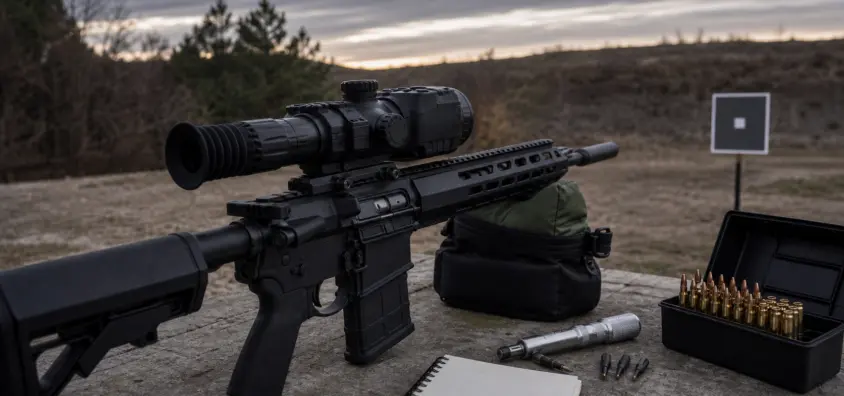
June 17, 2026
Why Your Thermal Scope Loses Zero: Zero Shift Causes and Fixes
Learn about why your thermal scope is losing zero, how to field-check your scope, and how to fix your scope.
The Short Version
A thermal scope losing zero typically appears when the rifle appears to be confirmed, after transport, cold weather, ammo change, suppressor change or a quick menu change in the dark. Don’t mistake real thermal scope ‘zero shift’ for poor mounting, incorrect profiles, suboptimal thermal targets and aiming confusion.
Real Shift: Group centre moved as compared to a confirmed Zero. Many "thermal scope POI shift" issues are not what people think, but rather are a system issue: rifle, rail, mount, ammunition, suppressor, shooter, target, battery, display, profile, and optic all play a role in thermal scope POI shift.
This is a troubleshooting guide, NOT a zeroing walkthrough. If you must do the initial process, first read NV Guide USA’s guide to how to zero a thermal rifle scope. If the scope can’t be mounted properly, check out how to mount a thermal scope before looking for digital adjustments.
Why Thermal Scopes Seem to Lose Zero
Real Point-of-Impact Shift vs. Image/Aiming Confusion
Real thermal scope point of impact shift is simply a deliberate group landing that occurs at a different location from the final zero documented. That’s not the case for image confusion. The image seen in thermal optics can be processed and displayed on a small screen, and the image clarity of the point of aim may vary depending upon the focus, NUC, brightness, contrast, palette selection, humidity, and desired quality of the image.
On its own, those image controls are not responsible for physically moving the point of impact. NUC does NOT move the barrel. The brightness of the display does not mechanically move the reticle. Digital zoom should not change zero. However, each of them can be used to target a different heat edge, blob’s center, or pixel border.
That’s why a single misfire does not mean that a thermal scope has no zero hold. A close moving group is a helpful piece of evidence. A dispersed mass is typically an issue.
Thermal optics differ from traditional glass scopes in several ways.
Daylight scope provides reflected-light detail through glass. Thermal scope provides a digital image that depends on the temperature difference. Thermal may cause plain paper to appear blank. This is because a large hand warmer might be easy to see, but difficult to hit accurately.
Repeatable small thermal-visible aiming point. The target should be easily seen for centering but not large enough to where each shot is taken at a slightly different part of the heat signature.
Other features included with thermal scopes are digital zero profiles, electronic reticles, firmware updates, batteries, and, in some cases, multiple rifle or ammo profiles. Those features are great, but they create additional user error opportunities.
The Most Common Causes of Thermal Scope Zero Shift
Loose rings, base screws, or QD mounts.
The first place I look is loose hardware. Inspect rail, base screws, ring screws, crossbolts, recoil lugs and QD levers. Check for misalignment of witness marks, rub shiny marks or any indication the optic shifted on recoil.
If the thermal scope zero changes after transport check the mount before touching the zero. A heavy thermal riding high on a rifle gives bumps and vibration more leverage and that’s a bad set up.
Excessive or insufficient ring pressure can result from improper torqueing.
The real problem is due to bad torque. If there is not enough torque, the optic will move. Excessive torque or unequal pressure of the rings can cause stress to the mount or scope body. Refer to mount or ring manufacturer for thermal scope mount torque. Avoid making up brand specific torque values from forum posts.
If the scope was installed by feel, check it with the proper tool before making a determination that the optic is faulty.
The scope is not completely seated on the rail.
A mount that is tight when slightly off on the rail. Always insert the optic in the same slot and seat the mount in the rail slot shoulder in the same way, as described by the mount manufacturer, and lock it in the same manner each time.
This is important when it comes to AR style rifles and bolt guns with long rails, as it is easy to reinstall the scope close to its former position, but it is not the same.
Wrong Zeroing Profile or Saved Rifle Profile
Several thermal scopes provide for multiple profiles. Very useful for changing rifles, loads, suppressor on/off, or zero distances. It also provides an easy failure mechanism.
Always check for the proper rifle, caliber, ammunition, distance, reticle, and thermal scope zero profile first before making any changes. The active profile, (which is wrong), can cause a digital zero thermal scope to get mechanically solid yet print wrong.
If you’re looking for profiles related control, check out NV Guide USA’s thermal scope settings.
Varying Ammunition or Suppressor or Barrel temp.
Various ammunition types have varying degrees of impact movement. The weight, velocity, barrel harmonics and changes in lot are important. If a suppressor is added or removed from the rifle, this can also cause impact to be affected, even if rifle was consistent with suppressor installed.
The cold-bore and hot-barrel characteristics can vary as well. It’s not necessarily a scope failure. It simply indicates that the rifle system must be tested in the state that you intend to hunt with it.
Sensor Warm-Up and Early Zero Confirmation
There are a few thermal scopes that operate better after a brief warm up. Another complaint may be "thermal scope warm up zero shift", meaning that the display and the behaviour of the sensor has not yet stabilized.
Turn the unit on, allow the unit to stabilize as per manual and field experience, perform NUC as appropriate and confirm zero. NV Guide USA’s thermal NUC explained guide clarifies NUC and what it is and isn’t.
Poor thermal target contrast at range.
An inaccurate target can cause a good scope to appear bad. There can be a large heat source that is visible but inaccurate. A small heat point might vanish due to wind, shade or moisture shifting the target. If you cannot hit the same spot each time, don’t refer to it as a zero issue.
Recoil, Impact and Transport Damage
Weak hardware or an damaged optic may result from hard recoil, dropped rifle, slammed case or long rough ride. Do not exceed the scope’s specified limits, but be aware no optic is impervious to abuse.
How to Check Whether Your Thermal Scope Is Actually Losing Zero
Start with a solid base setup.
If the original confirmed zero is known, use the same rifle setup, distance and rest. Always shoot from a steady bench, bags, tripod, or rest which eliminates as much shooter error as possible. Avoid a field diagnosis based on field shots alone.
Check rifle, ammunition, suppressor and profile.
Confirm the rifle, ammunition, suppressor, zero distance, reticle and active profile before firing. This is required if you share one thermal between rifles.
Allow the Scope to warm up.
Preheat the thermal first before shooting. Let it stabilize. Conduct the NUC or calibration as specified in the manual and under the conditions. NUC can correct image uniformity, but will not mechanically alter its zero. If it was blurry you will need to aim more consistently, but live fire is the only answer.
Use a Thermal-Visible Target.
Repeat with a target that the thermal can clearly see. Don’t make the aiming point too large to center. If the target signature changes due to changes in sun, shade, rain or wind between groups, then so too is your aiming reference.
Shoot a Group Before Adjusting
Shoot a safe 3 shot group prior to reaching the zero. If the group is compact and the displacement is great, then you have valuable clues. If the group is broken up, group them first. Here is the real world solution to how to check thermal scope zero: control variables, fire a group, record the group center, and compare it to a known baseline.
Field Checklist Before You Re-Zero
Work through this checklist before making a thermal scope re-zero adjustment:
- Inspect rail, mount, ring screws, crossbolts, recoil lugs and QD levers.
- Check that torque is correct as per manufacturer’s spec on mount or ring.
- Make sure the optic is in the same rail slot.
- Check rifle, ammunition, suppressor, zero distance and current profile.
- Battery check and battery contacts.
- Use low lighting so that the display will not overpower your eye.
- Check alignment of diopter and objective focus. To focus for troubleshooting see how to focus a thermal scope.
- If the image appears uneven run NUC/calibration.
- Employ a precise thermal-visible target.
- Always live-fire where possible.
- Record Distance, Ammo, Temperature, Profile, Target Type, Group size and Group center.
A bore-sight or laser can pick up any obvious issues, but should not replace live fire. If you are not sure as a lead up to a hunt, downgrade your rifle and lower your level of confidence.
When You Should Re-Zero the Thermal Scope
After Removing and Reinstalling the Optic
If the scope has been removed and reattached, check it for zero. If a good mount finds himself close, only live fire will tell to see if that rifle is still confirmed.
After Changing Ammunition or Adding a Suppressor
Any change of ammunition should be confirmed. Confirmation should be given if adding or removing a suppressor. Don’t assume that the old zero is good since the rifle "usually shoots close."
Following a hard bump, drop, or long road trip
If the rifle was bounced in a truck, UTV or soft case containing other equipment, check the rifle. Most of the time a transport related shift is not due to some magic electronics, but rather either a mount or handling issue.
After Major Environmental Changes
Ballistic and ammunition effects and thermal target can vary with range, altitude, and temperature. A confirmation group is cheap insurance prior to a long hunt in the evening.
Prep your camp before a Paid Hunt or Important Night.
For travel, landowner trust, and paid hunt, confirm zero. Five minutes checks can save the entire night.
When the Scope May Need Service
If the shift is still occurring after you’ve checked the standard reasons for a shift (mount, torque, rail fit, ammo, suppressor, profile, target, rest, and warm-up), you may need manufacturer support. If the rifle is zero’d with another scope, then it’s one more reason to go with the case.
Note service level issues such as reticle movement that is not per the manual, profiles changing without input, adjustment values not tracking, image freezing, reboot loops or random shutdowns. Sometimes battery problems can look like larger problems – inspect the battery setup as well. NV Guide USA’s guide to thermal scope battery life includes internal batteries, removable batteries, power banks and cold weather.
When contacting support, note down the rifle, caliber, ammunition, suppressor, mount, the method of tightening the mount, the target distance, target type, weather, the firmware, the current profile, and group measurements. Photograph the mount, rifle set-up and target. Without good documentation, it is difficult to differentiate between a real defect and normal setup noise.
Practical Zero-Holding Routine for Hunters
Range Confirmation Routine
Use the same configuration that you hunt with. Confirm the mount. Choose a suitable profile. Allow thermal to warm up. Use NUC as necessary. Make sure that the thermal-visible target is precise. Shoot a group. Change only when you are told to do so by the group.
Pre-Hunt Confirmation Routine
Prior to a hunt, ensure that the scope is tight, that the battery is charged, the lens is clean, the correct profile is set, the reticle is not obstructing the view, and that the objective focus is close for the distance expected.
Post-Transport Check
If the rifle has experienced a rough ride, check it before assuming that it is ready. Inspect mount, rail, QD lever, battery compartment, lens cap and zero profile.
What to Write Down in a Zero Log
Maintain a simple zero log of rifle, caliber, ammunition, suppressor state, optic model, profile, rail slot, zero distance, weather, type of target, group size, group center and any adjustment made. The log must be accurate enough to determine if the rifle was altered or if three factors were changed simultaneously.
Quick Answers: Thermal Scope Zero Shift FAQ
Does a thermal scope require warm-up before Zeroing?
Yes. Wait for thermal to stabilize prior to final zero confirmation. Follow the manual and your model’s behavior. A live-fire group is not a substitute for warm-up and NUC that may be used to stabilize the image.
Can a thermal scope lose zero from cold weather?
Don’t assume that the scope lost zero just because the weather is cold. It could impact batteries, shooter behavior, ammunition, comfort and environmental contrast. Before the optic, check the mount, profile, ammo and group.
Does digital zoom affect zero?
Digital zoom should not physically move zero. It may alter the view of the image and reticle and make a soft target more difficult to precisely target! If there is a concern, go back to a basic repeatable setup and be aware of how a scope behaves when it comes to reticle scaling. To learn more about reticles check out thermal scope reticles explained.
Re-zeroing is recommended after removing a thermal scope.
You should at least verify zero after dismounting and remounting the scope. Close is OK with a good mount but only live fire will determine if your rifle is still confirmed.
What is the frequency for which hunters need to check their thermal scope zero?
Inspect following mounting changes, ammo changes, suppressor changes, hard transport, drops, or major setup changes, or prior to important hunts. One thing I have done is develop a quick confirmation routine on a regular basis by the amount of rifle travel to make sure I know what is going on.
Final Field Rule
Until proven otherwise, a thermal scope that appears off zero is a system problem. Do the easy checks first. Avoid "digital chasing" every miss. Mount, profile, shoot with a good thermal target, allow scope to stabilize, shoot an actual group, record result.
Thermal optics have become night hunting tools of great power and require disciplined set-up. The best zero is not the one that you played last month. It is the one you have verified (with the rifle you will be using in the state you will be using it in).
IR Illuminator Not Working With Night Vision? Beam, Battery, Focus and Compatibility Check.
Is your NV not turning on? Battery, Contacts, Mount and Tube-Safe Troubleshooting
Night Vision Collimation and Alignment: Fix Double Vision, Eye Strain and Dual-Tube Setup Issues