
July 8, 2026
Do Thermal Scopes Work in Rain, Fog, and Snow? Bad-Weather Field Guide for Hunters
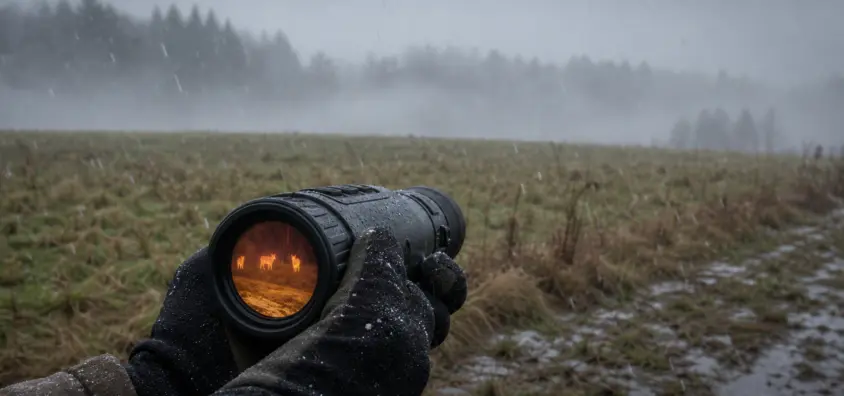
A thermal scope is not a weather-proof superpower, but it can be useful in bad weather. However, the presence of thin fog, falling snow, and humid nights may still allow your detection of warm animals amidst light rain. The first part to change is typically not the detection part. It’s recognition, identification confidence, edge detail and the range at which a responsible hunter can make a clean decision.
That distinction matters. The sighting of a warm shape at the edge of a field is not the same as species ID, direction, backstop and whether or not it is a legal target. In bad conditions, I’m not taking any chances on any thermal image. The scene could be exactly as intended, and the composition, weather and temperature differential can contribute to making a scene appear flat.
More thermal education is available in NV Guide USA’s Thermal Scopes & Imaging section which includes the following guides: image quality, settings, DRI distance, NETD, cleaning, and field workflow.
The Short Version
Yes, in lighter conditions, thermal scopes can often work in rain, fog and snow. Darkness is not the issue, because they are not dependent on visible light. The scope measures temperature differences and emitted infrared energy. The useful thermal contrast reaching the sensor is reduced and the ability of your eye to interpret the display is reduced in bad weather.
Field rule to use:
- Detection typically takes the longest. You can still see a heat signature.
- Recognition is more difficult earlier. The shape might no longer resemble a clean hog, coyote, deer, calf, dog, or person.
- The first thing to get shortened is identification. When the weather conditions cause the image to be in question, the distance available for your ethical shot becomes shorter.
Don’t determine a bad-weather hunt with a thermal scope based on the spec-sheet detection range value. Marketing numbers from clear-night conditions don’t necessarily indicate what dense fog, heavy rain, wet vegetation, hot ground or thermal crossover will do in a real field.
What Bad Weather Actually Does to a Thermal Scope
Thermal optics don’t search for reflected visible light. They generate an image of infrared energy and temperature difference. The system and your eye can easily interpret a warm animal, against a cooler background. Humid air, heat-soaked brush, rain-cooled ground or a warm animal against wet grass is more difficult.
The image can be compromised in two ways due to bad weather:
- Can lessen the useful heat signal between you and your target.
- It may decrease the contrast between the animal and the background.
The consequence is the well-known "thermal scope image washed out" grievance. The scope is still illuminated. The crosshairs are clear. Warm objects in the immediate vicinity might still appear. However, the contrast of the scene is lower, the edges are smoother, and the details of the scene in the distance are less reliable.
Detection, Recognition, and Identification Are Not the Same
The field version of NV Guide USA’s exhaustive guide to thermal detection, recognition and identification (DRI) distances explained is as follows:
- Detection: I know something warm is there.
- Recognition: I can recognize what kind of object or animal it is likely to be.
- Identification: I am confident enough in species, position and context to make a safe and legal decision.
Weather has a negative impact on identification first, since identification requires detail. Don’t just give me a heat blob. Low contrast, wet fur, rain streaks, heavy mist and orientation and what’s behind the animal can strip away the details that hunters rely upon, such as gait, body length, tail, ears, and antlers.
Why Spec-Sheet Detection Range Shrinks in Real Weather
Detection ranges published typically refer to controlled conditions. There is no control in real fields. Rain cools surfaces. When it comes to fog, moisture is added to the viewing path. Humidity lowers contrast. Heat can be retained in hot rocks, roads, brush, and dirt. Thermal crossover occurs during the dawn or dusk when the temperature of the animals and the background become closer.
That is why, “my scope will see to X yards” is not the same as “I’m going to be able to see a legal target at X yards tonight”. Lens Size, Sensor Resolution, NETD, Focus, Base Magnification, Target Size, Terrain, and Background are all important factors.
Do Thermal Scopes Work in Rain?
The answer is, yes, thermal scopes can work in light rain. A warm hog or coyote will still be detected on a cooler field. However, heavier, steadier rainfall and/or high humidity and wet vegetation make the thermal imaging less reliable.
Light Rain vs Heavy Rain
Peak contrast will only be slightly lowered in light rain. May still be able to detect and recognize animals at normal working distances for working terrain. Heavy rain is not the same. It can help cool the ground, moisten vegetation, provide moving clutter between you and target, and make the overall scene look flatter.
Here, hunters get fooled. It’s possible for detection to still occur, but range of detection is not the most important number with thermal scope detection in rain. A better question would be: is your distance range for thermal scope identification still sufficient for the shot you’re thinking of taking?
Wet Fur, Wet Grass, and Cooled Ground
Wet conditions alter surfaces. Grass, leaves, dirt, fences, rocks and tree trunks can cool or even out. It’s possible that they’re still warm in there, but it can dampen the contour with wet fur and wet background. Even an open pasture pig can be seen. Coyote activity in wet brush can be much more difficult to read.
When all things seem grey following a shower, don’t presume the optic is faulty. This is a typical thermal scope bad weather behavior.
Rain on the Lens Is a Different Problem
Separate weather performance from water on the optic. Rain in the air and damp ground affect the scene. Water droplets, external dew or smears on the objective lens affect the scope itself.
If the image is foggy at both close range and distance, nearby warm objects look bad too, or moisture is visible on the glass, refer to NV Guide USA’s guide to thermal scope fogging and condensation. Following the wet hunts, follow sane cleaning and drying habits as per the thermal scope maintenance guide.
Do Thermal Scopes Work in Fog and Mist?
Useful light fog and ground mist detection is still possible. Dense fog is quite a different matter. Thermal scope in fog will still be able to show heat signatures at shorter distances, but as the fog thickens, thermal imaging in fog becomes less rangey and less detailed.
Why Fog Makes the Image Look Flat
In fog, there are tiny water droplets between the optic and the target. Throw in high humidity, damp vegetation and low temperature differentials and the display can lose edge definition. It is likely to be the same animal, but the edges are not as well defined.
That’s why the question of can thermal scopes see through fog must be carefully worded. A thermal scope will have a longer useful range than a visible-light scope in light fog, but in dense fog it will also be affected and can reduce useful range and detail. It is not to see through the fog in a magic, unlimited manner.
Light Fog, Ground Fog, and Dense Fog
I slow down the scan in light fog and am not surprised if I get less identification distance. When it comes to ground fog, I look for if the legs are covered, if brush is covered, if there are terrain features that affect safety covered. With dense fog, I assume a long shot is suspect at any time I can see a heat source through the scope.
Fog also affects depth perception. Landmarks, fence lines, feeders, trees and field edges are more significant, as the thermal picture may not provide the same clear context as it would on a clear night.
When Fogging on the Scope Is the Real Issue
Atmospheric fog is outside the optic. The fogging is of the scope or in the scope. They may occur during the same hunt but they are not the same issue.
If the eyepiece is hazy, the objective has dew, the image remains milky on a nearby object, the case foam was damp, or there is a haze behind the glass, it may be optic fogging or moisture. Don’t attribute everything to the weather until you check the lens and eyepiece.
Do Thermal Scopes Work in Snow and Cold?
Thermal scope in snow can be quite reliable, if background is cold and animal is warm. Cold can be used to contrast. A warm body might show up prominently against a snow-covered ground or frozen over ground.
Snow does not necessarily make for good thermal weather. Problems can be caused by falling snow, blowing snow, frost, wet gloves, cold batteries and lens contamination.
Cold Can Help Contrast
Warm animals can come out when the ground is cold and stable and show good separation. One of the reasons thermal hunting can be easier in the winter than on hot, humid summer nights is because of this.
But this does not obliterate the identification rule, even on the basis of good detection. A bright white or black object on the screen requires species, direction and backstop identification.
Blowing Snow and Frost Can Still Hurt the Image
Blowing snow contributes moving material in viewing path. The objective lens may be affected by frost/snow, which can cause an image blur. Moisture problems can occur when a cold optic is exposed to warm trucks, cases and outside air and are likely to be misdiagnosed as atmospheric performance.
Cold Weather Battery and Display Issues
Cold will shorten run time and cause weak batteries to reveal themselves sooner. If the scope dims, shuts down, lags, or is unstable, troubleshoot power before image contrast. If the battery cannot provide constant power, a great cold weather picture isn’t going to do the trick.
High Humidity, Heat, and Thermal Crossover
The thermal scope humidity issues can be worse than a light rain. Some summer evenings, the whole countryside seems to be hot and sticky. The animal is warm and the ground is warm, the brush is warm and the air is loaded with moisture. That’s when the picture can appear low-contrast although there’s no precipitation.
Why Humid Nights Look Washed Out
Thermal users prefer a clean separation, which is not attainable in high humidity and small temperature differences. It will still show animals, but the display isn’t as crisp. Edges become blurred, background clutteriness augments, and sometimes, the digital zoom exacerbates the issue.
Why Dawn and Dusk Can Be Hard
Thermal crossover occurs when objects in the environment get closer together in apparent temp. Animals, rocks, trees and vegetation can briefly be in a narrower contrast band around dawn and dusk. For a more detailed explanation check out thermal crossover explained.
A smart play in the crossover is not to make it a long shot. Take your time, utilize familiar landmarks and reduce the distance you are comfortable with identifying.
Hot Fields, Rocks, Roads, and Brush
Clutter is caused by heat soaked backgrounds. Distracting shapes are created by rocks, roads, bare dirt, feeders, fence posts, and brush, which hold heat. This isn’t a fault in the scope. It is more difficult to play the scene.
Utilize when possible field edges, shaded areas, holes and cooler backdrops. Terrain is a true image quality feature.
Settings That May Help in Bad Weather
Settings can assist you in deciphering a weak image. They are not able to clear rain, fog, snow, humidity or thermal crossover. Change it slowly and don’t try and change all the menus at the same time.
To learn more about a broader setup baseline, refer to NV Guide USA’s guide to thermal scope settings.
NUC or Calibration
Execute a normal NUC/calibration process of your model. NUC can correct for non-uniformities in sensor response and ensure a more uniform image. It won’t make dense fog go away or make up for lost identification range during heavy rains.
Contrast, Gain, Brightness, and Sharpness
Change only one variable each time. Too bright can create a washed out scene and make it look worse. When sharpness is too high, wet grass and snow can cause noise. Pushing the gain or contrast to the extreme may result in a dramatic image, but with no more real target detail.
Store a known baseline profile to be able to go back to a night with a normal profile.
Color Palettes
White hot and black hot are often the most useful initial choices. Color palettes can assist in distinguishing temperature ranges but will not give you more sensor detail that isn’t present. See thermal color palettes explained for palette tradeoffs.
High-Humidity or Image Modes
The high humidity, fog, rain, ultraclear or image-enhancement modes are found on some thermal scopes. Others do not. Don’t assume the same processing with another brand. Read the manual and try those modes to see if they work for you before using them in the field.
Field Tactics for Hunting With Thermal in Bad Weather
Weather affects the work process. Those who hunt best in the rain fog snow conditions when using thermal scope are typically not the same people who scan rapidly as they walk and act like it is a clear night.
Slow Down the Scan
Move slower. Pause more often. Low contrast = weaker movement cues and edge detail. A fast pan can turn a marginal animal into a smear.
If you are using a scanner, NV Guide USA’s thermal monocular scanning tips are immediately applicable. The same patience is also required when behind the weapon-mounted optic with the additional factor of muzzle control safety.
Shorten Your Identification Distance
Your distance of confidence should be lower in bad weather. Animals that are normally identified across a field comfortably on a clear night should not be assumed to be the same on a night with fog or drizzle or snow or high humidity.
Move closer when safe and legal; change angle; wait until the animal steps into a cleaner opening or pass.
Choose Terrain That Gives Contrast
Keep an eye out for openings, edges, field margins, shaded strips, and cooler backdrops. If the animal is small and there is a better angle, do not ask your optic to pick out the animal against hot brush, wet grass, and clutter.
Use Known Landmarks and Backstops
In bad weather, context comes into play. Before the hunt, familiarize yourself with the lanes, backstops, roads, houses, livestock locations, fence lines, and property boundaries. Thermal isn’t all seeing. It does not see through water, glass, walls, solid obstacles, or dense brush in terms of making dangerous shots safe.
Respect state and local hunting regulations, landowner policies and standard gun safety precautions.
Compare With a Thermal Monocular or Partner
Using the handheld thermal may be of assistance for detection and to keep the weapon pointed safely. A partner can verify movement, position and backstop. Both help to delay final identification, but neither is a substitute.
Bad Weather vs Scope Problem: Quick Diagnosis
This fast split will come in handy before they start pointing fingers at the optic.
It Is Probably Weather If…
- All far away objects appear flatter than normal.
- As fog, rain, humidity or snow accumulates, the range decreases progressively.
- Warm objects in the immediate vicinity are still clearly visible.
- The image improves when weather clears up or terrain changes.
- The background clutter and wet vegetation are the primary issues.
It May Be Fogging or Moisture If…
- Lens (or eyepiece) is clearly moist.
- Milky at all distances.
- Case, caps or foam was wet.
- Haze is visible within the optic.
- Cleaning the external lens will alter the image.
It May Be Settings or Focus If…
Sharp reticle and soft scene.
- Distance of the objective focus is off.
- Brightness is overdriven.
Digital zoom can exacerbate the issue.
- Recently a palette, gain, contrast or sharpness setting has been altered.
For general troubleshooting of images, refer to thermal scope image quality problems.
It May Be Hardware or Firmware If…
- The display powers off.
- Scope freezes or turns off.
- Controls stop responding.
- Artifacts, dead pixels or significant image issues persist in good weather.
- The problem began following impact, water, battery leak, or after an update failure.
Buying Implications: What Specs Matter for Weather?
Severe weather cannot be overcome with one spec alone. Some specifications, however, are important when hunting frequently in low-contrast areas, wet weather or humidity.
NETD and System Sensitivity
Thermal scope NETD is an indication of the sensitivity of sensors to small variations in temperature. NETD can help retain contrast in challenging scenes, but is not a magic fog or rain cure. The actual weather still matters, as do the lens, sensor resolution, image processing, focus, and display. NV Guide USA’s NETD explained – thermal imaging guide takes it a step further.
Lens Size, Sensor Resolution, and Base Magnification
Detail and distance can be helped with a larger lens, higher resolution sensor and appropriate base magnification—but at the expense of cost, field of view, size and scanning close up. Match the optic to the terrain and realistic ID distance, not just the highest detection number.
Waterproof Ratings and Weather Resistance
Thermal scope waterproof rating refers to how well the optic will withstand moisture under designated conditions. This is independent of the rain or fog performance of the image. Don’t assume that all thermal scopes are identical with regards to IP ratings. See manual and manufacturer rating for specific model. There is a practical guide to NV Guide USA on night vision and thermal IP ratings waterproofing explained.
Do Not Buy Only for Marketing Detection Range
The detection range is the most simple number to market and the most simple number to misuse. When purchasing a thermal optic, see the ground, the animal, the weather, the field of view, the elevation of the stand, the battery life, the controls, the warranty and how far you can identify in a responsible manner.
Safe and Ethical Shot Decisions in Bad Weather
The all-weather mode most important is judgment.
Do Not Shoot a Heat Blob
It’s not enough to detect. You must have legal target confirmation, orientation, backstop and confidence you’re not viewing livestock, a dog, another hunter, or an animal you can’t legally take.
Know When to Move Closer or Pass
Rain, fog, snow, high humidity and thermal crossover should decrease your shot confidence distance. Please do not attribute every pass to gear failure. It is a part of using thermal responsibly.
Keep a Clear Manual Baseline
Know your normal focus, brightness, contrast, gain, palette, NUC behaviour, zero profile and battery set up before a serious hunt. A stable base line helps to avoid chasing the menu when the weather goes bad.
FAQ
Can thermal scopes see through fog?
Heat can sometimes be detected with a thermal scope in light fog, but dense fog reduces range, contrast and detail. A visible heat signature should not be taken as a positive identification.
Can thermal scopes see through rain?
Light rain is often workable. Heavy rain can cool surfaces, add clutter, reduce contrast and diminish practical identification range.
Is thermal better than night vision in bad weather?
In a lot of cases, yes, since thermal doesn’t require visible or near-infrared light in the same way image intensifier night vision does. However thermal is not rain, fog, humidity, wet lenses, heat or low contrast proof. As for a comparison context, be sure to check out night vision in bad weather.
Can thermal scopes be used in humid environments?
Yes. High humidity during thermal imaging can wash out images, meaning the image will have less contrast and less detail.
Do thermal scopes work in snow?
Often, yes. Warm animals can be made more noticeable by using cold backgrounds. Blowing snow, frost on the lens, wet gear and cold battery performance can all be issues.
Is it possible for bad weather to damage a thermal scope?
It depends on the weather resistance of the optic, sealing, battery compartment, caps and handling. Image performance in unfavorable weather and physical water resistance are separate issues.
What setting is best for fog or rain?
There is no one correct setting. Use proper focus and normal NUC/calibration, and a known baseline. Then tweak each of the values of contrast, gain, brightness, sharpness or palette as you see fit for your model manual.
IR Illuminator Not Working With Night Vision? Beam, Battery, Focus and Compatibility Check.
Is your NV not turning on? Battery, Contacts, Mount and Tube-Safe Troubleshooting
Night Vision Collimation and Alignment: Fix Double Vision, Eye Strain and Dual-Tube Setup Issues